38F vs 38G: How Much Bigger Is the Cup? Fit & Sizing Guide
The band stays 38, but F-to-G is not the same jump in every sizing system. Your brand chart decides whether you are testing one cup step or more.

Choose the fit signs you notice in the band, cups, center and straps. We’ll turn them into a practical next step for 38F.
Private fit check — your answers stay in your browser and are used only for this on-page guidance. Nothing is stored or submitted.
38F vs 38G: the practical difference
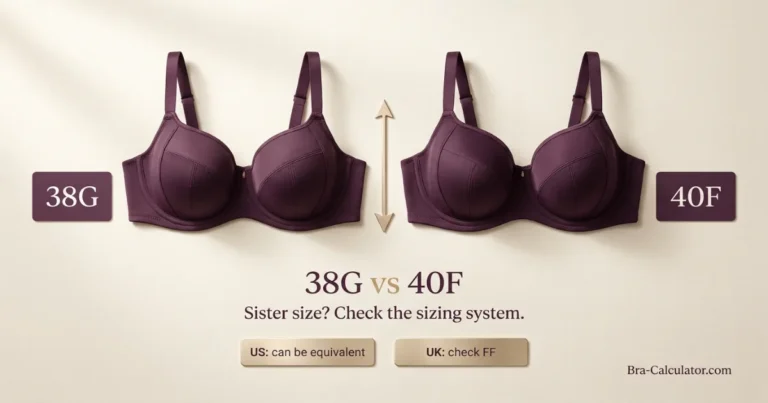
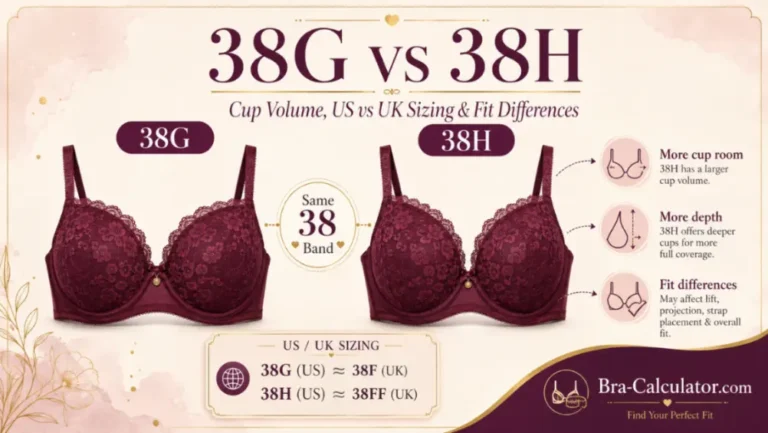
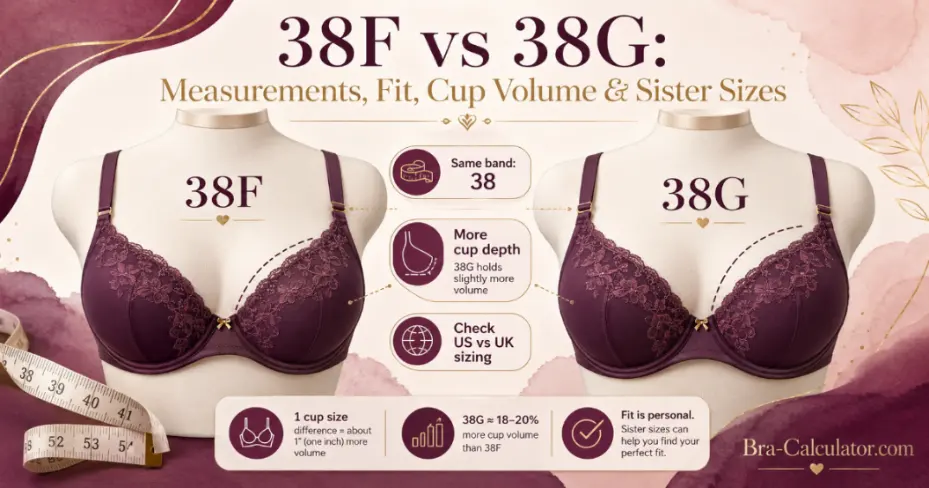
If your brand uses a US-style sequence where F is followed by G, 38G is usually the next roomier cup on the same band. In UK sizing, F is followed by FF and then G, so 38G can represent a larger jump. Choose 38F when G feels tall or loose; choose 38G when F feels compressed, the gore floats, or the wire cannot stay in the breast fold.
Which Should You Choose: 38F or 38G?
38F is often the cleaner fit when you need strong 38-band support but not the extra height or depth of G. If the larger cup wrinkles at the apex, opens along the top edge, or places the wire well behind your root, F may be the better volume—or the better shape match.
38G deserves the test when the F cup is being pushed away from the body. Persistent center spill, side tissue under the wire, or a cup that slides down can indicate that F lacks usable depth. The G should create space without making the band looser.
Best comparison method: Because 38F to 38G can be one US cup step or a larger UK jump, identify the cup sequence before comparing fit. Once the system is known, keep the 38 band and bra model constant so the volume change is the only major variable.
Why F-to-G Is a Bigger Question Than It Looks
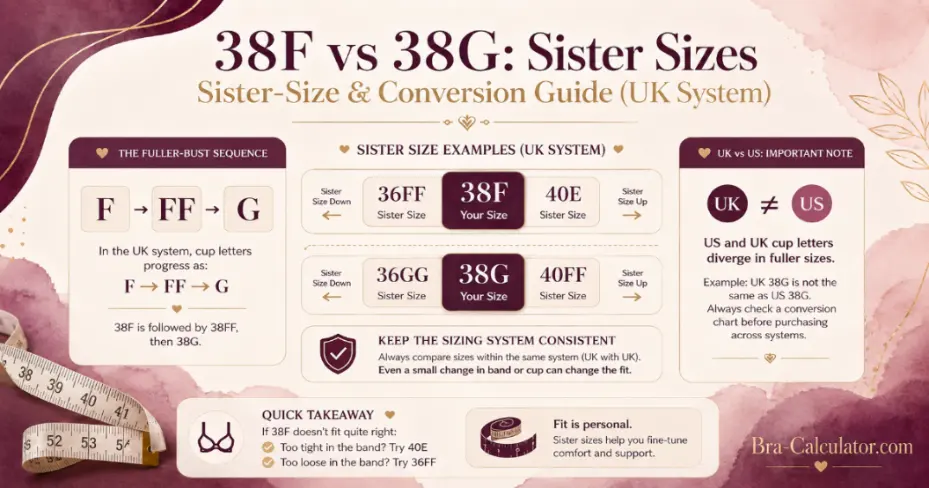
The key detail here is cup sequence. UK fuller-bust brands commonly run D, DD, E, F, FF, G, while many US charts use D, DD, DDD/F, G. That means “one letter up” does not always mean “one cup step up.” Search intent around 38F vs 38G is often really a sizing-system question hiding inside a fit question.
Once you know the system, compare the same bra model. In deeper cup ranges, manufacturers often change more than raw volume: straps can be wider, wings taller, wires stronger and cup seams more supportive. Those construction changes can make G feel noticeably more secure even beyond the extra cup space.
Avoid judging the larger cup only by how it looks standing still. Fuller cup volumes can seem fine in front view yet reveal their value when you sit, bend or take a deep breath. Movement is where crowding at the base and sides becomes obvious.
How Measurements Change the 38F vs 38G Decision
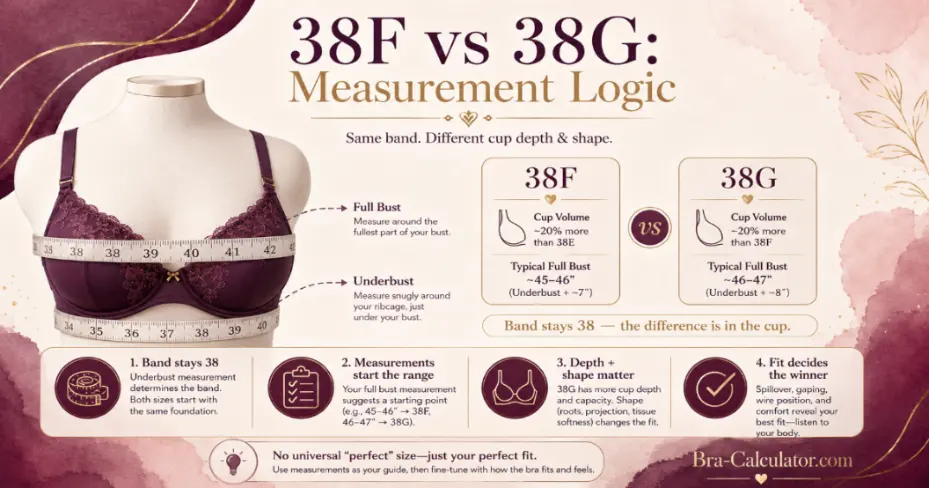
Because the band remains 38, this is primarily a cup-capacity and cup-shape comparison. If the band fits in F but suddenly feels better in G, that can be a clue that F was stealing circumference because the breast had nowhere to go.
The bust difference associated with a letter is only a rough sizing convention and varies by system. Use measurements to identify a starting range, then let the bra tell you whether you need more depth, more width, more upper-cup room or simply a different shape.
Read the Bra, Not Just the Size Tag
| Fit area | What you want | What the comparison may reveal |
|---|---|---|
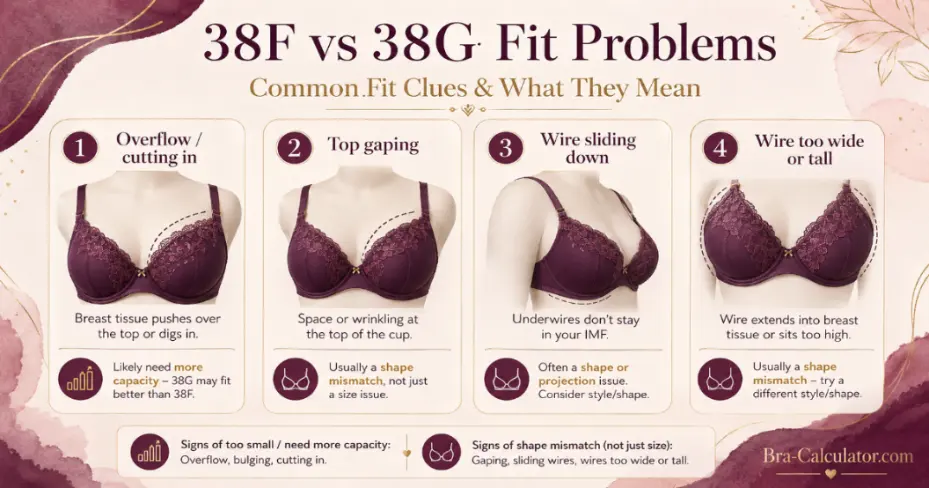
| Cup base | Breast settles into the bottom of 38F without pushing the wire down | 38G is favored when F cannot provide enough immediate depth |
| Upper cup | Smooth and supported | G should not create an empty, tall pocket above the breast |
| Center fullness | Contained without a ridge | Center spill in F is a strong reason to test G or a lower-gore shape |
| Wire width | Encircles tissue closely | G may widen the wire; make sure it does not overshoot your root |
| Band feel | Should stay consistent | If G makes the “tight band” problem disappear, F may have been too small in the cup |
In this pair, the cup base is unusually informative. If 38F is pushed downward while 38G sits in the breast fold, the larger cup may be solving depth even when the neckline difference looks modest.
How to Compare 38F and 38G Without Guessing
Identify US or UK sizing
Find the brand’s cup sequence before assuming how large the jump from F to G really is.
Use one bra style
Keep fabric, wire and strap design constant so the result reflects cup size rather than construction.
Inspect the base of the cup
Look for the wire sliding down or an empty crease above the wire—both can signal a projection mismatch.
Check center containment
After scooping, turn slightly side-on and look for tissue escaping toward the gore.
Wear each for ten minutes
A cup that seems fine for thirty seconds may reveal pressure or instability once your body warms and moves.
Three Bra Constructions That Make the Difference Easier to See
For F/G testing, choose constructions that can accommodate projection and show wire behavior clearly. A very rigid shallow molded cup can make both sizes look wrong for different reasons.

Deep Seamed Full-Cup Bra
Seamed construction gives fuller cup sizes room to project forward without forcing all volume sideways. It is a strong diagnostic choice when F feels flat at the base.
- Multi-part cup supports deeper projection
- Easy to read center and side overflow
- Stable frame suits 38-band testing

Side-Support Lift Bra
Side panels can keep a fuller G cup from feeling broad while also showing whether F is simply too small at the outer cup.
- Directs tissue inward
- Helps compare wire width
- Works well under everyday clothing

Encapsulation Sports Bra
At F/G cup volume, movement is an excellent stress test. A good encapsulation bra should contain each breast without the band climbing.
- Separate cup control
- Highlights hidden side spill
- Good secondary validation for cup capacity
Breast Shape Can Change Which Size Looks Right
Projected or center-full shapes are more likely to notice the benefit of extra cup depth. Shallow shapes may experience the G as overly tall or wide even if the calculated volume seems plausible. In that case, a differently shaped F can beat a larger G.
If you have soft tissue, stretch lace can bridge the size boundary more gracefully than rigid molded foam. If you have firm tissue, wire width and immediate projection tend to matter more because the breast will not easily conform to a shallow cup.
Use Sister Sizing Only After You Know the Correct Cup Position
After you decide between F and G, sister sizing can fine-tune band comfort. But the sister labels depend on whether you are shopping US or UK sizes. For example, UK sequences include FF and GG steps that many US charts do not use.
Use the calculator to change the band while preserving the cup position in the same sizing system. Mixing a UK cup letter with a US sister-size chart is one of the fastest ways to order the wrong volume.
Open the Sister Size Calculator → · Check International Conversions →
If You’re Ordering 38F or 38G Online
If a product page offers both “US size” and “UK size” selectors, do not switch between them mid-comparison. Choose one system, note where F, FF and G sit, and record the equivalent shown by the manufacturer. That small step prevents an accidental two-step cup jump.
For fuller cups, reading reviews by size can be useful only when reviewers mention the exact sizing system and fit symptom. “Runs small” is vague; “wire is wide, cup is shallow, and UK 38F cut in at the center” is actionable. Prefer fit-specific comments over star ratings alone.
What Usually Goes Wrong in a 38F vs 38G Comparison
- Assuming 38G is always exactly one cup larger than 38F.
- Ignoring the FF cup step when the brand uses UK sizing.
- Choosing G solely because the straps dig in, when strap tension may be compensating for a loose band.
- Keeping F even though the wire repeatedly slides below the breast root.
- Using molded bras as the only test when projection is the suspected problem.
Tools That Help You Confirm the Fit
38F vs 38G FAQs
How much bigger is 38G than 38F?
It depends on the sizing system. In many US charts G follows F; in UK sizing FF sits between F and G.
Does 38G have a looser band than 38F?
No. Both use a 38 band. Any comfort difference usually comes from how the cups distribute breast tissue and tension.
Why does 38F make my band feel tight?
If the cup is too small or shallow, breast tissue can push the bra outward and make the band feel tighter than it actually is.
What if 38G is roomy on top but 38F is tight at the bottom?
That strongly suggests a cup-shape mismatch. Look for more immediate depth or a shorter cup instead of only changing volume.
Is 38G always a fuller-bust specialist size?
Availability varies. Many specialist brands carry it routinely, while some mainstream brands use different labels for similar cup positions.
Which should I order first online?
Use your current fit symptoms and the brand’s own sizing system. If F is visibly crowded, include G; if G historically gaps, start with F or a different cup shape.
The Bottom Line on 38F vs 38G
The smartest 38F vs 38G decision starts with the sizing system. Once you know whether G is one step or more above F, compare the same bra and prioritize base depth, center containment and wire position over the letter itself.
Still Between 38F and 38G?
The answer to 38F vs 38G is partly a label question and partly a shape question. Verify the system first; then let cup-base depth, center containment and wire width decide whether the larger size is actually useful.