34B vs 32D: Are They Sister Sizes? (Complete Bra Fit Guide 2026)
Quick Answer: Is 32D the Same as 34B?
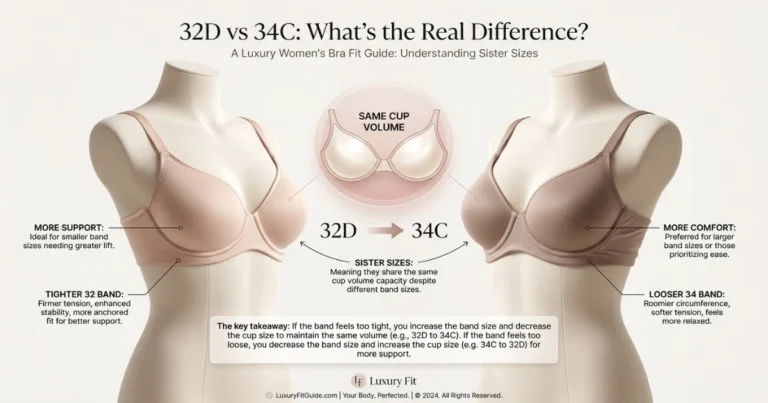
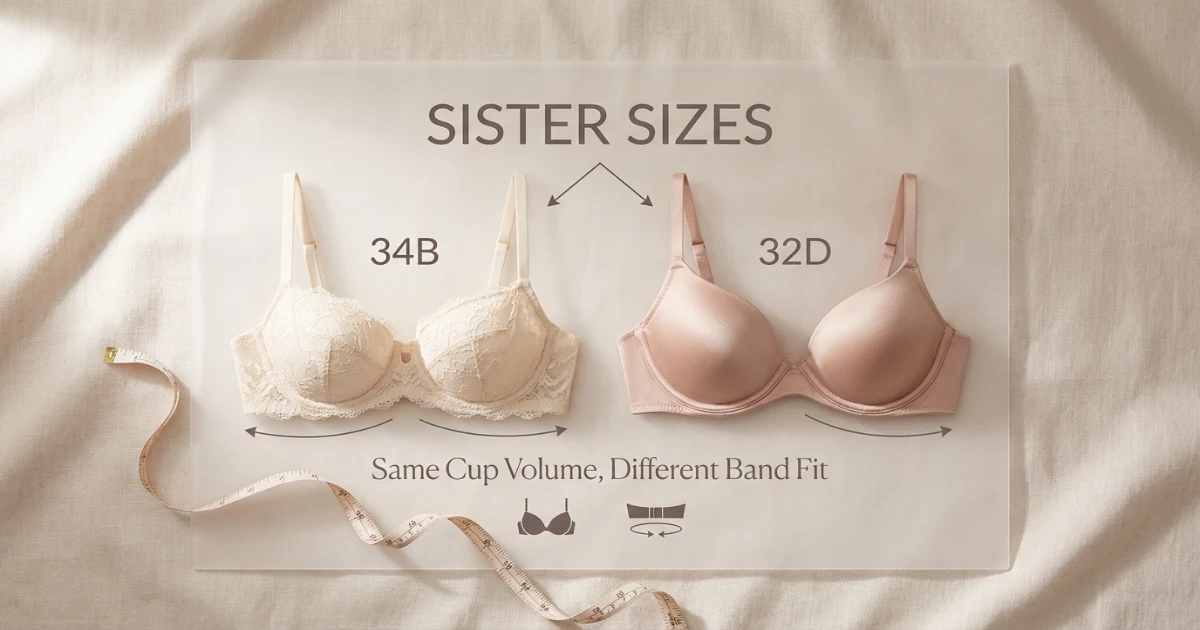
Yes — 34B and 32D are sister sizes. They carry nearly identical cup volume despite having different band numbers and cup letters. A 32D has a two-inch smaller band and a cup two letters larger than a 34B, which keeps total cup capacity equivalent. The practical difference between the two sizes is almost entirely in how tightly the band wraps around the ribcage.
Key Takeaways
- 34B and 32D share nearly the same cup volume — the two-letter cup jump compensates for the two-inch band drop.
- 32D has a firmer, tighter band that anchors closer to the ribcage and provides more structural lift.
- 34B has a looser, more relaxed band that suits wider ribcage measurements and those who find 32 bands restrictive.
- Sister sizes are a genuine fit tool — not a workaround — useful when your exact size is unavailable or band tension needs adjusting.
- Cup letters are always relative to band size. A D cup on a 32-band describes a physically smaller cup than a D cup on a 36-band.
- The band provides 80–85% of bra support. Getting the band right matters more than the cup letter for overall fit and comfort.
- 32D suits those with an underbust near 28–30 inches who need strong support; 34B suits those nearer 30–32 inches who prefer a relaxed band.
- If you’re unsure which size fits better, a five-minute fit check — covered in Section 10 — will tell you clearly.
Understanding Sister Sizes: Why 34B and 32D Are Linked
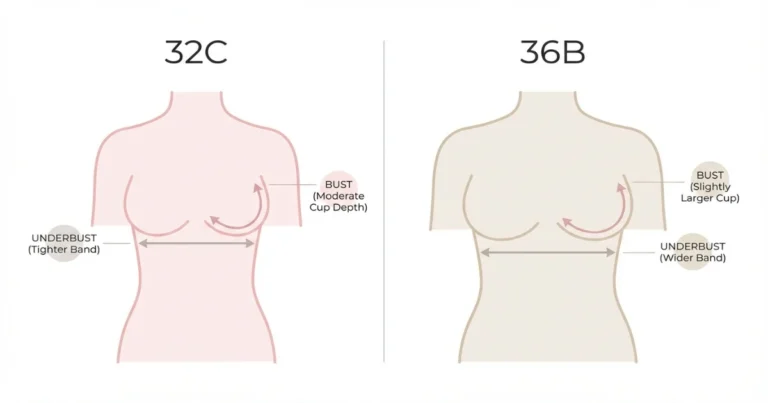
Sister sizing is a foundational concept in bra fitting. It describes a group of bra sizes that hold approximately the same cup volume, even though their band numbers and cup letters differ. The rule works like this: when the band increases by one step, the cup letter decreases by one to maintain cup volume — and when the band decreases by one step, the cup letter increases by one.
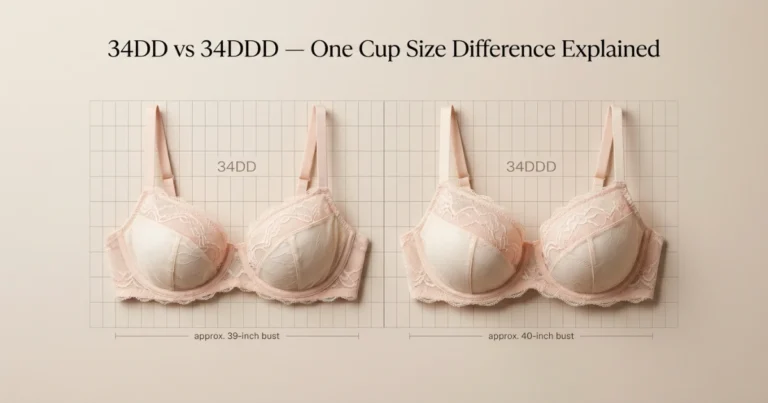
For 34B and 32D specifically, the band drops by two sizes (34 to 32), so the cup letter rises by two (B to D). The result is a pair of sizes that a professional fitter would consider functionally equivalent in cup volume, even though one sounds dramatically larger on paper.
Why Does This Mathematical Relationship Work?
Because cup letters measure a ratio, not an absolute volume. The cup letter is determined by the difference between underbust and bust measurements — roughly one inch per letter step. When the band (underbust reference) shrinks by two inches, the same cup volume now represents a two-letter jump in relative difference. The math resolves back to the same physical cup capacity.
This is why a 32D and a 34B can feel so similar when the cups are compared side by side — and so different once the band tension is felt. Sister sizing is one of the most powerful tools for fine-tuning bra fit. Read the full explanation in our sister sizes guide.
Exact Measurements: 34B vs 32D Side by Side
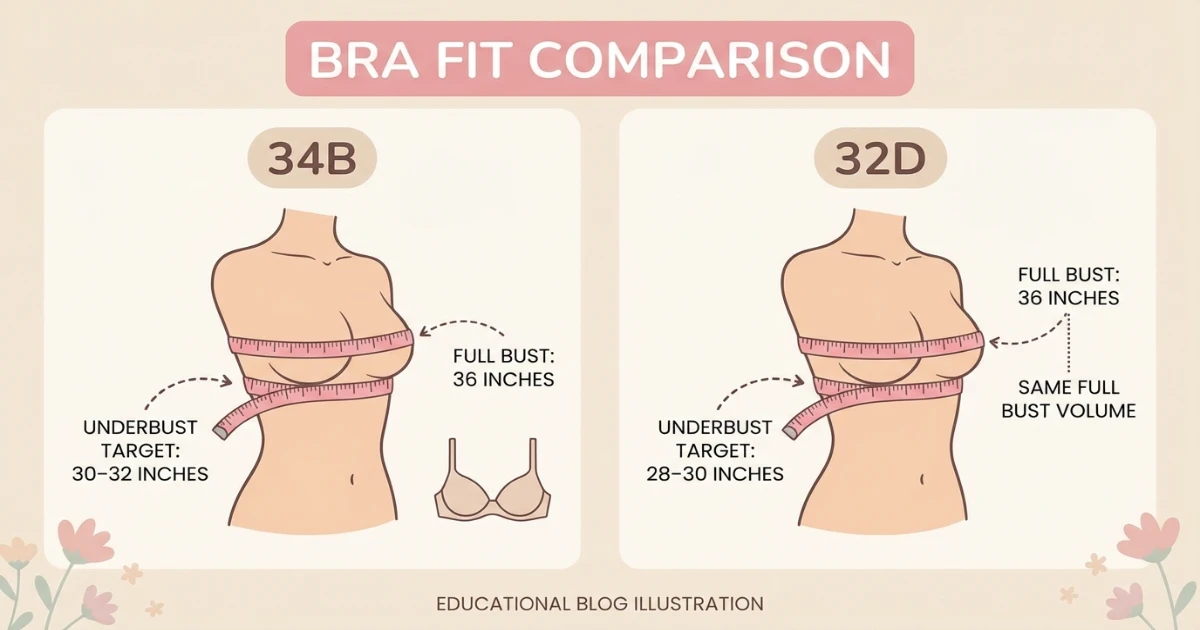
Understanding the raw numbers helps make sister sizing concrete. Here’s how each size translates to body measurements under standard US and UK sizing conventions. Note that brand variation exists — always verify with a proper bra measurement guide before purchasing.
Underbust target: ~30–32 in / ~76–81 cm
Full bust: ~36 in / ~91.5 cm
Cup difference: ~2 in / ~5 cm
Band character: Relaxed, moderate anchor
Underbust target: ~28–30 in / ~71–76 cm
Full bust: ~36 in / ~91.5 cm
Cup difference: ~4 in / ~10 cm
Band character: Firm, close ribcage contact
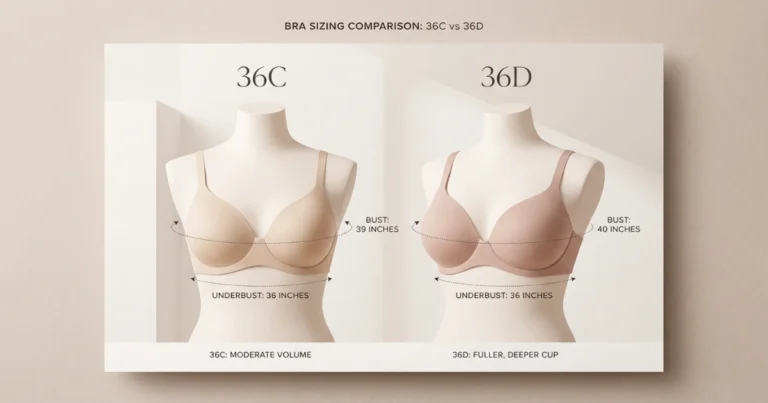
The striking detail here is that both sizes share the same full bust measurement — approximately 36 inches. The underbust differs by two inches, which explains both the band size difference and the two-letter cup jump. Identical bust measurement plus different underbust produces the same total cup depth from a different structural foundation.
If you haven’t measured recently — particularly after weight changes, pregnancy, or hormonal fluctuations — take fresh measurements using our step-by-step bra measurement guide before deciding between these sizes.
Band Size Difference: What Changing from 34 to 32 Actually Feels Like
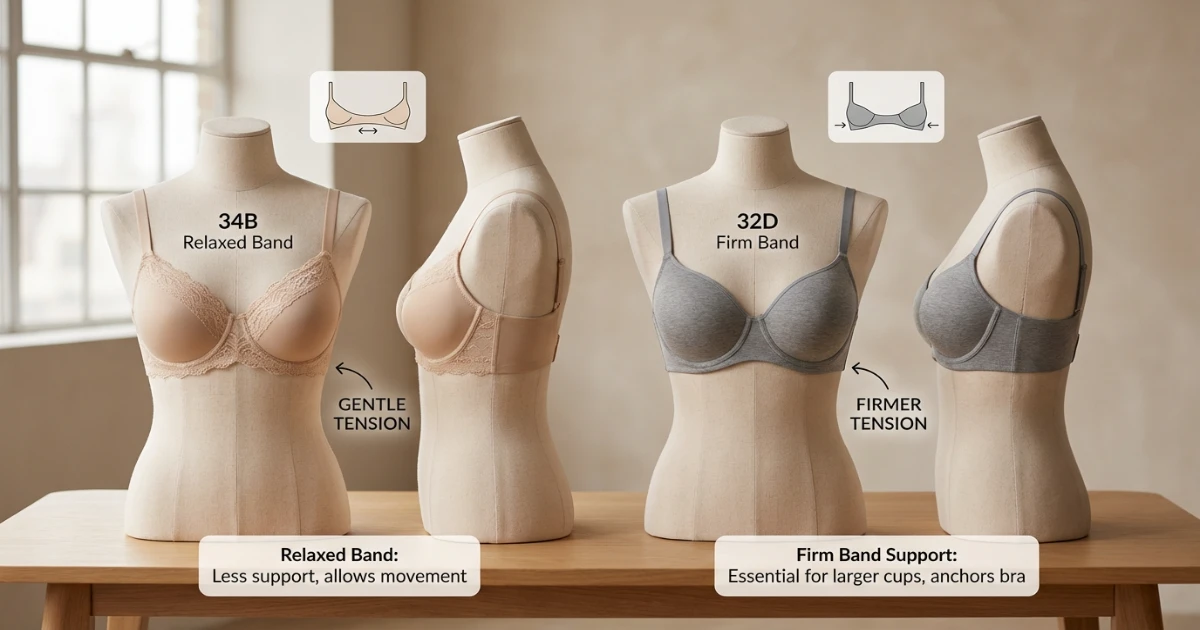
The two-inch band difference between 34B and 32D is the defining practical distinction between these sister sizes. Here’s how it plays out in real wear:
34B Band
- Designed for underbust ~30–32 inches
- Sits with moderate tension — firm but not compressive
- Better for those who find 32 bands restrictive or uncomfortable
- Slightly more prone to riding up if underbust is below 30 inches
- Good choice if you’re between band sizes and prefer comfort over maximum support
32D Band
- Designed for underbust ~28–30 inches
- Sits tightly and anchors close to the ribcage
- Provides maximum structural support — band bears more of the load
- Less likely to ride up during activity or movement
- May feel uncomfortably tight on underbust measurements above 30 inches
A well-fitting band should feel snug without restricting breathing or leaving pressure marks after a few hours of wear. If you put on a 32D and feel immediate constriction or can’t take a deep breath comfortably, the band is too small for your frame. Conversely, if a 34B rides up the moment you raise your arms, the band is too loose to anchor the bra effectively.
Band riding is one of the most common fit complaints and almost always signals an oversized band. If your 34B consistently migrates up your back, read our detailed guide on why bra bands ride up and how to fix it.
Cup Volume: Why 34B and 32D Hold the Same Amount
This is the part of sister sizing that surprises most people. How can a B cup and a D cup possibly hold the same volume? The answer lies in understanding that cup letters are relative measurements, not fixed sizes.
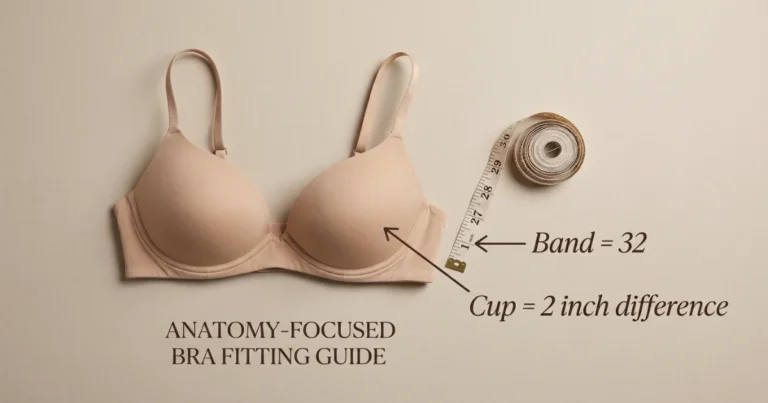
Each cup letter represents one inch of difference between underbust and bust. Here’s the breakdown for each size:
- 34B: Underbust reference ~34 in, bust ~36 in → 2-inch difference → B cup
- 32D: Underbust reference ~32 in, bust ~36 in → 4-inch difference → D cup
The bust measurement is the same: approximately 36 inches. The difference in cup letter simply reflects how large that bust measurement is relative to the underbust. On a 32-inch frame, a 36-inch bust looks like a much bigger difference — hence D. On a 34-inch frame, the same 36-inch bust is only 2 inches larger — hence B. But the actual physical breast volume contained by each cup is nearly identical because the bust measurement is the same.
Think of it this way: the D in 32D is not saying “this cup is large.” It’s saying “relative to this particular ribcage, the bust is four inches bigger.” The cup fabric still holds the same total volume as the B cup in 34B — it’s shaped differently because it wraps around a narrower frame, but it holds the same amount.
For a visual breakdown of how cups scale across band sizes, the cup size visual guide makes this concept immediately clear.
Who Should Wear 34B?
A 34B is the right choice when your ribcage measurement aligns with what a 34-inch band comfortably fits — and when you don’t want or need the tighter band tension of a 32D. You’re likely a good 34B candidate if:
- Your underbust measures approximately 30–32 inches — this range is what a 34 band is engineered to fit with proper tension.
- You tried a 32D and the band left red marks after a short time wearing, or caused difficulty breathing deeply.
- The 32D cups fit well but the band felt constricting — this is the clearest signal to move up to 34B.
- You carry soft tissue around the ribcage that a tight band compresses uncomfortably.
- You prefer moderate band tension — firm enough to support, relaxed enough to forget you’re wearing a bra.
Not sure if your current bra is doing its job? The complete guide to knowing if your bra fits correctly walks through every checkpoint in detail.
Who Should Wear 32D?
A 32D delivers more support through tighter band contact, making it the better choice for those with a smaller underbust or those who prioritise maximum lift and stability. Consider 32D if:
- Your underbust measures approximately 28–30 inches — this is the underbust range the 32 band is built for.
- The 34B band consistently rides up your back, especially when you move or raise your arms — the clearest sign the band is too large.
- Shoulder straps dig in even after adjusting — this almost always means the band isn’t anchoring properly and the straps are compensating.
- You play sport, exercise regularly, or need a bra that stays put — a 32D’s firmer band won’t shift with vigorous movement.
- The 34B cup fits well but the band feels consistently loose — dropping to 32D preserves cup volume while tightening the foundation.
For a full size reference and to compare how 32D sits within the broader size spectrum, see the bra size charts.
The Sister Size Ladder: Where 34B and 32D Sit
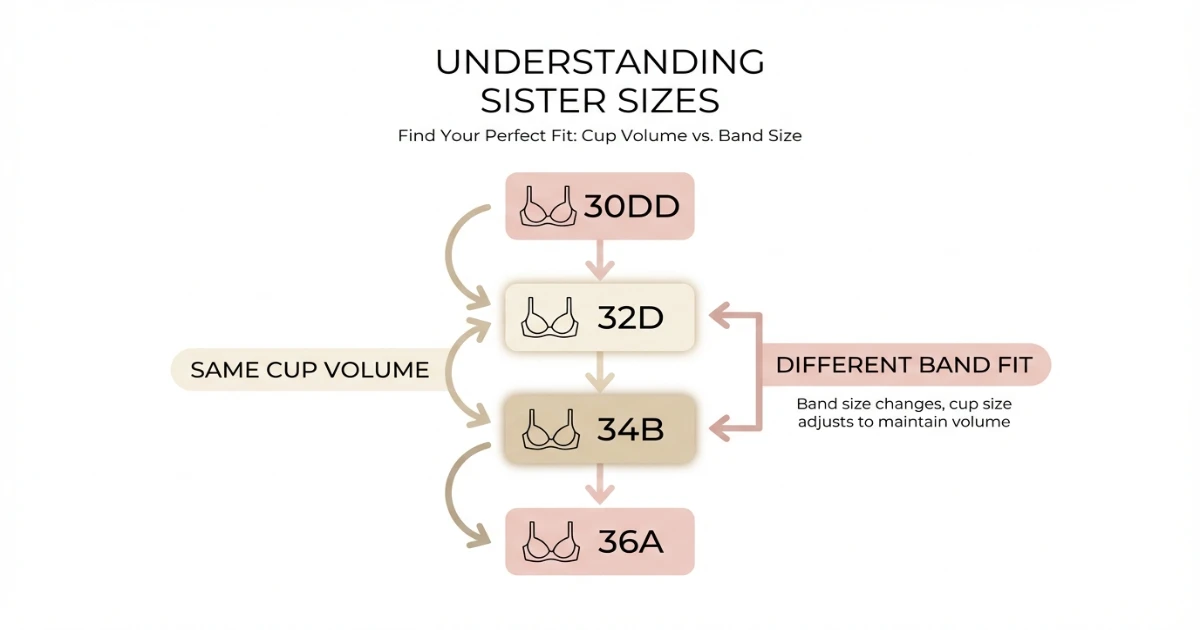
Sister sizes don’t exist in isolation — they run in a continuous ladder where each rung holds the same cup volume at a different band size. Here is the ladder that includes both 34B and 32D:
Every size on this ladder holds approximately the same cup volume. The two highlighted entries — 32D and 34B — are the most commonly interchanged sister sizes in this group for most women. Moving up the ladder loosens the band; moving down tightens it. Cup volume stays consistent throughout.
One important caveat: sister sizes work for volume, not for identical fit. A 30DD band will feel dramatically tighter than a 36A band, even though both hold the same cup volume as 34B. Always choose your band size based on your actual underbust measurement, not just cup volume matching.
Use our interactive sister size calculator to find the complete ladder for any starting size, including extended band and cup ranges.
Quick Bra Fit Test: 34B or 32D?
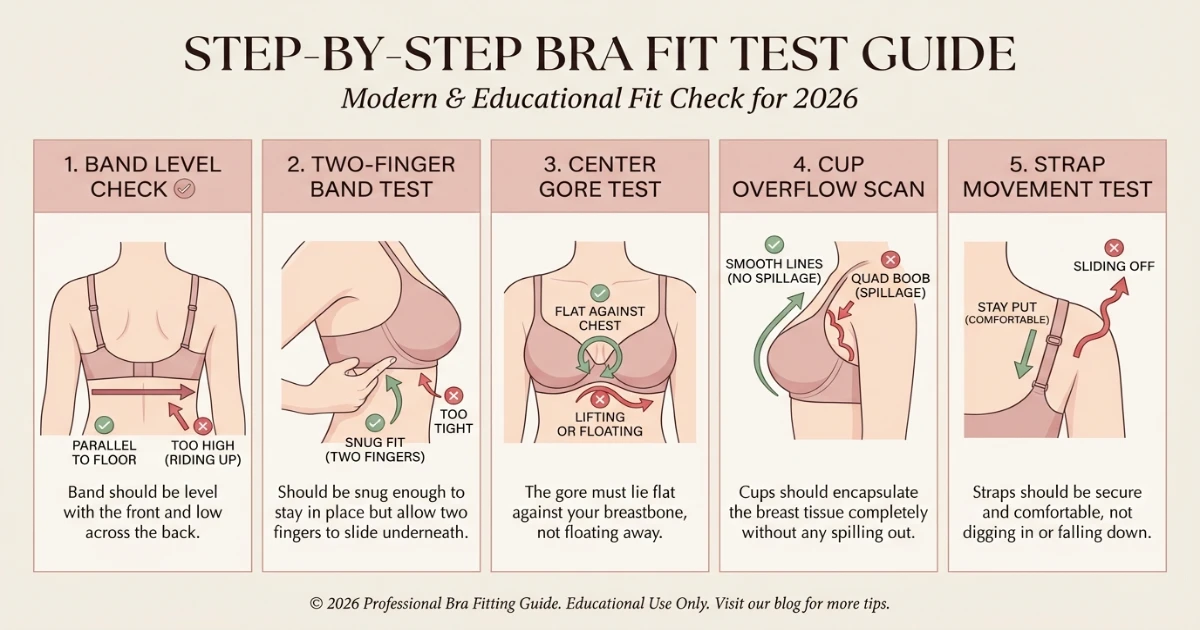
Run this five-step check wearing your current bra — it will clarify which size direction to move in:
- Band level check: Stand side-on to a mirror. The band should run parallel to the floor, perfectly horizontal all the way around your body. If the back rises higher than the front, the band is too large — a 32D may provide better anchorage than your 34B.
- Two-finger band test: Hook two fingers under the back band. You should feel clear resistance — it shouldn’t slide or flap. If three fingers fit without effort, the band is too loose. If you can barely slide one finger in, the band may be too tight.
- Center gore test: Press the fabric between the cups against your sternum. It should lie flat with full contact. If it hovers away from your chest, the cups are too small — but before upsizing the cup, confirm the band is right first.
- Cup overflow scan: Trace a finger along the top edge of each cup with arms at your sides. No breast tissue should spill over the top or sides. If it does, a larger cup is needed — but within your correct band size, not just via sister sizing.
- Strap movement test: Raise both arms above your head quickly. Straps should stay on your shoulders without slipping, and the band should not budge from its position. Straps that slide off signal too much band looseness; a 32D’s tighter band may solve this without strap adjustment.
Still unsure whether 34B or 32D is right for you? Our AI-powered bra size calculator analyses your measurements and shape to deliver a personalised recommendation — including your full sister size ladder.
Try the AI Bra Size Calculator →34B vs 32D: Full Comparison Table
| Feature | 34B | 32D |
|---|---|---|
| Band size | 34 (relaxed) | 32 (firm) |
| Cup letter | B | D |
| Cup volume | Nearly identical to 32D | Nearly identical to 34B |
| Full bust measurement | ~36 in / ~91.5 cm | ~36 in / ~91.5 cm |
| Underbust target | ~30–32 in / ~76–81 cm | ~28–30 in / ~71–76 cm |
| Band support level | Moderate — comfortable anchor | High — firm ribcage contact |
| Best for active wear | Moderate activity | Better for high activity |
| Band riding risk | Higher if underbust below 30 in | Low — band stays anchored |
| Comfort for wider ribcage | Better — less restrictive | May feel tight above 30 in underbust |
| Spillage risk | Low when correctly fitted | Low when correctly fitted |
| Gaping risk | Low when correctly fitted | Low when correctly fitted |
| Sister sizes | 32D, 36A, 30DD | 34B, 30DD, 36A |
People Also Ask: 34B vs 32D Questions Answered
They are sister sizes — meaning cup volume is nearly identical. The key difference is in the band: 32D has a two-inch smaller, firmer band, while 34B has a looser band. The same full bust measurement (~36 inches) in both sizes confirms the cup volume equivalence. The size that fits best depends on your underbust measurement.
The primary sister sizes of 34B are 32D (smaller, firmer band) and 36A (larger, more relaxed band). Extending the ladder further, 30DD and 38AA also belong to the same sister size group. All hold approximately the same cup volume, with the band fit being the only practical difference between them.
Sister sizes exist because cup letters measure a ratio — the difference between underbust and bust — rather than fixed volume. As the band grows or shrinks, the same cup volume corresponds to a different letter. This means you can fine-tune band fit without changing cup volume, which is genuinely useful when you’re between band sizes or a specific size is out of stock.
Yes — if your underbust is closer to 28–30 inches, or if your 34B consistently rides up, 32D may provide a better fit. Because they are sister sizes, the cup volume change is minimal. However, always try a 32D on the loosest hook first: if the loosest hook still feels very tight after 20 minutes, the band may be too small for your frame.
Not in cup volume. A 32D and a 34B hold approximately the same cup volume because they are sister sizes. The 34B has a larger band circumference, but the cup depth and capacity is very similar to the 32D. The D letter in 32D does not indicate a larger cup than the B in 34B — it simply reflects the ratio between that particular underbust and bust measurement.
The band provides 80–85% of a bra’s total support. A correctly fitted band anchors the bra against the ribcage, preventing riding, strap digging, and poor posture support. Too loose and the band migrates upward, transferring load to the straps. Too tight and it restricts breathing and leaves pressure marks. Getting the band right is more important for comfort and support than getting the cup letter right.
Bra cup letters represent the difference between underbust and full bust measurements, with each letter equalling approximately one inch of difference: A = 1 inch, B = 2 inches, C = 3 inches, D = 4 inches. Crucially, cup letters are relative to band size — a D cup on a 28-band holds far less volume than a D cup on a 40-band, even though both say “D.”
A too-loose band rides up, causes straps to dig in, and fails to provide adequate lift. A too-tight band restricts breathing, creates pressure marks, and may cause posture discomfort. Both scenarios can lead to breast pain, back pain, and a poor silhouette. Because the band delivers most of the bra’s support, a wrong band size undermines the entire fit even when the cup seems fine.
Yes — 34B is one of the most commonly produced and stocked bra sizes in US, UK, and Australian markets, sitting near the statistical average across major lingerie brands. Its wide availability makes it easy to find in almost every style and price point, and it’s often used as a fitting reference when exploring sister sizes like 32D or 36A.
You need a soft measuring tape and a mirror. First, measure your underbust: wrap the tape snugly directly below the bust and note the inches. Then measure your full bust: wrap the tape loosely around the fullest point of your chest. The underbust gives your band size; the difference between bust and underbust determines your cup letter. For full instructions, see our detailed measurement guide at bra-calculator.com.
Explore More Bra Size Comparisons
Understanding the 34B and 32D relationship is a great foundation, but bra sizing has many more nuances worth exploring — particularly if you’re trying to understand how your size relates to others across the spectrum. These resources can help:
- Full breast size comparison guide — see how common sizes compare across the full range
- Bra size chart and calculator — the complete band and cup matrix in one place
- Interactive sister size calculator — find the full sister size ladder for any starting size
- How to measure your bra size — accurate measurements are the foundation of every good fit decision
- Common bra fit problems — diagnose what’s going wrong with your current bra
- Breast shape identifier — your shape determines which styles suit each size best
Ready to find your ideal size — and every sister size equivalent across hundreds of brands? Our AI-powered calculator gives you a precise recommendation in under two minutes.
Get My Personalised Size Recommendation →