28D vs 28DD: What’s the Real Cup Size Difference? (2026 Guide)
Quick Answer
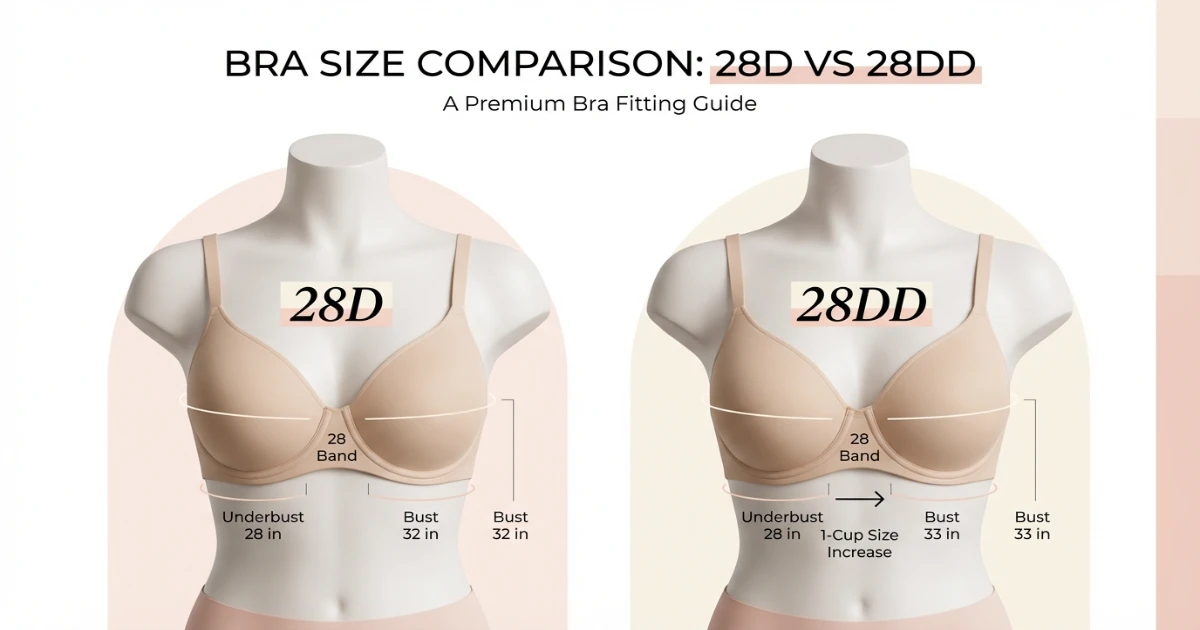
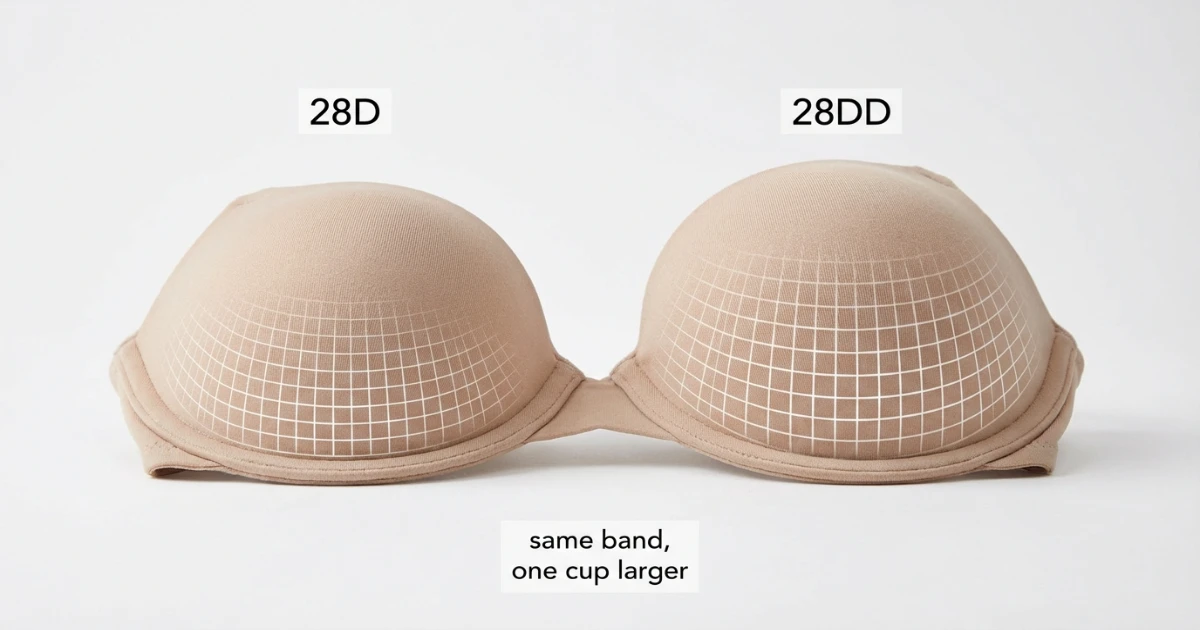
28DD is one cup size larger than 28D. Both bras share the same band size — a 28-inch underbust — but the DD cup holds approximately one inch more of bust measurement, meaning it accommodates slightly more breast volume. The difference is real and noticeable in fit: if your 28D cups feel snug, cause spillage, or cut into breast tissue, a 28DD is the logical next step up.
Key Takeaways
- 28DD is one cup size larger than 28D — the band stays identical at 28 inches.
- The difference in bust measurement between the two is roughly one inch (about 2.5 cm).
- On a 28 band, DD is not a “large” size — cup size is always relative to band size, not absolute volume.
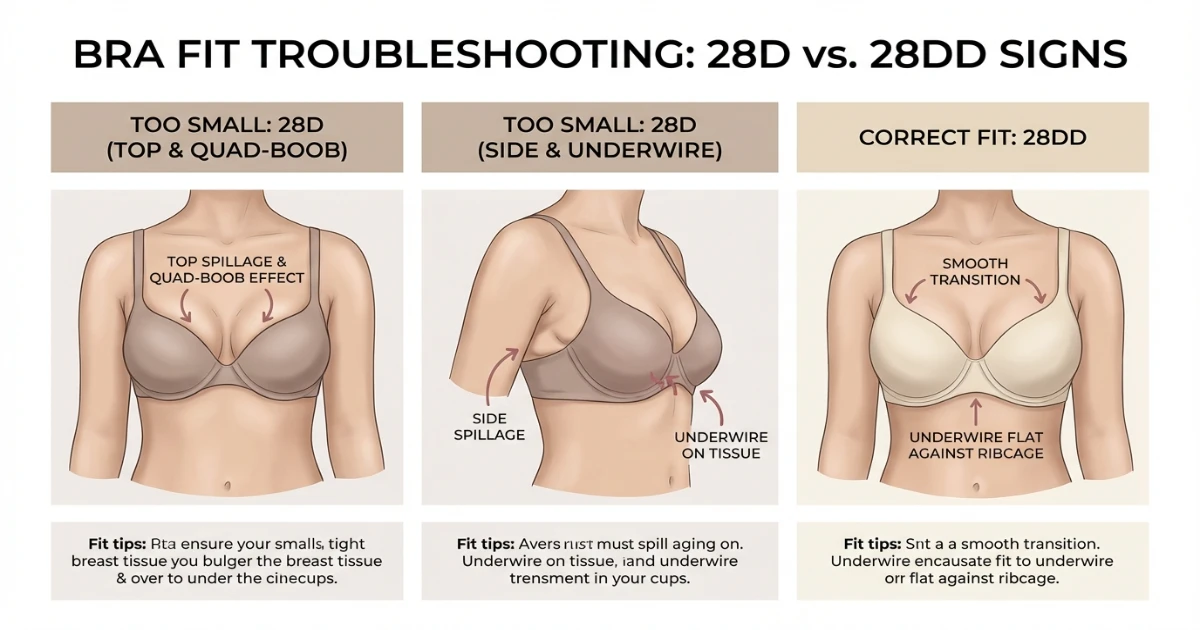
- Signs you may need to size up from 28D to 28DD: spillage over the top of the cup, quad-boob effect, or cups cutting into the sides of your breast tissue.
- Signs you may need to size down from 28DD to 28D: cups wrinkling or gaping, breast tissue sitting too low, or lack of projection to fill the cup.
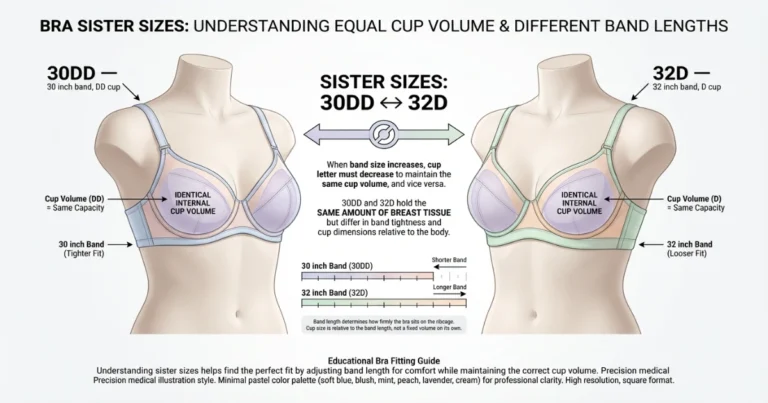
- Sister sizes let you find equivalent fits if a 28-band style isn’t available — 28D sisters are 26DD and 30C; 28DD sisters are 26E and 30D.
- 28-band bras in both D and DD cups are stocked by specialist brands — finding them in mainstream stores is less common.
Understanding Bra Cup Letters: Where Does DD Fit?
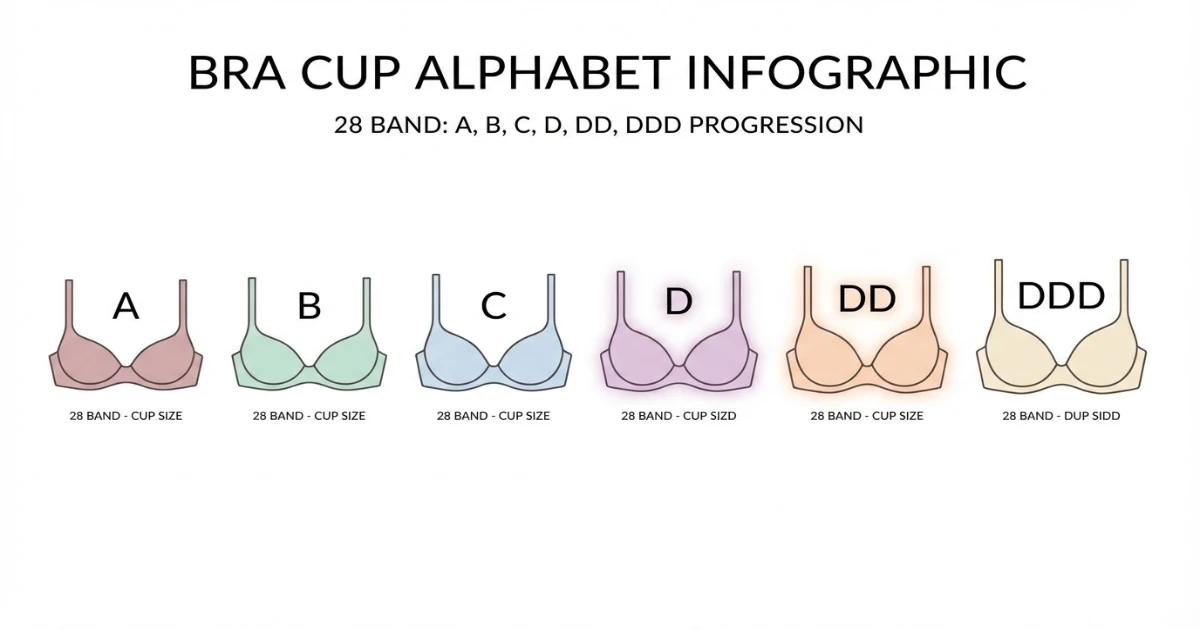
Cup letters trip people up constantly — and it’s not surprising, because the system isn’t intuitive. In standard US bra sizing, the cups run: A, B, C, D, DD (also written as E in some systems), DDD (or F), and beyond. So DD sits just one step above D. It’s not a dramatic leap, and it’s certainly not a double dose of D — it simply means one increment larger than a single D cup.
Cup Size Is Relative to Band Size
Here’s the part that changes everything: a DD cup on a 28 band is physically much smaller than a DD cup on a 36 band. The letter describes a difference between underbust and bust measurement — roughly one inch per cup letter in US sizing. A 28DD means a bust measurement approximately four inches larger than the underbust. A 36DD means a bust measurement four inches larger than a 36-inch underbust — a completely different volume of tissue.
This is why “DD cup” sounds alarming to some people but is actually a modest, everyday size on a smaller band. A woman wearing a 28DD has a petite ribcage and a proportionate bust — nothing extreme about it. Understanding this proportional relationship is fundamental to finding a bra that actually fits. Our bra size chart maps out how cup letters scale across every band size if you want to see the full picture.
The Alphabet Doesn’t Stop at D
Many women assume D is the largest cup available. It isn’t — it’s barely the middle of the alphabet for bra sizing. The reluctance to go above D often leads women to wear bands that are too large (to compensate) and cups that are too small. That’s a fitting trap worth knowing about before you buy your next bra.
Measurement Breakdown: 28D vs 28DD
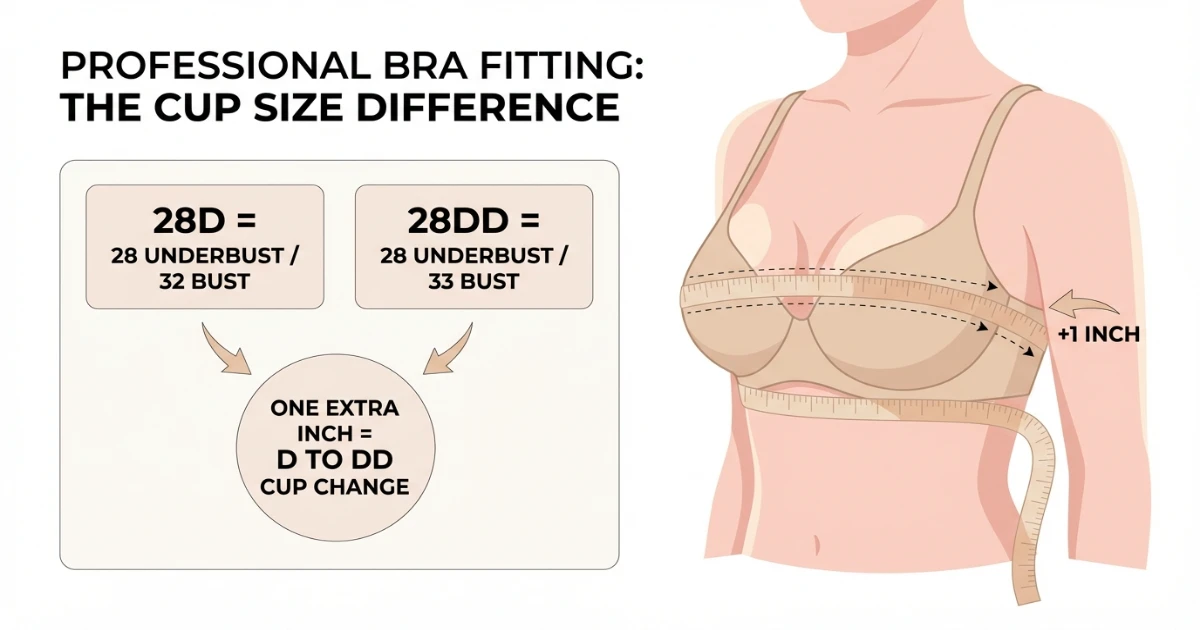
The numbers are the clearest place to start. In US sizing, the cup letter is determined by subtracting your underbust from your bust measurement. One inch of difference = A cup. Two = B. Three = C. Four = D. Five = DD. Here’s how that plays out for these two specific sizes:
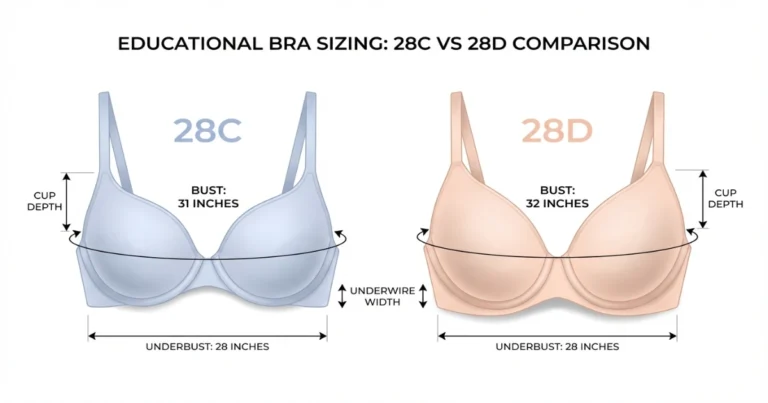
28D
Underbust: ~28 in / ~71 cm
Bust: ~32 in / ~81 cm
Difference: ~4 in / ~10 cm
Cup: D (4th letter)
28DD
Underbust: ~28 in / ~71 cm
Bust: ~33 in / ~84 cm
Difference: ~5 in / ~12.5 cm
Cup: DD (5th position)
That single inch of difference at the bust is what separates these two sizes. It doesn’t sound like much written down, but on the body — especially on a 28-inch underbust — it’s a tangible amount of tissue. The cup shape, depth, and underwire width in a 28DD are all slightly larger than in a 28D to accommodate that extra volume.
Note on UK vs US sizing: In UK sizing, DD is the same position in the cup sequence — D, DD, E, F, FF, G, and so on. The difference from D to DD is still one cup size. Some European brands skip DD altogether and use E, but the volume is equivalent. Always check the specific brand’s size chart when shopping internationally.
Need to measure yourself accurately before deciding? Our how to measure for a bra guide walks you through the process step by step, including how to account for different breast shapes when taking your bust measurement.
Cup Volume Difference: How Much Larger Is 28DD?
One cup size doesn’t sound dramatic — but the volume difference between a D and DD cup is more meaningful than you might expect. Think of it this way: every cup step up on a 28 band adds roughly the same amount of volume as adding a cup size on any other band. The cups get deeper, the underwire gets slightly wider, and the overall shape of the cup shifts to accommodate more projection and fullness.
What This Looks Like in the Cup
A 28DD cup has a slightly deeper cup bowl — meaning there’s more room from the underwire to the top of the cup. The underwire may be marginally wider to better encapsulate breast tissue that extends toward the armpit. The overall profile of the cup projects further from the chest, which is important for fuller or rounder breast shapes that need that depth to sit properly without spillage.
In a 28D cup, that extra projection simply doesn’t exist. For some breast shapes — particularly shallower, more spread-out tissue — that’s fine and actually preferable. But for rounder, fuller, or more projected breasts, a 28D cup may compress and flatten rather than contain and support.
Seeing is believing with cup size differences. Our cup size visuals page includes a side-by-side illustration of how D and DD cups differ in depth and shape. If you want to verify your size before ordering, the bra size chart calculator can help you cross-reference your measurements with the right cup letter.
Fit Differences You’ll Actually Notice
This is where the theory meets the reality of getting dressed every morning. The gap between 28D and 28DD shows up in some very specific, recognizable ways.
When Your 28D Is Too Small
Cup spillage over the top or sides is the most obvious sign. If breast tissue is overflowing the top edge of the cup or bulging out at the armpit, the cup is too small — full stop. This isn’t a body shape problem; it’s a sizing problem. Moving to a 28DD gives the cup the volume it needs to contain the tissue properly.
The quad-boob effect — that visible double-bulge line across the cup — is another dead giveaway. It happens when the top of the cup cuts across breast tissue rather than laying flat against the chest. Some people blame the bra style, but usually, it’s simply a cup that’s one size too small.
Underwire pressure on breast tissue rather than on the chest wall beneath it is a more subtle but important sign. If the underwire sits on soft breast tissue rather than the firm area just below and around it, the cup isn’t deep enough to house everything properly.
Strap digging in is often a consequence of a cup that’s too small — because the breast tissue can’t settle into the cup, the straps work harder to try to compensate, which leads to shoulder grooves and upper back fatigue.
When Your 28DD Is Too Large
Wrinkling or puckering fabric across the cup means there isn’t enough tissue to fill the available space. This is common for shallower breast shapes or women who are between cup sizes. The cup gapes at the top, and you may find yourself constantly adjusting to try to fill out the shape.
Underwire sitting away from the chest wall and floating over breast tissue is another sign — this time indicating the cup is too large and the underwire can’t find the chest wall to anchor against.
Our bra fit problems guide covers all of these symptoms in detail, along with what they mean and how to fix them.
Who Should Choose 28D?
The 28D is likely the right fit if:
- Your underbust measures right around 28 inches and your bust measures approximately 32 inches.
- You tried a 28DD and found the cups wrinkled or felt empty at the top.
- You have a shallower breast shape where tissue spreads wider rather than projecting forward — shallow-shaped breasts often fill a D cup well without needing the extra depth of a DD.
- You have less fullness in the upper part of the breast, which tends to leave DD cups gaping at the top.
- Softer, less projected breast tissue that doesn’t require a deep cup bowl to sit comfortably.
Breast shape matters enormously when choosing between adjacent cup sizes. Our breast shape identifier tool can help you figure out whether your natural shape tends toward shallow projection, which directly affects which cup depth will suit you best.
Who Should Choose 28DD?
The 28DD is the better choice if:
- Your bust measures approximately 33 inches with a 28-inch underbust.
- You experience spillage in a 28D — breast tissue escaping over the top, sides, or armpit area of the cup.
- You have rounder or more projected breast tissue that needs a deeper cup to sit inside rather than being compressed.
- You notice the underwire of your 28D pushing into breast tissue rather than sitting cleanly on the chest wall beneath.
- You have fullness in the upper part of the breast, which needs cup height and depth to be accommodated comfortably.
- Your 28D straps constantly dig into your shoulders — a common sign that the cup is working overtime to contain tissue it can’t quite hold.
If you’re still not certain which side of the line you fall on, our how to know if your bra fits guide gives you a clear checklist to run through with any bra you try on.
Sister Sizes for 28D and 28DD
Finding a 28-band bra in any style is harder than it should be — most mainstream stores simply don’t stock them. That’s where sister sizing becomes genuinely practical. Sister sizes share the same cup volume but use a different band size. Going up one band size means dropping one cup letter; going down one band size means going up one cup letter.
28D Sister Sizes
- 26DD — smaller band, same cup volume
- 28D — your true size
- 30C — larger band, same cup volume
- 32B — two bands up, same volume
28DD Sister Sizes
- 26E — smaller band, same cup volume
- 28DD — your true size
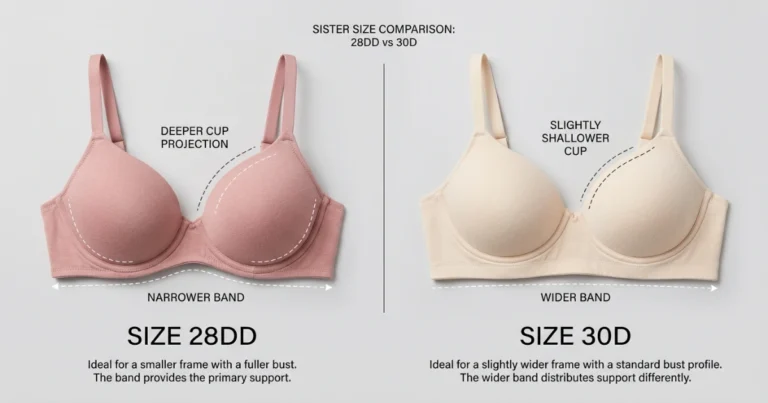
- 30D — larger band, same cup volume
- 32C — two bands up, same volume
Sister sizing is a workaround, not an exact replacement. When you switch to a larger band, the cups get shallower and wider; the band provides less support. When you switch to a smaller band, the cups get deeper and narrower, and the band grips more firmly. The cup volume stays similar, but the bra’s behavior on your body will differ.
Read the full explanation of how and when to use sister sizes in our sister sizes guide. Or, to generate your complete sister size chart instantly, use the sister size bra calculator.
Quick Bra Fit Test: Do You Need to Go Up a Cup?
If you’re deciding between 28D and 28DD, this fast self-check with your current bra will point you in the right direction:
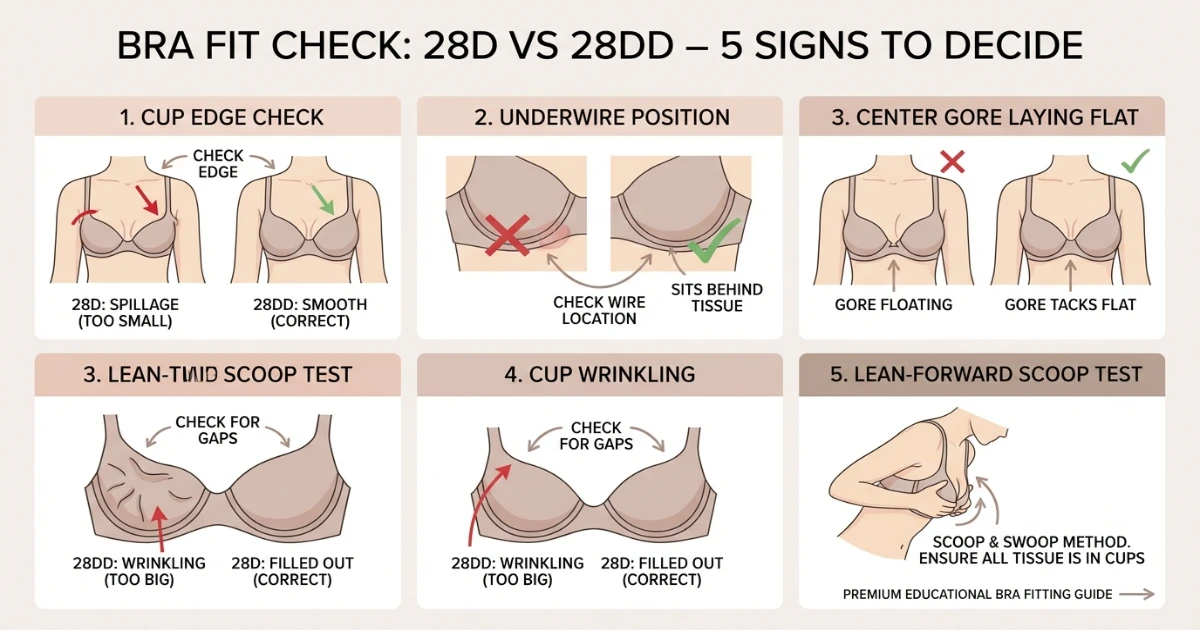
- Look at the cup edge: Does the fabric lay flat against your chest, or does breast tissue bubble over the top or sides? Overflowing tissue = cup too small.
- Check the underwire position: Slide a finger along the underwire channel. It should sit on firm chest wall all the way around — not on soft breast tissue at any point. Underwire on tissue = cup too small.
- Look straight at a mirror: Is there a visible double-bulge across the cup? That quad-boob line is a reliable indicator that you need the next cup up.
- Assess the center gore: The panel between the cups should lie flat against your sternum. If it floats away from your chest, the cups are too small.
- Check for cup wrinkling: If the fabric across the cup wrinkles or folds, you may be in too large a cup — or wearing a style that doesn’t match your breast shape.
- Try the lean-forward test: Lean forward 90 degrees and scoop all breast tissue into the cups. Fasten the bra. Stand up straight. Everything should now be neatly inside the cups with no tissue left outside.
Still unsure about your bra size? Our AI-powered bra size calculator uses your measurements and fit preferences to recommend your best size.
Find My Size with the AI Calculator →28D vs 28DD: Full Comparison Table
| Feature | 28D | 28DD |
|---|---|---|
| Cup volume | 4-inch bust-to-underbust difference | 5-inch bust-to-underbust difference |
| Support | Firm band support — same as 28DD | Firm band support — same as 28D |
| Coverage | Less cup depth; better for shallower shapes | More cup depth; better for projected shapes |
| Spillage risk | Higher for fuller or projected breasts | Low when cup matches breast volume |
| Gaping risk | Low for correct breast shape and volume | Higher for shallower or smaller breasts |
| Comfort | Best for shallower, less projected tissue | Best for rounder, fuller, more projected tissue |
| Best breast shapes | Shallow, east-west, relaxed tissue | Round, full-on-top, projected, close-set |
| Sister sizes | 26DD / 30C / 32B | 26E / 30D / 32C |
| Availability | Specialist brands and online retailers | Specialist brands and online retailers |
People Also Ask
Related Bra Size Comparisons
Brand sizing note: Bra sizing is not standardized across manufacturers. A 28DD from one brand may fit quite differently from a 28DD made by another due to variations in underwire width, cup depth, band elasticity, and fabric stretch. The measurements and guidance in this article follow average US and UK sizing conventions and are intended as a general starting point. Always refer to individual brand size charts and, where possible, try before committing to a purchase.