Your Bra Band Rides Up in the Back for One Main Reason
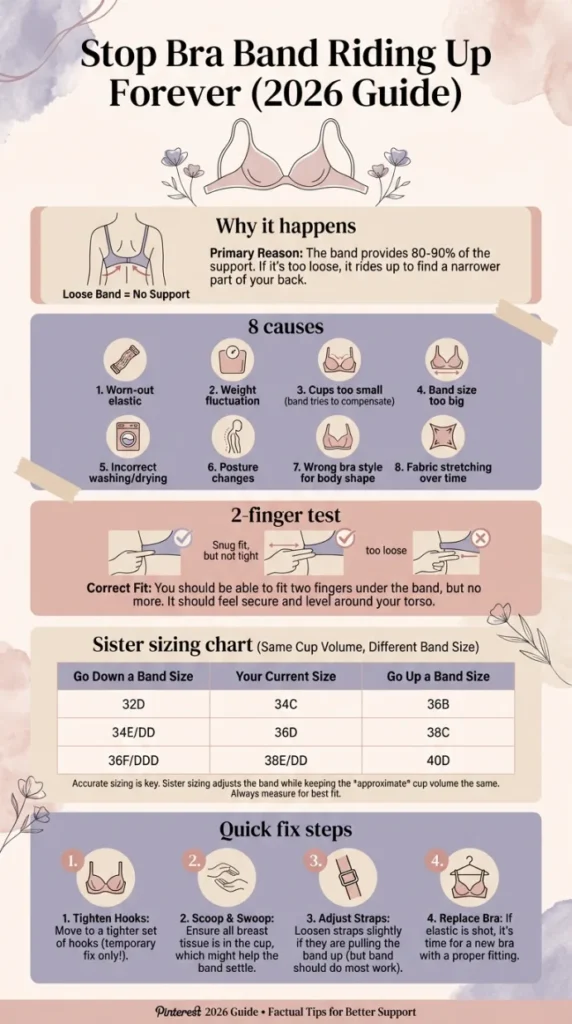
A bra riding up in the back is almost always a sign that the band is too large and lacking proper bra band tension. The band is designed to deliver nearly 80% of total support, anchoring the underwire positioning securely around your ribcage.
If you’ve ever tugged your bra down all day wondering why it won’t stay put, the answer is almost always the same: your band is too loose. When the foundation of your bra lacks proper tension, gravity wins — pulling the front down, pushing the back up, and turning a simple sizing mistake into daily discomfort.
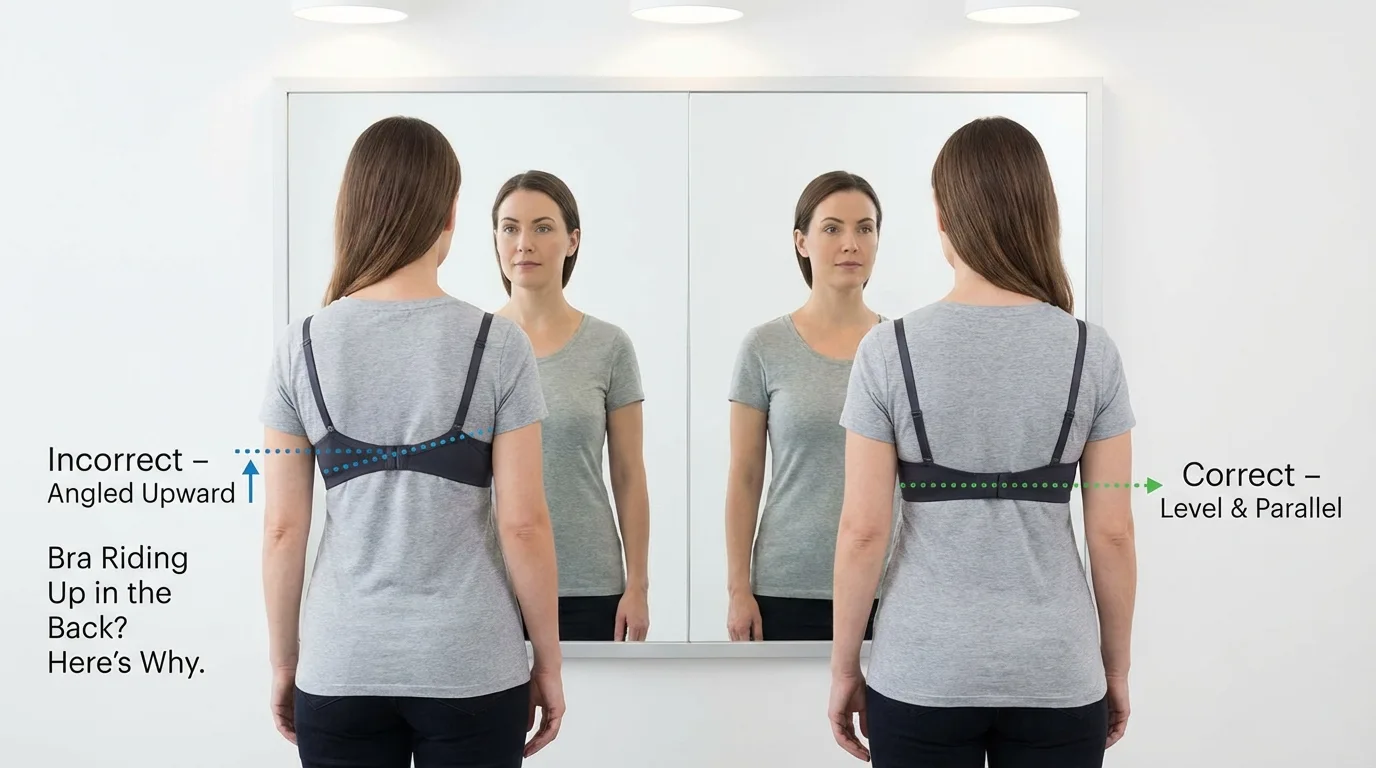
A correctly fitted bra band should sit level (parallel to the floor), provide around 80% of total support, and barely move when you lift your arms. Constant ride-up leads to:
- Shoulder and neck strain
- Straps digging painfully
- Spillage or poor lift
- Posture collapse
- Faster elastic breakdown
If you’ve ever tightened your straps to “fix” the problem — and it got worse — you’re not alone.
This 2026 guide covers the 8 real causes of bra band riding up (including sneaky ones most people miss), the mirror + 2-finger test professionals use, sister-sizing secrets, and a 6-step reset that most women solve in under 10 minutes.
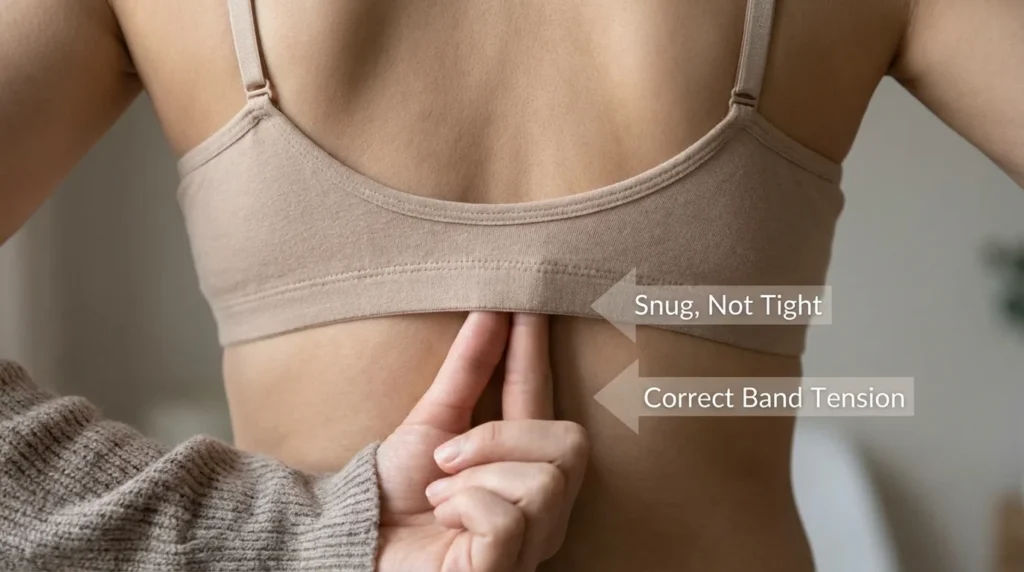
What Does Bra Band Riding Up Actually Mean?
A bra riding up in the back is one of the most common bra support problems women experience. It reflects incorrect proper bra band tension, meaning the band isn’t gripping firmly enough around the ribcage to stabilize the underwire positioning and distribute weight evenly.
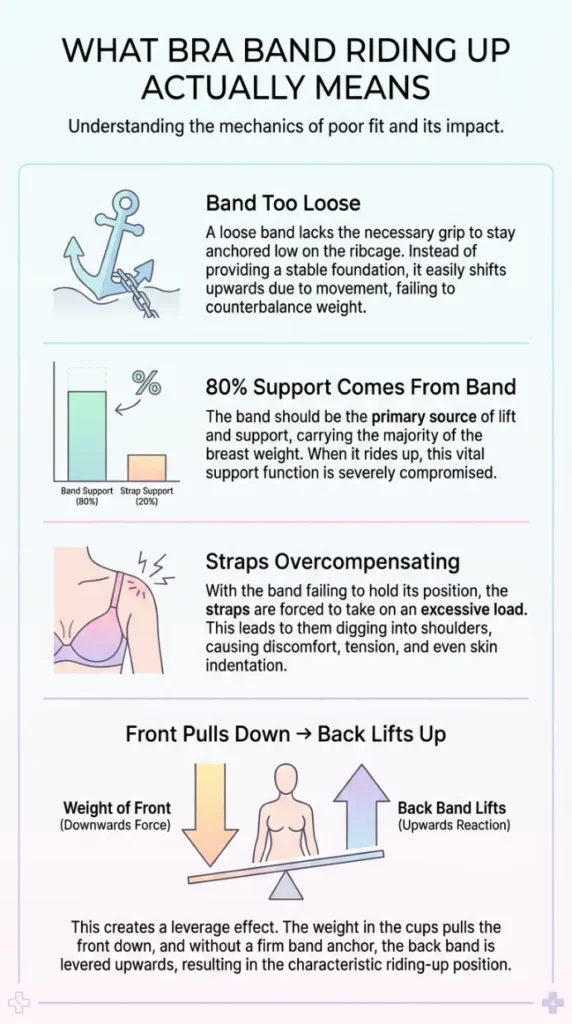
Bra band riding up means the back band climbs toward your shoulder blades instead of staying level with the front underwire — usually signaling that the band is too loose to anchor against gravity.
Correct vs Riding Up: Quick Fit Comparison
| Aspect | Correct Fit | Riding Up (Problem) |
|---|---|---|
| Back band position | Straight horizontal line | Angles upward |
| Height alignment | Same as front underwire | Noticeably higher |
| Two-finger test | Snug fit | Pulls away easily |
| Arm raise test | Stays put | Slides upward |
| Support feel | 80% from band | Straps overworking |
If your band looks like a diagonal line across your back — it’s not doing its job.
Disclosure: As an Amazon Associate, we may earn from qualifying purchases (at no extra cost to you).
Panache Women’s High-Impact Underwire Sports Bra
Built for movement days—encapsulation support + secure band tension helps stop “bra riding up in the back” when you’re active.
- Best for: band ride-up during workouts, running, high-movement days.
- Why it helps: defined cups + adjustable band closure let you set proper bra band tension.
Fit tip: Start on the loosest hook; if the back still creeps up, sister-size down a band.
HSIA Longline Strapless Bra (Higher Side + Back Coverage)
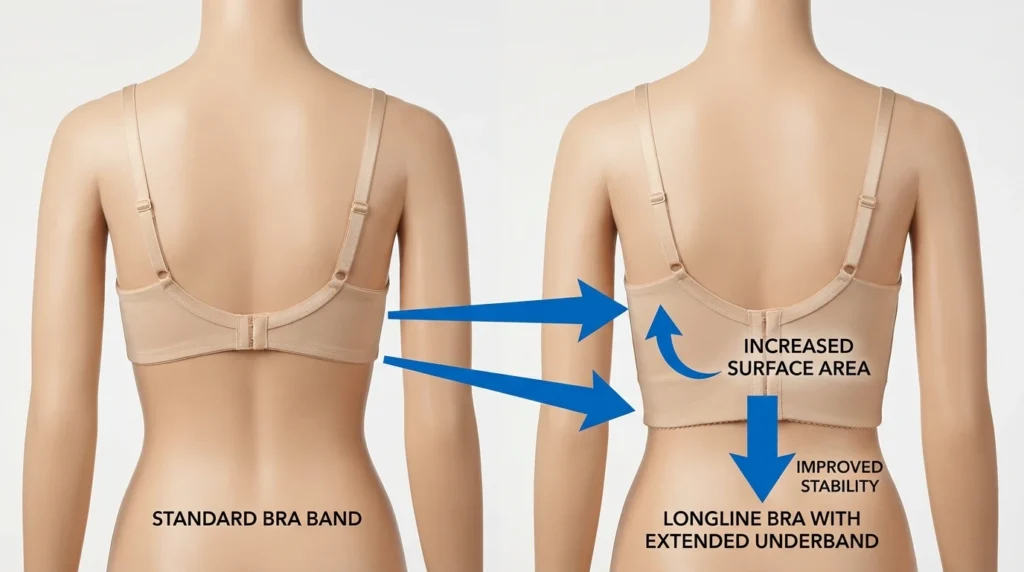
Longline designs add more “real estate” on your ribs—helpful for band fit issues, smoothing, and staying level without creeping up.
- Best for: strapless outfits, smoothing, and preventing “bra band rides up” with added band height.
- Why it helps: wider band + higher sides can improve grip and reduce upward migration.
Pro tip: If the band feels tight but still rides up, re-check cup volume—cups that are too small can distort underwire positioning.
What Happens If You Ignore a Riding-Up Bra Band?
Ignoring it isn’t just cosmetic. Over time, it can lead to:
- Forward bust drop
- Strap digging and red marks
- Upper back tension
- Neck stiffness
- Faster bra deterioration
- Reduced support during movement
A loose band shifts responsibility to the straps, which were never designed to carry the load.
Why Is My Bra Riding Up in the Back Even When the Front Looks Fine?
When a bra is riding up in the back, it usually signals underlying band fit issues, not front cup positioning. Even if the underwire positioning looks correct in front, the back anchor determines overall support.
This is one of the most searched questions online — and the physics are simple.
Breast tissue has weight. When the band is too loose:
- The front gets pulled downward.
- The back floats upward.
- Straps compensate.
- The imbalance worsens throughout the day.
That’s why tightening straps often makes the ride-up worse instead of better.
Can Tight Straps Actually Cause Band Ride-Up?
Yes — and this surprises many people.
If the band is already loose and you tighten the straps:
- The back gets yanked upward.
- The front stays pulled down.
- The diagonal angle increases.
Straps should provide only about 10–20% of support. If they’re doing more, your band is likely the issue.
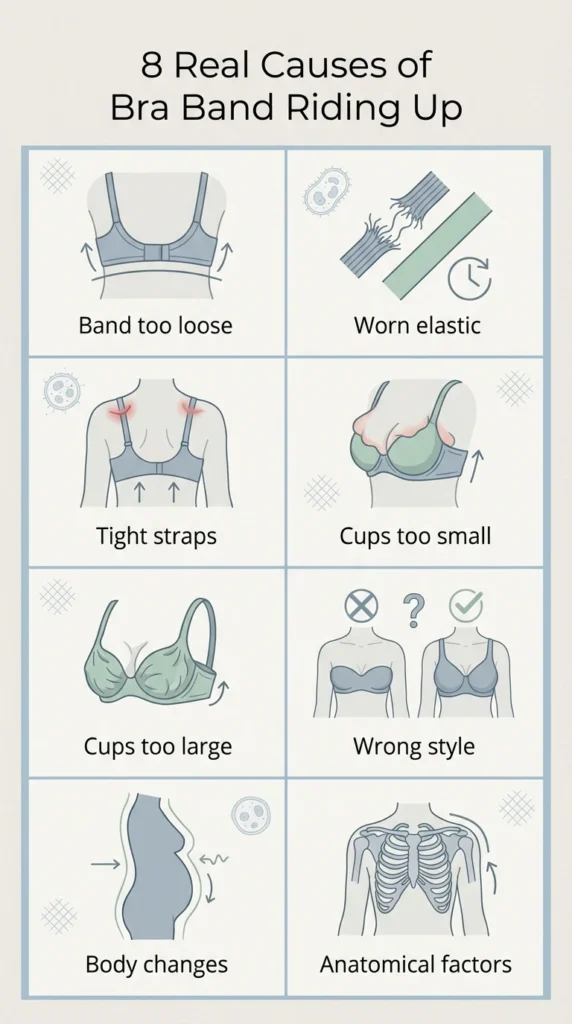
The 8 Real Causes of Bra Band Riding Up
Here’s the complete breakdown, ranked by frequency from fitter consensus and bra-fit communities.
1. Band Too Loose (Most Common – 70%+ Cases)
The majority of band fit issues occur because retailers historically recommended adding inches to the underbust measurement — which results in reduced proper bra band tension and inevitable ride-up.
This is the primary cause.
A loose band cannot anchor against gravity. Even a difference of one band size (34 to 36) can create ride-up.
👉 If unsure, use our Bra Size Calculator to verify your true size before adjusting anything.
2. Worn-Out Elastic
Elastic weakens over time. Most bras last:
- 6–12 months (daily wear)
- 1–2 years (rotated wear)
Signs:
- Back stretches 3+ inches
- Must use tightest hook immediately
- Band rolls or folds
If the elastic has died, no adjustment will fix it.
3. Over-Tightened Straps
Correcting bra riding up in the back often requires restoring proper underwire positioning through accurate sister sizing — not just tightening straps.
This is a compensation mistake.
You feel the band riding up → you tighten straps → the back lifts even higher.
4. Cups Too Small
When cups are too small:
- Tissue spills out
- Pressure pushes downward
- Band shifts upward
Spillage in front often equals ride-up in back.
5. Cups Too Large
Gaping cups can allow band migration. The bra floats rather than anchors.
6. Wrong Bra Style
Certain styles are more prone to ride-up:
- Soft bralettes
- Triangle bras
- Thin elastic bands
- Ultra-stretch wireless bras
Supportive styles that resist ride-up include:
- Longline bras
- Wide back wings
- Power mesh bands
7. Body Changes
Even small changes affect fit:
- 5–15 lb weight shifts
- Postpartum changes
- Menopause
- Rib flare
If your bra suddenly rides up, your body may have changed — not the bra.
8. Anatomical Factors (Less Common)
- Rib flare
- Scoliosis
- Asymmetry
In these cases, slight fit customization may be needed.
Why 70–80% of Women Wear the Wrong Bra Band Size
The Retail Fitting Myth
For decades, many stores measured women over clothing and automatically added 4–5 inches to the underbust measurement — a legacy practice from the 1940s when bras were made from rigid fabrics.
This outdated method almost guarantees a band that’s too loose.
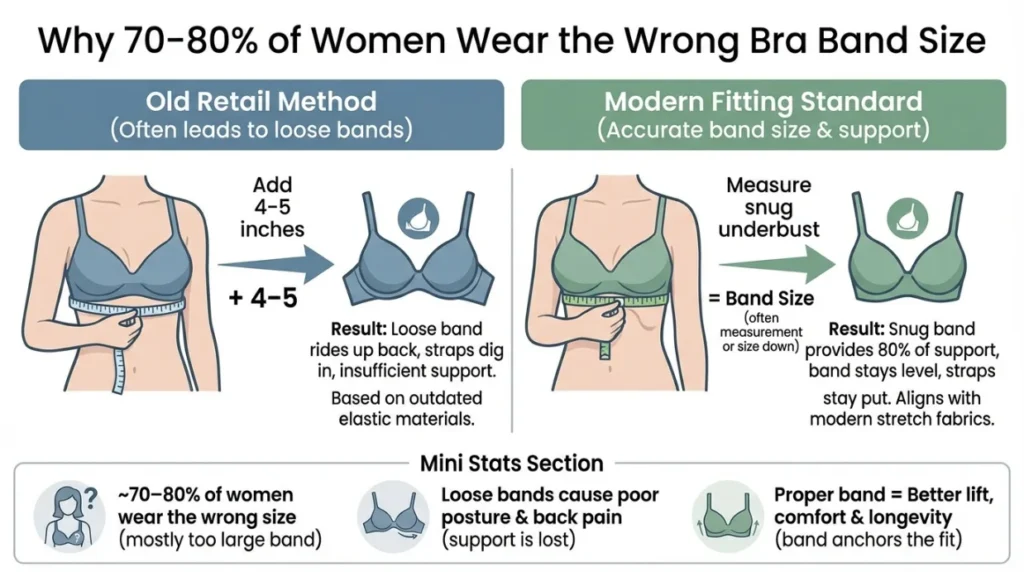
The Modern Fitting Standard
Today, professional bra fitters measure the underbust snugly — without adding inches — and match that number directly to the band size.
Organizations such as the Intimate Apparel Professionals Association promote updated fitting education based on fabric stretch and anatomical support principles.
The Cost of Wrong Sizing
Studies and consumer surveys suggest:
- Many women spend $500+ lifetime on ill-fitting bras
- 3–5 daily adjustments are common
- Up to 40% report chronic shoulder tension related to poor support
Ergonomic research from institutions like University of Portsmouth has examined breast support mechanics, reinforcing the importance of firm band stabilization for reducing movement and discomfort.
Community-based sizing research from r/ABraThatFits further confirms widespread mis-sizing patterns.
When It’s NOT the Band Size
Sometimes the band feels tight — but still rides up.
Possible reasons:
- Slick fabrics with low grip
- Very soft elastic
- Incorrect hook positioning
- Strap imbalance
This is why full fit diagnosis matters.
How Tight Should a Bra Band Be?
A properly fitted band should:
- Feel snug but not painful
- Allow two fingers underneath
- Stay level when raising arms
- Start on loosest hook if new
If you can pull the band more than 2–3 inches from your body, it’s too loose.
How to Stop Bra Band Riding Up: 6-Step Pro Reset
This section is your step-by-step fix.
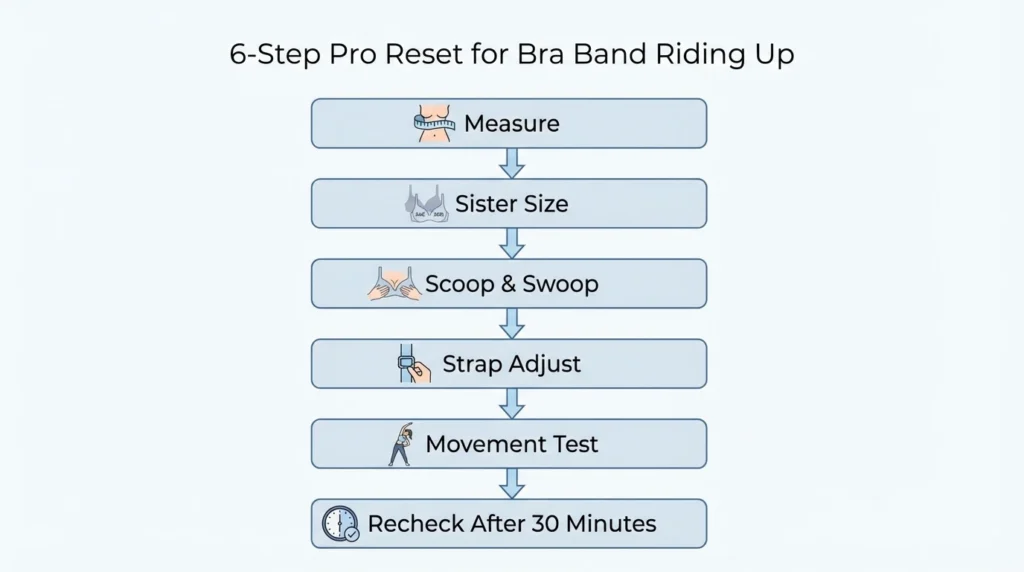
Tools Needed:
- Soft measuring tape
- Mirror
- Current bra
- 1–2 sister sizes
Step 1: Quick Self Diagnosis (45 Seconds)
Ask yourself:
- Does it angle upward?
- Do straps dig in?
- Can I pull it 3+ inches?
- Does tightening straps worsen it?
If yes to 2+, band size likely wrong.
Step 2: Measure Your Underbust Properly
- Stand straight
- Exhale
- Measure snug under bust
- Repeat 3 times
- Average result
Then verify using the Global Size Chart on our site.
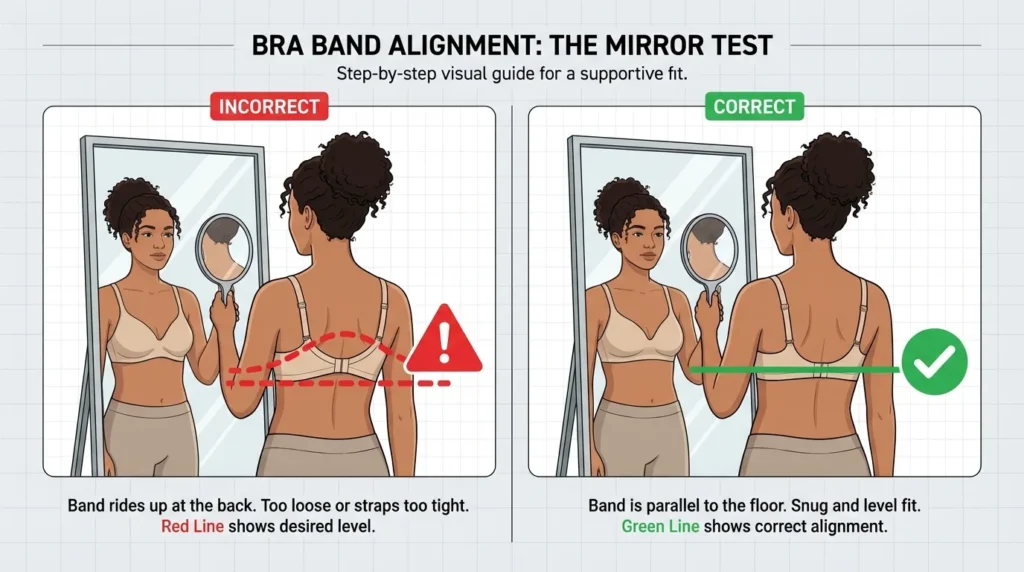
Quick Mirror Test:
Stand sideways in front of a mirror. If the back band angles upward instead of staying level with the front underwire, your band size likely needs adjustment.
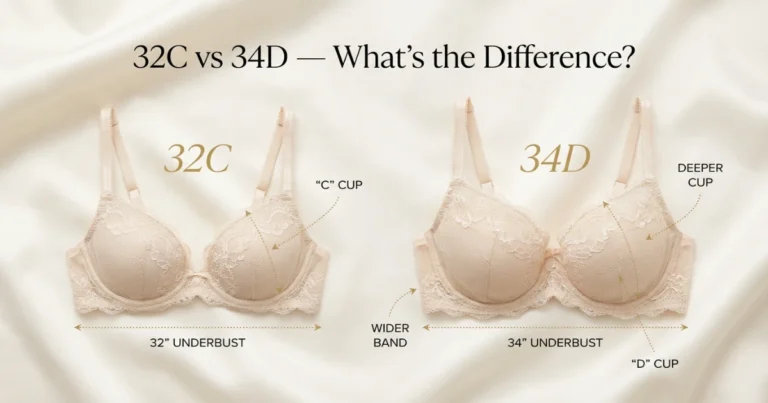
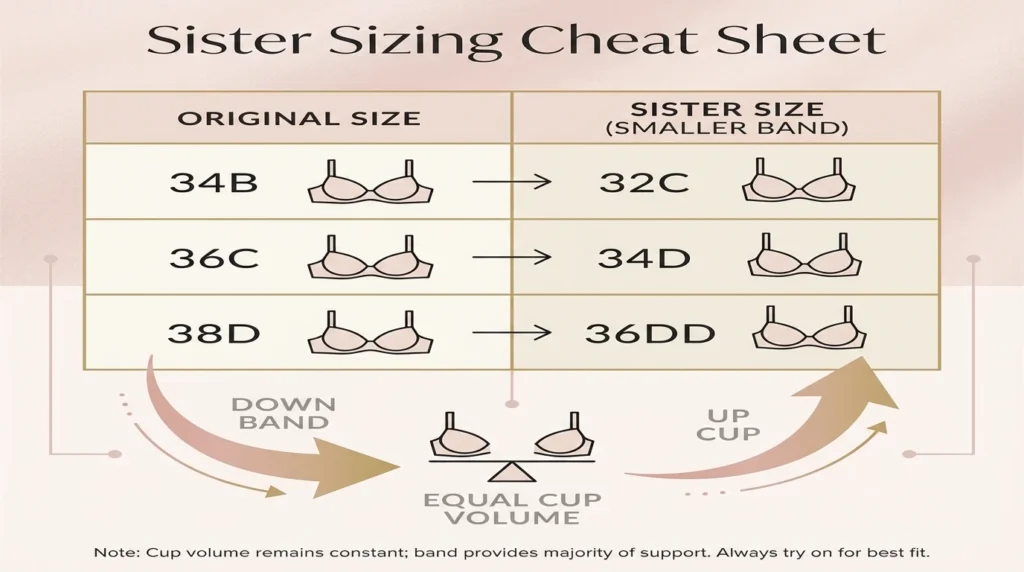
Step 3: Use Sister Sizing Correctly
If you go down a band size, go up a cup letter.
Examples:
| Current | Try Instead |
|---|---|
| 34B | 32C |
| 36C | 34D |
| 38D | 36DD |
Cup volume stays similar — band becomes firmer.
Step 4: Scoop & Swoop
Lean forward and:
- Pull all tissue into cups
- Fasten on loosest hook
- Adjust straps lightly
Many fit problems disappear here.
Step 5: Strap Fine-Tune
Straps should:
- Stay put
- Allow two fingers
- Not leave deep marks
Step 6: Movement Test
Raise arms.
Walk.
Bend forward.
The band should remain level.
Most people fix ride-up within one fitting session.
Bra Band vs Cup: Why Sister Sizing Works
Many people misunderstand cup letters.
A 34B is not “bigger” than a 32C — they can hold similar volume.
Band changes alter anchor strength.
That’s why simply tightening straps fails.
If you’re unsure, start with our Bra Size Calculator to confirm your baseline.
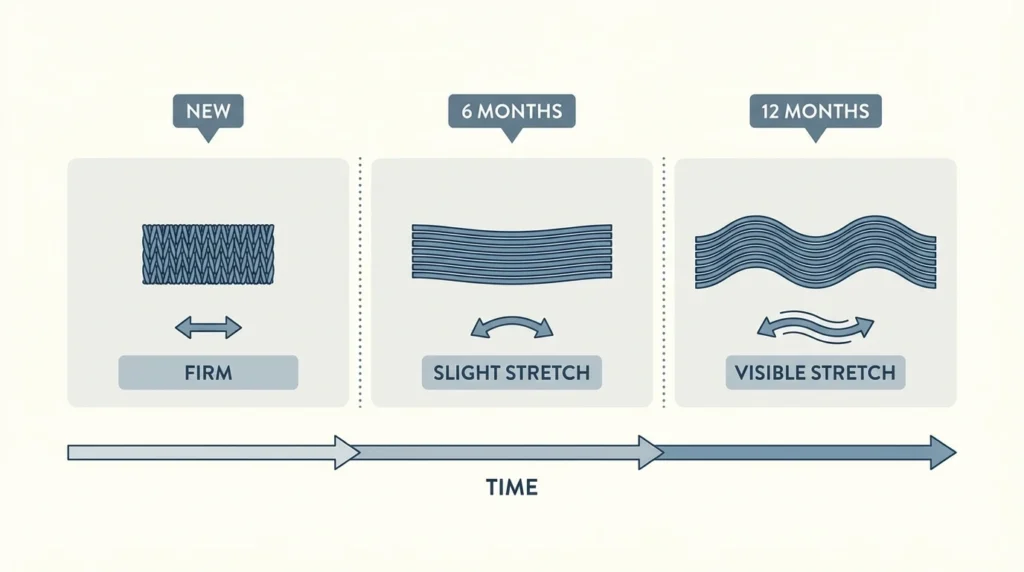
When to Replace Your Bra
Replace if:
- Elastic feels weak
- Band rides up despite correct size
- You’re on tightest hook immediately
- Fabric ripples
Even perfect sizing can’t fix dead elastic.
Best Bra Styles That Prevent Riding Up
Look for:
- Wide back wings
- Firm elastic
- Power mesh lining
- Longline support
- Silicone grip strips (strapless)
Avoid:
- Thin elastic
- Ultra-stretch bralettes
- Fashion-first designs
We’ll list top recommended options next.
Temporary Fixes (If You Can’t Shop Today)
- Temporary band tightener
- Sewing hook adjustment
- Wearing a fitted camisole layer
- Switching hook position
These are short-term — not permanent solutions.
Pro Fitter Tip:
If the band feels tight but still rides up, the cups are likely too small — causing the band to sit incorrectly and shift upward.
Frequently Asked Questions
What If My Bra Band Is Tight But Still Rides Up?
If the band feels tight but continues riding up in the back, possible causes include:
- Cups too small (band displaced downward)
- Slick, low-grip fabrics
- Strap imbalance
- Incorrect underwire positioning
A tight feeling alone does not guarantee proper band tension.
How Do I Know If My Cups Are the Right Size?
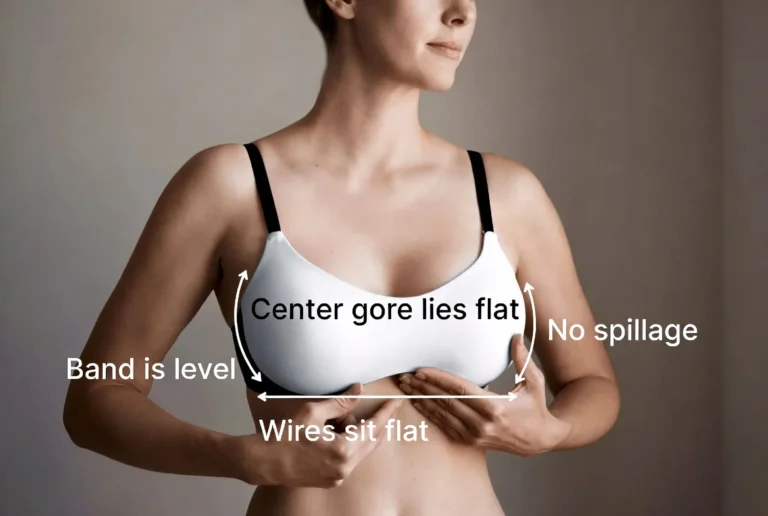
Signs your cups fit correctly:
- No spillage at top or sides
- Underwire sits flush against ribcage
- Center gore lies flat
- No gaping
For deeper guidance, see our full cup fit guide on Bra-Calculator.com.
Can I Fix a Riding-Up Band Without Buying New Bras?
Short term:
- Use a temporary band tightener
- Adjust hook placement
- Light strap recalibration
Long term:
If elastic has stretched, replacement is the only permanent fix.
Why Does My Sports Bra Band Ride Up?
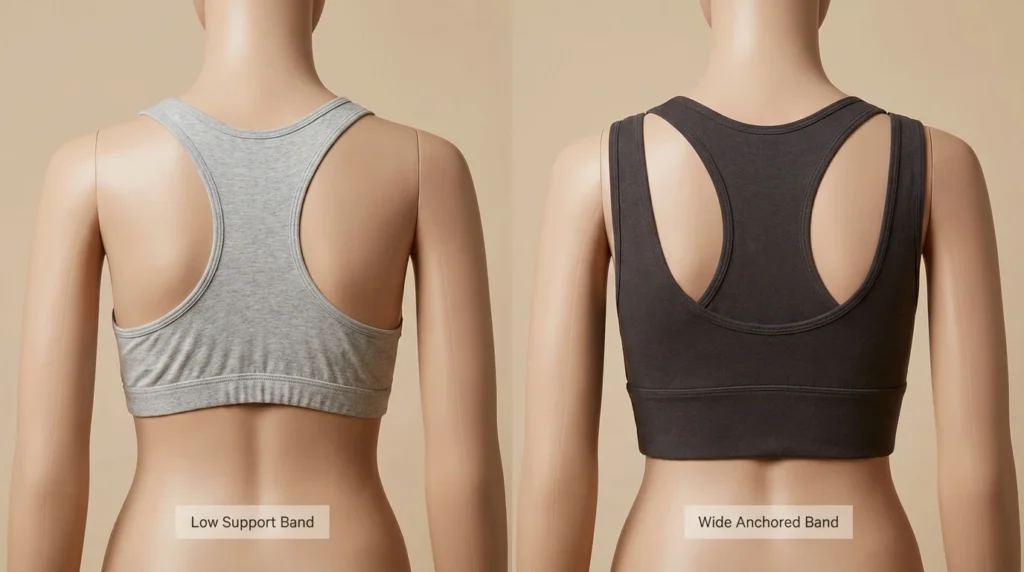
Sports bras may ride up due to:
- Excess compression without anchor support
- Thin elastic underbands
- High-impact motion
Look for wide, firm underbands with reinforced lower panels.
Why does my bra band ride up in the back?
Because it’s too loose in most cases. A loose band cannot anchor, so gravity pulls the front down and the back rises.
Is my bra too big if it rides up?
Usually yes — specifically the band is too big.
Should I go down a band size?
If the band rides up and feels loose, yes — but increase cup letter to maintain volume.
Why do my straps dig in?
Because the band isn’t doing its 80% support job.
Can weight changes affect band fit?
Yes. Even small fluctuations change ribcage tension.
How often should bras be replaced?
Every 6–12 months with regular wear.
Final Takeaway: The Band Does the Work
If your bra band rides up, it’s not random.
It’s physics.
The band is your foundation. When it fits correctly:
- Straps relax
- Lift improves
- Posture improves
- Comfort increases
- Confidence rises
Before buying another bra, confirm your size using our Bra Size Calculator and review the Size Charts to ensure a true fit.