Best Blazers for Curvy Women 2026: Tailored, Not Boxy
Architectural tailoring is 2026’s #1 curvy fashion trend — and it starts with the blazer. Here’s how to spot real shaping vs. a boxy graded-up cut, exactly how to style it, and what’s genuinely worth your money.
The best blazers for curvy women in 2026 have princess seams, waist darting, and a stretch-woven or ponte fabric with 2–4% elastane — construction that shapes the waist and bust rather than a straight-size pattern simply graded up in fabric. Universal Standard, Eloquii, Vince Camuto, and Henning are consistently doing this well.
This guide is part of our 2026 Curvy Fashion Trends series, where architectural tailoring came out as the single biggest shift in curvy fashion this year. The blazer is where that trend shows up first, most obviously, and most affordably — a genuinely well-cut blazer changes the line of an entire outfit before you’ve styled anything else around it. Get this one piece right and every other item in a curvy capsule wardrobe gets easier to build around it.
Most plus-size blazers on the market still aren’t built the way this guide describes, which is exactly why so many curvy shoppers assume blazers “just don’t work” on their body. That’s rarely true. It’s usually a construction problem, not a body problem — and once you know what to look for, it’s genuinely easy to spot the difference in under thirty seconds of handling a garment.
⚡ Key Takeaways
- Look for princess seams and waist darts — not a boxy rectangle graded up from a straight-size pattern.
- Ponte knit or stretch-woven fabric with 2–4% elastane holds shape without restricting movement.
- Shoulder seam must sit exactly at the shoulder bone. This is the one fit point you can’t tailor around easily.
- A nipped waist or self-tie belt creates definition without a single tailoring appointment.
- Single-button closures elongate better than boxy double-breasted cuts with no waist shaping.
- Two blazers cover most curvy wardrobes: one everyday ponte-knit, one structured piece for formal occasions.
- Budget tip: a well-fitted secondhand designer blazer (Henning, Theory) from consignment often beats fast-fashion plus-size at full price.
Why Most Plus-Size Blazers Still Get It Wrong
Here’s what actually happens on a factory floor: a design team drafts a blazer pattern on a straight-size fit block — usually a US 8 or 10 — and once that pattern is approved, it gets “graded” up and down to create every other size on the size chart. Grading adds width and length in fixed increments across the whole pattern. It does not add darting. It does not reposition the waist suppression. It does not account for the fact that a bust-to-waist-to-hip ratio on a curvy body is proportionally different from a straight-size body, not just larger.
The result is the blazer every curvy woman has worn at some point: shoulders that fit, a bust that pulls, buttons that strain, and a waist that hangs like a sack because the pattern was never actually shaped for a curvy silhouette in the first place. It photographs boxy. It feels uncomfortable by 2pm. And it gets blamed on the body wearing it, when the actual fault sits entirely in the pattern-drafting process.
Architectural tailoring is the direct answer to this problem. Brands doing it properly build a genuinely separate curvy fit block from the ground up — with darting, princess seams, and waist suppression drafted specifically for a fuller bust and hip, rather than a scaled-up version of a smaller pattern. It costs more to develop, which is exactly why it’s concentrated at brands like Universal Standard, Eloquii, and Henning rather than fast-fashion basics.
What “Architectural Tailoring” Actually Means
Architectural tailoring is a construction approach where a garment is cut with real darting, princess seams, and waist-and-bust shaping on a fit block developed specifically for an extended-size body — not a straight-size pattern that has simply been graded up in fabric amount. On a blazer, you can identify it by three visible seams: a curved seam running from the underarm toward the waist (princess seam), visible shaping stitched into the front and back panels (darting), and shoulders that sit flat without pulling toward the bust point.
How to Check a Curvy Blazer’s Fit — 5 Steps
Run through this checklist before you buy — in a fitting room or before you click “add to cart.” It takes under a minute and it’s the same process our fit checklist for curvy fashion recommends for any structured garment.
It must align with the edge of your shoulder bone. If it hangs off or cuts in, no other fix matters — this size is wrong, and no amount of tailoring elsewhere will fix a shoulder that doesn’t sit right.
Look for princess seams or visible darting through the waist. A blazer with none is a rectangle, not a fitted piece — no matter what the size label says.
Check the label for 2–4% elastane. Anything fully rigid (100% wool, 100% cotton twill) will pull at the shoulders and gap at the bust by the second wear.
Raise both arms and sit down fully. Nothing should pull, gap, or ride up the back — a blazer that only looks good standing still will fail you in real life.
If shoulders and bust fit but the waist is loose, a $20–50 tailoring job outperforms buying another blazer, and it’s the single best-value fix in this entire guide.
Blazer Types Compared
| Blazer Type | Best For | Fabric | Price Range |
|---|---|---|---|
| Ponte Knit Blazer | Everyday, travel | Ponte knit + elastane | $$ |
| Structured Wool-Blend | Office, formal | Wool blend + stretch | $$$ |
| Wrap Blazer | Versatile day-to-night | Stretch crepe | $$ |
| Double-Breasted | Statement, events | Twill/wool + darting | $$$ |
Blazer Fabric Deep-Dive
Fabric choice matters as much as cut. Ponte knit is the single best all-purpose fabric for a curvy blazer — it’s a double-knit that holds its shape structurally while still moving with the body, and it doesn’t wrinkle on a plane or a long commute.
Stretch-woven wool blends (usually 92-96% wool with 4-8% elastane) give a crisper, more formal finish and are the better choice for a piece that needs to read as “suiting” rather than “smart-casual.” Pure, non-stretch wool or cotton twill is the fabric most responsible for the boxy, pulling fit curvy shoppers complain about — if the composition tag doesn’t list any stretch fiber, assume it will fight your movement rather than work with it. Our full fabric performance guide covers how ponte, denim, and TENCEL each behave on a curvy frame in more depth.
Find Your Best Bra Match
Answer a few fit questions to get bra styles matched to your support needs, breast shape and everyday preferences.
Question 1 of 5
Why it matches
What to look for
What may not work
Private fit matching: your answers are used only to build the recommendation on this page. No measurements or fit selections are submitted to Bra-Calculator.com.
This tool suggests a starting bra style, not a medical or diagnostic recommendation. Individual brands and bra models can fit differently.
Our Top Picks for 2026
Three picks across three budgets and use-cases — each chosen for genuine waist shaping, not just an extended size range.

VINCE CAMUTO Women’s Plus Size Single Button Ponte Blazer
Ponte knit construction gives structure without stiffness, and the interior seam shaping follows the natural waist rather than a boxy graded-up cut. The single button creates a clean vertical line from shoulder to hip — our top pick for the everyday, do-everything blazer.
Sizes available: 14W–24W
View on Amazon →
ellos Women’s Plus Size Ponte Knit Button-Front Blazer
An unconstructed, relaxed-silhouette ponte blazer with front princess seams and a notched collar — genuinely shaped rather than boxy, and priced well below most designer alternatives. A smart pick if you’re building your first architecturally-tailored blazer on a budget.
Sizes available: 12–24
View on Amazon →
dgd Women’s Plus Size Blazer — Stylish Workwear Suit for Curvy Women
A lightweight, breathable point-collar blazer designed specifically for curvy fit, at an entry-level price point. Not as heavily structured as our editor’s pick, but a solid starting blazer if you’re testing the architectural-tailoring trend before investing further.
Sizes available: XL and up
View on Amazon →ℹ️ As an Amazon Associate, Bra Calculator earns from qualifying purchases. Prices and availability subject to change.
Other Brands Worth Checking
Universal Standard and Eloquii both cut genuine extended-size fit blocks rather than grading up a straight-size pattern. Henning — often found on consignment resale platforms at a fraction of retail — is the benchmark for architectural tailoring in 2026. For budget options, Old Navy and Target have improved their stretch-woven blazers significantly this year, though neither has fully closed the gap on waist shaping that dedicated curvy-fit brands offer.
3 Ways to Style a Curvy Blazer
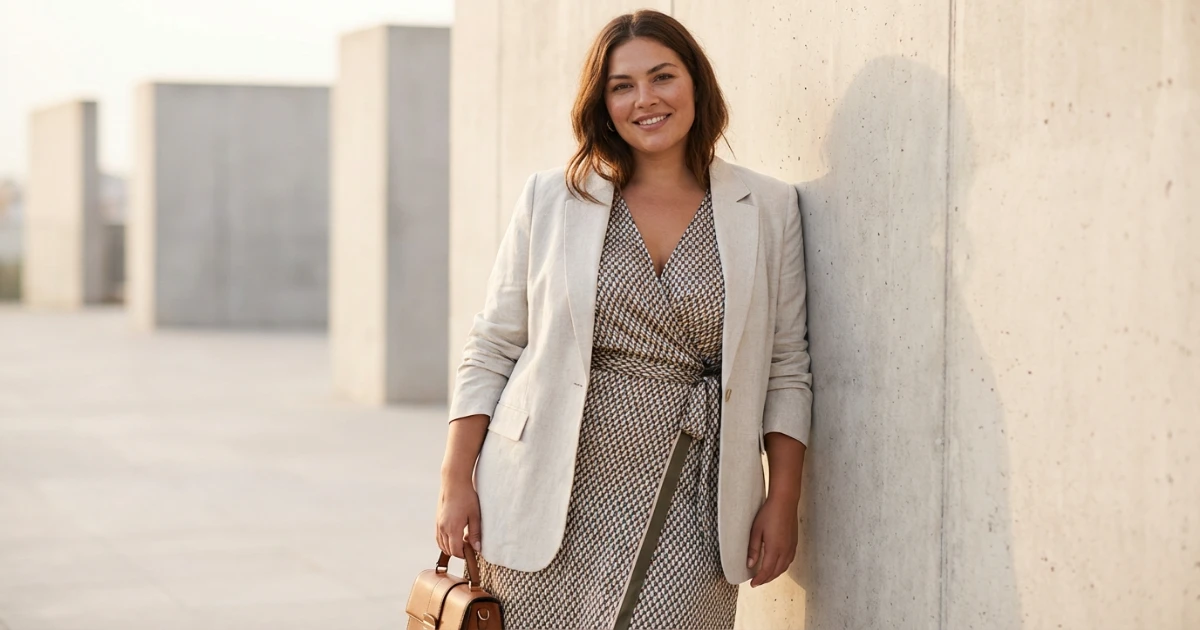
1. Over a wrap top or wrap dress. A blazer’s structure balances the soft drape of a wrap silhouette — one of 2026’s most flattering shapes on its own, covered in full in our curvy fashion trends guide. Leave it open to let the wrap neckline show, or belt both together for a sharper, more polished line.
2. With barrel-leg or wide-leg denim. A fitted blazer is the natural counterweight to 2026’s roomier denim silhouettes. Because a wider leg adds volume below the waist, a fitted blazer on top keeps the whole outfit proportional — see our barrel-leg denim guide for exactly which cuts pair best.
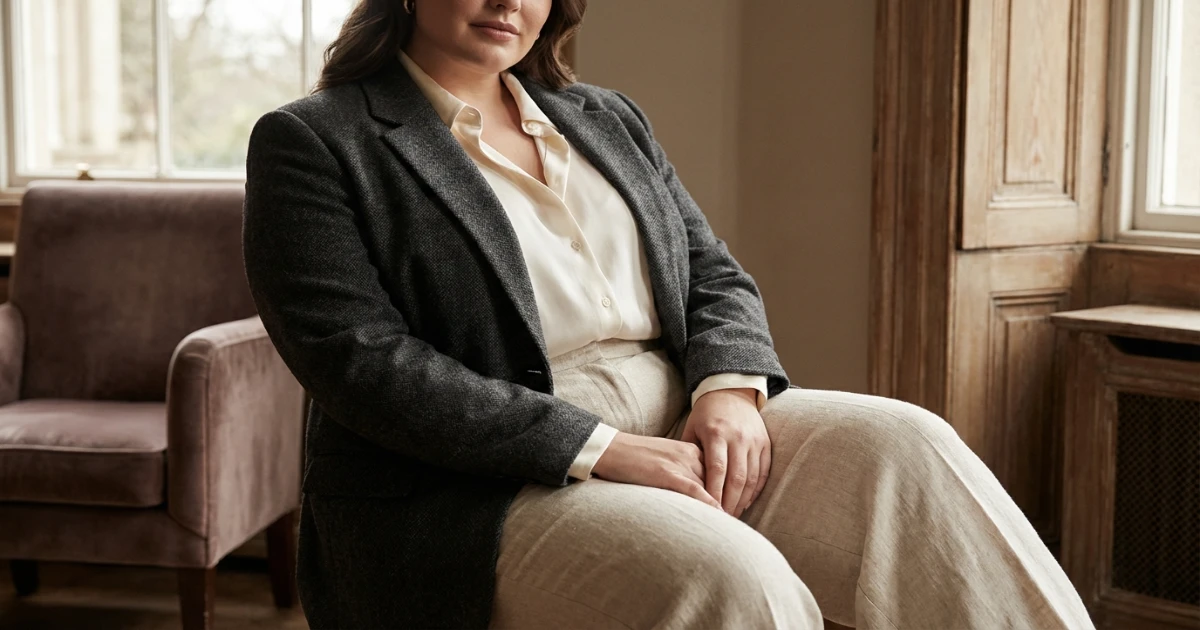
3. Over a knit tank with tailored trousers. The most office-ready combination: a fitted knit underneath keeps the silhouette clean, and matching or contrasting tailored trousers turn a single blazer into a full “suiting” look without buying a matched set.
Common Blazer Fit Mistakes to Avoid
- Sizing up for the bust and accepting a loose waist. Buy for your bust and shoulders, then tailor the waist — sizing up everywhere just moves the boxy problem rather than solving it.
- Buying a fully rigid, non-stretch fabric because it “looks more structured” on the hanger. It will pull the first time you sit down or reach for something.
- Ignoring sleeve length. A sleeve that’s too long reads as borrowed, not tailored — hem it to hit at the wrist bone.
- Choosing a double-breasted cut with zero waist shaping. The extra fabric across the front adds visual bulk without a nipped waist to balance it.
- Skipping the movement test in the fitting room. A blazer that only looks good standing perfectly still will fail you at your desk, in your car, or at dinner.
Why the Foundation Still Matters
A blazer only looks tailored if what’s underneath it sits correctly. A bra with the wrong band size changes your posture and the line of your shoulders — which changes how any blazer sits, no matter how well it fits on paper. This is the same principle behind every trend covered in our 2026 curvy fashion guide: the foundation layer determines how everything on top of it actually looks. Check your size with our AI Smart Fit Calculator before you invest in a tailored piece, and use our at-home measuring guide if you haven’t measured in the last few months.
Get your bra size right before you invest in tailoring. A correctly fitted bra changes your posture and silhouette — and how every blazer sits on your shoulders.
Find My Correct Bra Size →Frequently Asked Questions
What blazer is best for curvy women?
The best blazers for curvy women have princess seams, waist darting, and a stretch-woven or ponte fabric with 2–4% elastane — construction that shapes the waist and bust instead of a straight-size pattern graded up in fabric.
How should a blazer fit a curvy body?
The shoulder seam should sit exactly at the shoulder bone, the waist should show visible shaping rather than a straight rectangle, and you should be able to raise both arms and sit down without pulling across the back or bust.
Can curvy women wear double-breasted blazers?
Yes, as long as the blazer has waist shaping. A double-breasted cut with no darting can add visual bulk, so prioritize brands that build in a nipped waist or a self-tie belt to create definition.
What fabric is best for a plus-size blazer?
Ponte knit or a stretch-woven wool blend with 2–4% elastane. Ponte holds structure without stiffness, while a fully rigid woven is more likely to pull at the shoulders and gap at the bust.
Is it worth tailoring a plus-size blazer?
Yes. A blazer that fits everywhere except the waist can usually be taken in for $20–50 by a local tailor — far cheaper than continuing to buy ill-fitting blazers, and it gives a genuinely custom result.
What is architectural tailoring in plus-size fashion?
Architectural tailoring means a garment is cut with real darting, princess seams, and waist-and-bust shaping on a genuine extended-size fit block, rather than a straight-size pattern simply graded up in fabric amount.
How many blazers does a curvy woman actually need?
Two is usually enough to start: one neutral ponte-knit blazer for everyday wear and one structured wool-blend or statement piece for formal occasions. Both should pass the shoulder, waist, and movement fit checks above before anything else gets added.
Can a boxy blazer be altered to fit a curvy body?
Sometimes. A tailor can take in the side seams and add waist darts if there’s enough fabric in the seam allowance, typically for $30–60. A blazer that’s tight across the shoulders or bust usually can’t be let out enough to fix that specific problem.