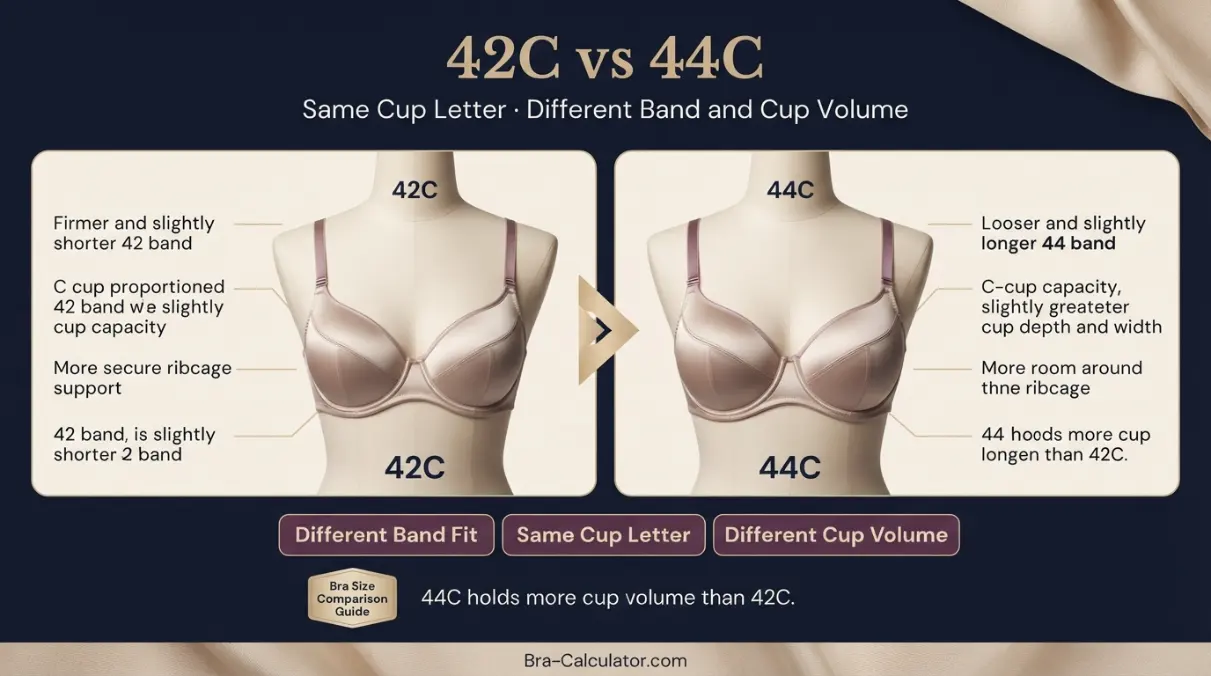
42C vs 44C is a cross-band comparison with the same cup letter, but the cups are not automatically the same. A 44C cup usually has more total capacity than the same letter on a 42C band. Choose 42C if you need a firmer base. Choose 44C if the ribcage needs more room and the cup still stays controlled.
Jump to a Section
Choose the fit signs you notice in the band, cups, center and straps. We’ll turn them into a practical next step for 42C.
Private fit check — your answers stay in your browser and are used only for this on-page guidance. Nothing is stored or submitted.
42C vs 44C at a Glance
| Attribute | 42C | 44C |
|---|---|---|
| Band starting point | 39–41 inches | 41–43 inches |
| Main comparison type | 42 vs 44 band | |
| Size relationship | same cup letter with different band volume | |
| Best clue | Choose 42C if its band tension and cup coverage feel balanced after scoop-and-settle. | Choose 44C if its ribcage comfort improves without making the cup unstable. |
| Core reminder | Cup letters never work alone. Band size, tissue shape, root width, projection, and bra construction change how 42C vs 44C behaves on the body. | |
What Does 42C vs 44C Really Mean?
42C vs 44C is the kind of comparison people search when one bra almost works, but not quite. Sometimes the cup cuts in, sometimes the band shifts, and sometimes one size looks better in the mirror but feels worse by lunchtime. This guide compares both sizes in practical terms so you can understand whether your real issue is cup volume, band tension, shape mismatch, or a mix of all three.
In premium fitting, the goal is not just to avoid obvious spillage or gaping. The goal is to find the size that keeps the band level, the wires around all tissue, the center gore stable, and the cup edge smooth without forcing the straps to do all the work. For 42C vs 44C, that means looking at band comfort, wire width, cup coverage, and whether the cup becomes too roomy instead of trusting the label in isolation.
This page is written for real-world fitting, not label myths. That means we will look at measurement logic, body shape, sister sizes, common errors, best bra styles, and the way this comparison behaves under daily movement. If you are deciding between 42C and 44C, this is the level of detail that actually helps.
Measurement Logic for 42C and 44C
Start with the underbust. A bra is supported by the band first, so your snug ribcage measurement is the anchor for this entire comparison. 42C typically suits a snug underbust around 39–41 inches, while 44C generally relates to about 41–43 inches. After that, the full-bust measurement and breast shape help determine which cup is more realistic.
For 42C vs 44C, a tape measure gives you a starting point, not the final answer. A projected bust may need more cup depth than the numbers alone suggest. Soft tissue may settle differently than firmer tissue. A molded cup can look wrong even when the size is technically close. That is why the best fitting workflow is always: measure, test both sizes in the same bra, scoop and settle, then evaluate the fit signs.
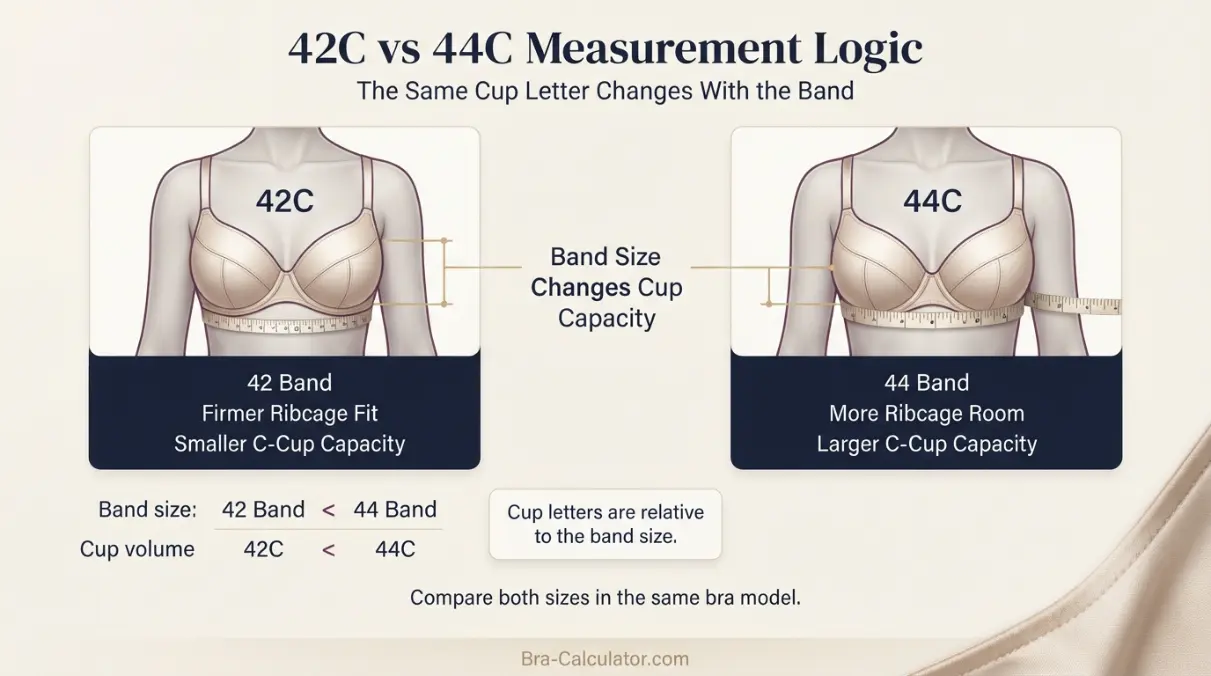
If one size looks close but the band feels wrong, do not stop there. Sister sizing and construction differences often explain why a label feels nearly right yet still uncomfortable. This is especially true in cross-band comparisons, where a small label change can still create a big difference in comfort and containment.
The band is your support base, so confirm whether the band number is realistically close before obsessing over the cup letter.
Do not flatten the tissue. Let the tape rest at the fullest point so the cup starting point is honest.
Different bras hide fit clues. The same bra in both sizes gives the clearest comparison.
Look for cutting in, gaping, floating gore, side-wire pressure, band movement, and strap strain.
What Does 42C vs 44C Look Like?
On the body, 42C vs 44C can look much less dramatic than people expect — or much more dramatic — depending on frame, tissue distribution, and the bra style you use for comparison. A shallow molded cup may hide the true difference between sizes, while a seamed or side-support bra can make the contrast clearer immediately.
Shorter torsos often show fit changes faster because there is less vertical space for the cup to disappear visually. Broader frames may distribute volume more widely, which can make two nearby sizes look calmer than the label suggests. Soft tissue often benefits from better containment, while projected tissue usually exposes cup-depth problems more clearly.
Real fit beats online myths. The right choice is the one that looks calmer, feels more secure, and keeps the bra working through daily movement — not the one that simply sounds more familiar.
In a comparison like 42C vs 44C, the most reliable signs are cup edge smoothness, center-gore stability, and whether the band stays level without help from the straps.
Best Products to Test 42C vs 44C
The product picks below are designed for this comparison level and the kinds of fit questions it creates. In this range, the most useful testing bras tend to emphasize T-shirt bras, balconettes, side-support bras, and everyday underwire styles with stable band support.

Structured T-Shirt or Full Cup Bra
- Balances smooth shaping with enough structure to show the real difference between nearby sizes.
- A strong choice when you need stable support without going too heavy.
- Use the same bra model in both sizes for the fairest comparison.

Balconette or Side-Support Bra
- Helps center tissue and reveals whether the larger cup is needed for cleaner containment.
- Ideal when side tissue and upper-cup pressure are the biggest clues.
- Often more diagnostic than soft bralettes.

Encapsulation Sports Bra
- Useful when motion makes fit problems more obvious than a mirror check.
- Great for spotting bounce, hidden compression, or cup instability.
- Especially helpful if you are active and want multi-purpose support.
How Body Shape Changes 42C vs 44C
Body shape is one of the biggest reasons two people can wear the same size label and have very different fitting experiences. Volume placement, root width, tissue softness, and torso proportions all change how this comparison behaves.
Depth shows fast
If you are projected, the deeper option often solves center pressure, lower-cup collapse, and upper-edge cutting more clearly than a shallower cup.
Depth mattersShape can override size
Shallow breasts may not fill a taller, more projected cup even when the tape suggests it. Cup shape matters as much as the label.
Check cup opennessContainment matters
Softer tissue often prefers a stable band, side support, and a cup that surrounds the whole root without cutting in.
Watch side supportWire width matters
If tissue spreads wider across the chest, a different wire shape can fix fit problems that look like a simple size issue.
Check wire width42C vs 44C Sister Sizes
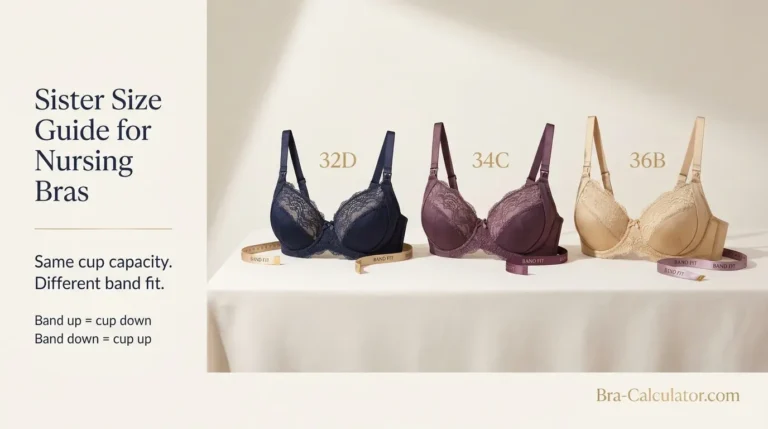
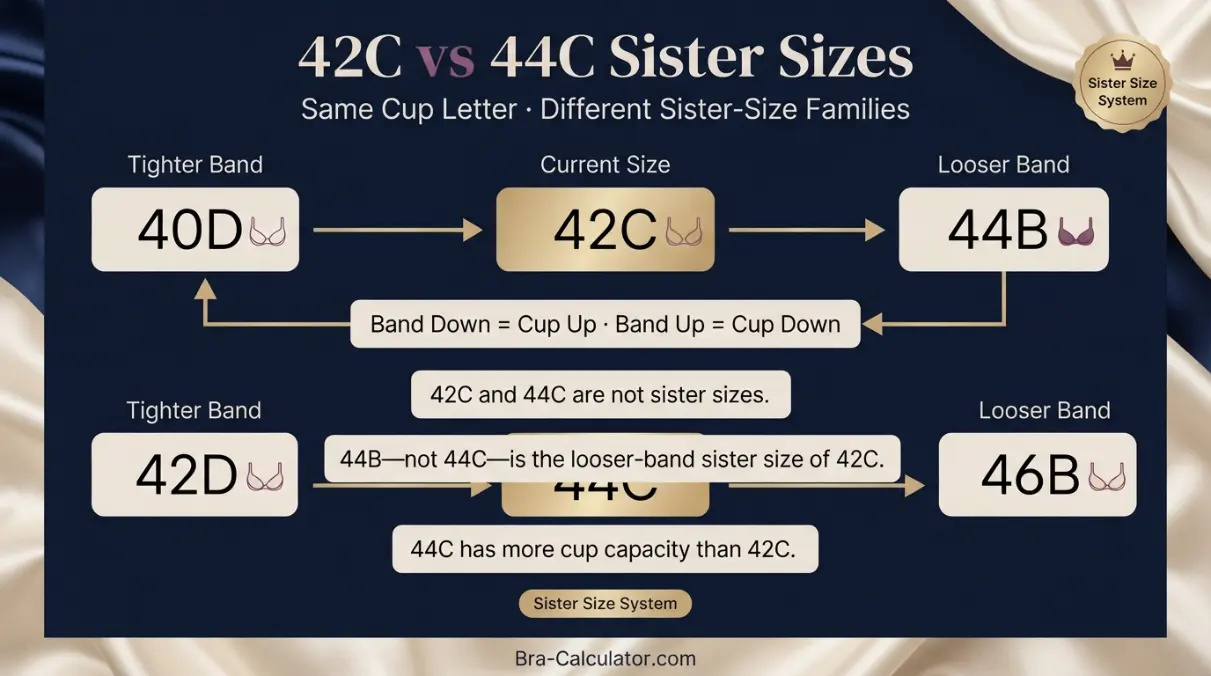
Sister sizing lets you keep similar cup capacity while changing the band, which is crucial when a size feels close but not comfortable. The core rule is simple: down one band, up one cup; up one band, down one cup. Even when 42C and 44C are not exact sisters, the sister-size ladder helps you find the next logical test size.
42C
44C
| Situation | Try | Why |
|---|---|---|
| Band rides up | Go down one band and up one cup | This keeps similar capacity while making the band more supportive. |
| Band feels truly tight | Go up one band and down one cup | This keeps similar capacity while giving the ribcage more room. |
| Smaller option spills | Move toward the larger or deeper option | Spillage, cutting in, or a floating gore usually means you need more cup room or a different shape. |
| Larger option gaps | Move toward the smaller or shallower option | Wrinkling or standing-away cups often mean the cup is too tall, too deep, or mismatched in shape. |
42C vs 44C: Real Fit Differences
- 42C uses a 42 band with C cup volume.
- May be better if the alternative wrinkles, feels too tall, or opens away from the upper bust.
- Underbust range usually starts around 39–41 inches.
- Always judge in the same bra model for a clean comparison.
- 44C uses a 44 band with C cup volume.
- May be better if the other option cuts in, spills, or makes the gore float.
- Underbust range usually starts around 41–43 inches.
- Cup letter alone never tells the whole story without band and shape.
- May suit your shape best if the alternative cup feels too tall, too wide, too shallow, or too projected.
- Check the cup edge under a thin top for the most honest result.
- Use scoop-and-settle before judging the fit.
- May suit your shape best if the other option cuts in, gaps, or shifts tissue toward the sides.
- Look at center depth, lower-cup support, and side containment.
- Judge in the same bra model whenever possible.
- Often better if the band feels right and the cup looks calmer without extra bulk.
- May become uncomfortable if tissue is compressed or straps take over.
- Band accuracy still matters as much as the cup label.
- Often better if you need a different balance of containment, depth, and ribcage comfort.
- Should improve support, not just create a bigger-looking label.
- In fuller ranges, side support and strap width become more important.
- Try this if 44C feels too open, too tall, less stable, or less natural in the cup.
- Check returns policy because brands scale sizes differently.
- Do not fix cup problems by overtightening straps.
- Try this if 42C spills, cuts in, gaps, or fails to keep the gore and wires stable.
- Use the brand size chart before shopping internationally.
- Movement tests often reveal the winner faster than a mirror check alone.
Which Bra Styles Work Best for 42C vs 44C?
The best test bra is one that exposes fit truth instead of hiding it. For 42C vs 44C, the most useful options are stable styles that clearly show depth, side control, edge behavior, and band movement.
Great for everyday comparison because it reveals smoothness under clothing and highlights edge issues quickly.
Often the best way to see real lower-cup depth and center support without the distortion of stiff molded foam.
Excellent when side tissue and forward projection are part of the fitting puzzle.
Useful when you need a more open upper cup or want to test wire width more clearly.
Ideal for revealing bounce, hidden compression, and stability issues during normal motion.
Comfortable, but often too soft to tell you which size is actually working better.
Common Fit Problems in 42C vs 44C
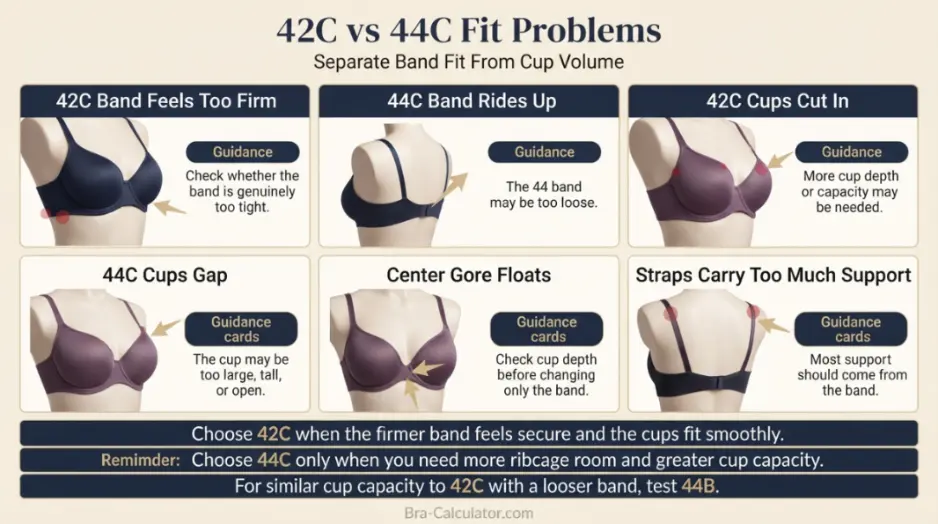
This usually means the smaller, shallower, or less open option does not have enough room at the top or center of the cup.
This often means the larger or taller option is too deep, too open, or not shaped for your tissue.
A floating gore can point to too little cup depth, the wrong cup shape, or sometimes an overly loose band.
When the back of the band climbs upward, support shifts into the straps and cup fit becomes harder to judge.
Straps usually compensate when the band and cups are not sharing support properly.
The smaller or narrower-wired option may not surround the full breast root.
International Conversion Notes for 42C vs 44C
International sizing can change the meaning of a label, especially once you move beyond the most common cup letters. US, UK, EU, and AU brands may not all progress cups in the same way, so always check the brand chart when buying across regions or when comparing DD, DDD, E, F, G, H, I, and beyond.
Use the Global Bra Size Converter and the Brand Size Decoder before buying across regions.
Related Tools & Guides for 42C vs 44C
| Guide / Tool | Why It Helps |
|---|---|
| Bra Size Calculator | Calculate your band and cup using real measurements rather than guesswork. |
| Cup Size Visuals | See how cup letters change with band size and body shape. |
| Sister Size Calculator | Adjust the band while keeping similar cup capacity. |
| Global Bra Size Converter | Check labels across US, UK, EU, AU, and brand systems. |
| AI Smart Fit Bra Calculator | Diagnose gaping, spillage, strap digging, floating gore, and side tissue issues. |
Frequently Asked Questions
42C vs 44C is a cross-band comparison with the same cup letter, but the cups are not automatically the same. A 44C cup usually has more total capacity than the same letter on a 42C band. Choose 42C if you need a firmer base. Choose 44C if the ribcage needs more room and the cup still stays controlled.
Yes. Breast shape, tissue softness, bra construction, and the way volume sits on the frame can make 42C and 44C look closer than people expect.
It depends on the symptoms. For 42C vs 44C, check the underbust first, then judge cup edge smoothness, gore position, side-wire placement, and support after movement.
Try 42C and 44C in the same bra model, scoop all tissue into the cups, start on the loosest hook, then check the band, cup edge, center gore, side wire, and strap pressure.
That usually means shape is part of the story. A different cup cut, stretch-lace edge, wire width, or side-support style may solve the problem better than changing the label alone.
Yes. Sister sizing helps separate a band-tension problem from a true cup-volume problem, especially when one size feels close but not quite right.
They can. US, UK, EU, and AU systems do not always label larger cup progressions the same way, so always check the brand chart before buying.
Do not chase the label alone. Use your underbust, full-bust measurement, cup shape, and real fit symptoms to decide whether 42C, 44C, or a nearby sister size gives the calmest support.
Find Your Best Fit
Use your measurements, fit symptoms, body shape, and sister-size options to decide whether 42C, 44C, or a nearby alternative gives the cleanest and most supportive result.