International Bra Size Conversion Chart
Moving between US, UK, European, French, Australian or Japanese bra sizes is mostly a labeling problem — until the cup letters begin to split. This guide keeps the two jobs separate: convert the band first, then convert the cup. The tables below show the common equivalents, explain where the systems stop matching, and show exactly when you should defer to a brand’s own chart.

A common US/UK 34 band converts to EU 75, France 90, Japan 75 and Australia/New Zealand 12. Cup letters usually agree through D. Above D, the naming splits: a common US 34DDD/F maps to UK 34E, EU 75F, France 90F, Japan 75F and AU/NZ 12E. Brand charts can override these conventions, especially in extended cup ranges.
30, 32, 34, 36 and so on match directly.
Metric-style retail labels, not a raw body measurement.
EU 75 is commonly France 90.
US/UK 34 commonly maps to AU/NZ 12.
International Bra Band Size Conversion Chart
Band conversion is the stable part of the job. If you already know your band in one system, use this table to find the label used in another. The numbers look very different because the countries use different retail conventions, not because the physical ribcage has changed.
| US / UK | EU / Germany | France / Spain | Japan | Australia / NZ |
|---|---|---|---|---|
| 26 | 55 | 70 | 55 | 4 |
| 28 | 60 | 75 | 60 | 6 |
| 30 | 65 | 80 | 65 | 8 |
| 32 | 70 | 85 | 70 | 10 |
| 34 | 75 | 90 | 75 | 12 |
| 36 | 80 | 95 | 80 | 14 |
| 38 | 85 | 100 | 85 | 16 |
| 40 | 90 | 105 | 90 | 18 |
| 42 | 95 | 110 | 95 | 20 |
| 44 | 100 | 115 | 100 | 22 |
| 46 | 105 | 120 | 105 | 24 |
| 48 | 110 | 125 | 110 | 26 |
| 50 | 115 | 130 | 115 | 28 |
International Bra Cup Size Conversion Chart
Cup conversion is more complicated because the letter sequence is not globally standardized. Most systems agree through D. After that, UK sizing uses double letters such as FF and GG, many US brands use DD/DDD or a single-letter progression, and continental brands often move through single letters. The table below shows a common cross-system sequence, not a promise that every label will use the same naming.
| Cup step | Common US | UK | EU / France / Japan | Australia / NZ |
|---|---|---|---|---|
| 0 | AA | AA | AA* | AA |
| 1 | A | A | A | A |
| 2 | B | B | B | B |
| 3 | C | C | C | C |
| 4 | D | D | D | D |
| 5 | DD / E* | DD | E | DD |
| 6 | DDD / F* | E | F | E |
| 7 | G* | F | G | F |
| 8 | H* | FF | H | FF |
| 9 | I* | G | I | G |
| 10 | J* | GG | J | GG |
| 11 | K* | H | K | H |
| 12 | L* | HH | L | HH |
| 13 | M* | J | M | J |
| 14 | N* | JJ | N | JJ |
| 15 | O* | K | O | K |
UK lettering adds intermediate double letters. A UK FF is not a smaller cup than a US H in the common sequence; the two labels can sit at the same cup step.
A cup letter is incomplete without its band. A 30F and a 40F are not the same cup volume, so always convert the full size.
Common Full Bra Size Conversions
These examples combine the band row with the common cup sequence above. They are useful when shopping an international retailer and you already know your current size.
France 85C · AU/NZ 10C · Japan 70C
France 90C · AU/NZ 12C · Japan 75C
France 90D · AU/NZ 12D · Japan 75D
France 90E · AU/NZ 12DD · Japan 75E
France 90F · AU/NZ 12E · Japan 75F
France 95G · AU/NZ 14F · Japan 80G
France 95H · AU/NZ 14FF · Japan 80H
France 100I · AU/NZ 16G · Japan 85I
France 105J · AU/NZ 18GG · Japan 90J
How to Convert a Bra Size Between Countries
The cleanest way to avoid mistakes is to split the size into two parts. The band tells you the row. The cup tells you the step within that row.
Find the equivalent band label
Example: a US/UK 36 band maps to EU 80, France 95, Japan 80 and AU/NZ 14.
Match the cup by sequence, not appearance
Example: common US DDD/F is the sixth cup step, which maps to UK E and continental F in the table above.
Recombine the converted band and cup
US 36DDD/F therefore becomes UK 36E, EU 80F, France 95F, Japan 80F and AU/NZ 14E.
Verify the retailer’s own chart
International conversion gets you to the likely label. The product page still matters because brands can use different letters, wire shapes and cup depths.
Never convert “DD” by itself. Convert 34DD, 38DD or whatever full size you actually wear.
EU 75 and France 90 are labels in a sizing system. They are not instructions to alter your underbust measurement.
When the brand publishes its own conversion table, that table should win for the final shopping decision.
How the Main Bra Sizing Systems Differ
The underlying fit problem is the same everywhere: support comes from the band and the cup has to match the breast volume and shape. What changes is how that result is written on the label.
Band labels match the UK. Above D, cup naming varies by brand, which is why the same cup step may be written DD, DDD, E, F or another label depending on the company.
Band labels match the US. The UK cup progression includes double letters such as DD, FF and GG, making UK conversions especially important in fuller-bust ranges.
Uses band labels such as 65, 70, 75 and 80. The cup sequence commonly moves through single letters after D, though individual brands can differ.
French-style band labels are commonly 15 higher than the equivalent EU band. EU 75 therefore aligns with France 90.
Band labels use clothing-style numbers such as 8, 10, 12 and 14. Cup progressions often resemble UK naming in larger sizes.
Band labels commonly line up numerically with EU bands. Fit and cup labeling can still differ by brand, so a Japanese product chart is worth checking before ordering.
US to UK Bra Size Conversion
US-to-UK is easy until you move beyond DD. The bands stay the same, which means a US 30 stays UK 30, US 34 stays UK 34, and US 40 stays UK 40. The only real conversion job is the cup sequence.
| Common US Cup | UK Cup | Example US Size | Common UK Equivalent |
|---|---|---|---|
| A | A | 34A | 34A |
| B | B | 34B | 34B |
| C | C | 34C | 34C |
| D | D | 34D | 34D |
| DD / E* | DD | 34DD | 34DD |
| DDD / F* | E | 34DDD/F | 34E |
| G* | F | 34G | 34F |
| H* | FF | 34H | 34FF |
| I* | G | 34I | 34G |
| J* | GG | 34J | 34GG |
This is why a UK bra can look “one or two letters smaller” on the tag even when the cup volume is meant to be equivalent. The UK sequence inserts double-letter sizes that the common US sequence does not.
US / UK to EU and French Bra Size Conversion
EU and French conversions look more dramatic because both the band and the cup labels can change. The useful shortcut is to keep the band and cup jobs separate.
US/UK 34 → EU 75 → France 90. US/UK 38 → EU 85 → France 100.
Common US DDD/F → EU F. UK E → EU F. Common US H → EU H while UK FF → EU H.
A full example makes the logic clearer: a common US 36DDD/F maps to UK 36E, EU 80F and France 95F. The fit may still differ across brands, but the converted labels sit at the same place in the reference system.
Australian and New Zealand Bra Size Conversion
Australia and New Zealand use a different band-number scale, but the pattern is regular. US/UK 30 maps to AU/NZ 8, 32 maps to 10, 34 maps to 12, 36 maps to 14 and so on.
| US / UK Band | AU / NZ Band | Example C Cup | Example DD Cup |
|---|---|---|---|
| 28 | 6 | 6C | 6DD |
| 30 | 8 | 8C | 8DD |
| 32 | 10 | 10C | 10DD |
| 34 | 12 | 12C | 12DD |
| 36 | 14 | 14C | 14DD |
| 38 | 16 | 16C | 16DD |
| 40 | 18 | 18C | 18DD |
| 42 | 20 | 20C | 20DD |
Above DD, many Australian charts follow a UK-like cup sequence. For a deeper local reference, use the Australian Bra Size Chart.
If You Do Not Know Your Current Bra Size Yet
A conversion chart assumes you already have a size to convert. If you are starting with a tape measure, calculate the size first and convert it second.


Use the measurement-based bra size chart for band and cup starting points.
Use the Bra Size Calculator and then return here only if you need an international label.
International Conversion vs Sister Sizing
These are two different operations. International conversion keeps the intended size the same and changes the label. Sister sizing changes the band and cup together to keep roughly similar cup volume.
If a US 34C converts to EU 75C, that is an international conversion. If the 34C cup feels right but the band feels too tight and you try 36B, that is sister sizing. Mixing the two ideas is one of the easiest ways to end up with the wrong label.
Five Checks After You Convert the Size
A conversion chart gets you to the correct label family. It does not remove normal brand-to-brand fit variation. Before you buy, make these five checks.
Confirm which sizing system the retailer is actually using
A UK company can sell US-labeled stock, and an international marketplace can show converted labels. Look for the brand’s own size guide rather than guessing from the store’s country.
Check whether the product page lists both systems
Many retailers show UK and US cup labels together. If they do, use the product page’s conversion rather than manually translating it again.
Read how the specific style fits
A plunge, balconette and molded T-shirt bra can fit differently in the same labeled size because the cup depth and shape are different.
Check the return policy before buying an unfamiliar system
International conversions are much less stressful when the retailer allows a straightforward size exchange.
Try the converted size as a starting point, not a verdict
The band should stay level, the cups should contain the tissue, and the underwire should sit around rather than on breast tissue.
What Usually Goes Wrong With International Bra Size Conversion
Cup volume changes with the band, so “F to E” is meaningless unless the band stays part of the size.
EU 75 is a retail label. Use the conversion row rather than trying to infer a body measurement directly from 75.
US extended cup naming varies. Check the brand when you reach DD/DDD and beyond.
FF and GG are real cup steps in UK sizing, not stylistic variations of F and G.
34C → 36B changes the band and cup. That is fit adjustment, not country conversion.
Label equivalence does not guarantee the same wire width, cup depth, strap position or fabric stretch.
Use the Right Bra-Calculator.com Page for the Next Step
Useful After You Have Confirmed the Label
Keep shopping aids below the charts. The first job is getting the label right; products come second.

Flexible Body Measuring Tape
Useful if you want to re-check underbust and full bust before converting to another sizing system.
Check on Amazon →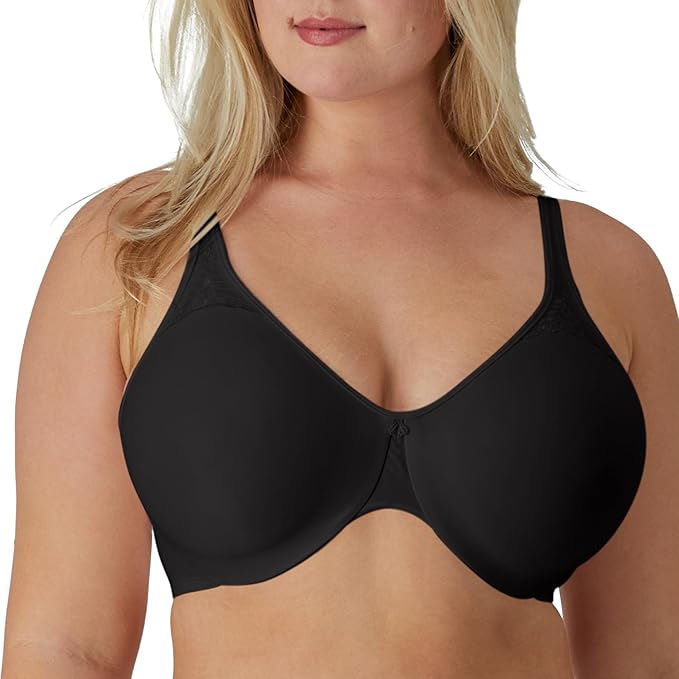
Bali Passion for Comfort Minimizer Bra
A current shopping option after sizing. Check the live listing’s own size chart before ordering.
Check on Amazon →As an Amazon Associate, Bra-Calculator.com earns from qualifying purchases. Price, availability and sizing can change.
Frequently Asked Questions
Are US and UK bra band sizes the same?
Yes. The band labels normally match directly: US 32 = UK 32, US 34 = UK 34, US 36 = UK 36. The main difference begins in the cup sequence above D/DD.
What is a US 34C in UK, EU, France and Australia?
A common conversion is US 34C = UK 34C = EU 75C = France 90C = Japan 75C = Australia/New Zealand 12C.
What is a US 34DD in the UK?
US 34DD commonly maps directly to UK 34DD. The larger naming split usually begins at the next cup step.
What is a US 34DDD or 34F in the UK?
In the common US sequence used on this page, US 34DDD/F maps to UK 34E.
What is a US 36G in UK sizing?
A common conversion is US 36G to UK 36F. In EU sizing, the same cup step is commonly 80G.
What is a UK 34FF in US sizing?
UK 34FF commonly maps to US 34H in the sequence shown here. US naming can vary by brand, so check the retailer before purchasing.
What is a US 34C in European sizing?
US 34C commonly converts to EU 75C.
What is a US 34C in French sizing?
US 34C commonly converts to France 90C. The French band is usually 15 higher than the equivalent EU band.
What is a US 34C in Australian sizing?
US 34C commonly converts to Australian/New Zealand 12C.
Why do EU bra bands look so different from US bands?
EU bands use a different retail-label scale. US/UK 34 and EU 75 sit on the same conversion row even though the numbers look unrelated.
Do Japanese bra sizes use the same system as Europe?
Japanese band labels often align numerically with EU bands, but cup labeling and product construction can differ. Check the Japanese brand’s own chart for the final decision.
Can I trust an international conversion chart for every brand?
Use it as a label reference. If the brand publishes a chart for the exact product line, that chart should be your final check because cup naming and fit can vary.
Why does the same converted size fit differently in another brand?
The label can be equivalent while the garment is not. Wire width, cup depth, strap position, fabric stretch and pattern shape can change how two bras fit.
Should I sister-size when converting countries?
No, not automatically. Convert the same size first. Sister sizing is a separate fit adjustment used only if the band feels too tight or too loose while cup volume is close.
Want the Conversion Without Reading the Tables?
Use this page when you want to understand the systems. Use the dedicated converter when you already know one size and simply need the matching label in another country.
Open Global Bra Size Converter →