34G vs 36F: Are They Sister Sizes? Same Cup Volume, Different Band Explained (2026)
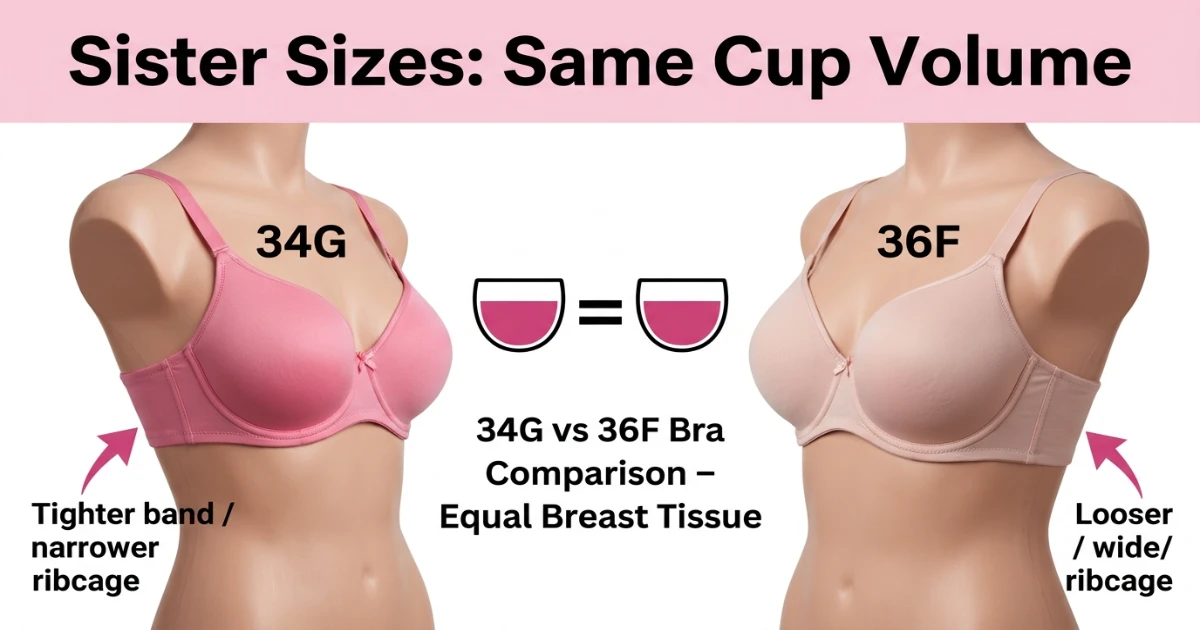
Quick Answer: Yes — 34G and 36F are sister sizes. They hold approximately the same cup volume on different band sizes. Going up one band from 34 to 36 and dropping one cup letter from G to F follows the sister size rule exactly, preserving cup volume. The difference between them is entirely in the band: 34G is tighter for a narrower ribcage; 36F is looser for a wider one. Neither is correct for everyone — your underbust measurement decides which fits.
✅ This is a confirmed sister size comparison. Unlike same-letter comparisons such as 34G vs 36G — where the same letter on a larger band produces more cup volume — 34G and 36F follow the sister size rule and hold equivalent breast tissue volume. The band is the only meaningful difference between them.
Choose the fit signs you notice in the band, cups, center and straps. We’ll turn them into a practical next step for 34G.
Private fit check — your answers stay in your browser and are used only for this on-page guidance. Nothing is stored or submitted.
⚡ Key Takeaways
- Sister sizes: 34G and 36F hold approximately equal cup volume — they belong to the same volume family.
- Band is the only real difference: 34G fits ~29–30″ (74–76 cm) underbust; 36F fits ~31–32″ (79–81 cm) underbust.
- Same cup volume, different fit: The 34G band anchors more firmly; the 36F band sits wider and looser.
- UK sizing diverges here: US 34G = UK 34F; US 36F = UK 36E — cup letters shift above DD.
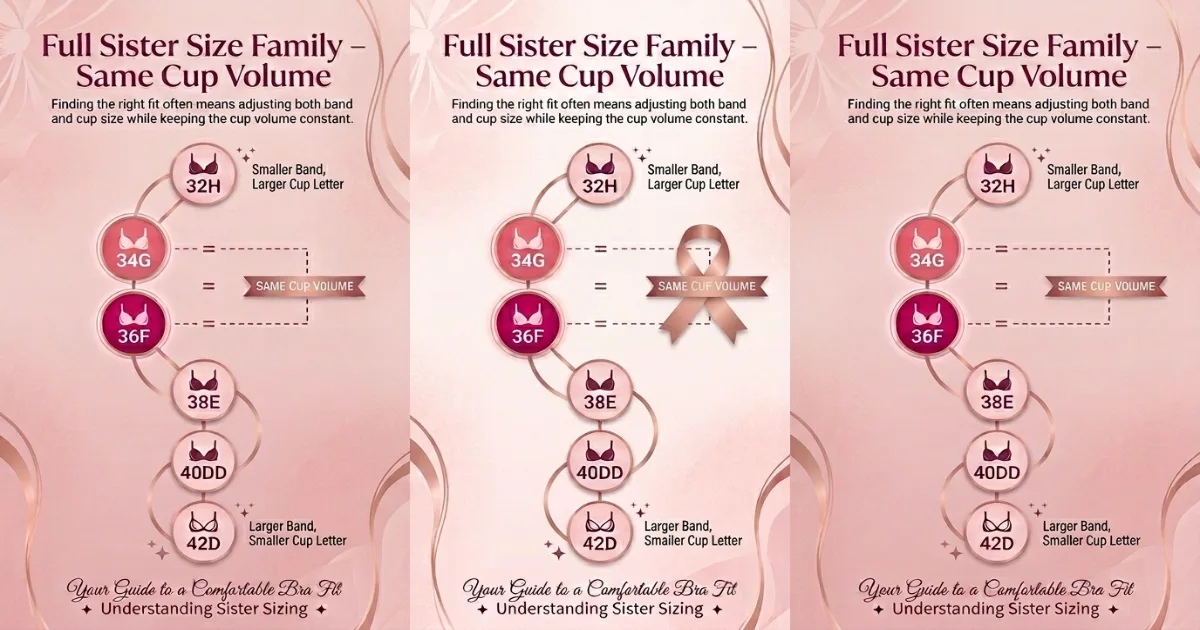
- Full sister size family: 32H — 34G — 36F — 38E — 40DD — 42D.
- Correct substitution: If 34G is unavailable, 36F is the right swap — not 36G.
- Underwire width increases with band: The 36F underwire is wider to match a broader chest wall.
- Support depends on band fit: On the correct ribcage, both sizes perform equally — measure first.
Why 34G and 36F Hold the Same Cup Volume
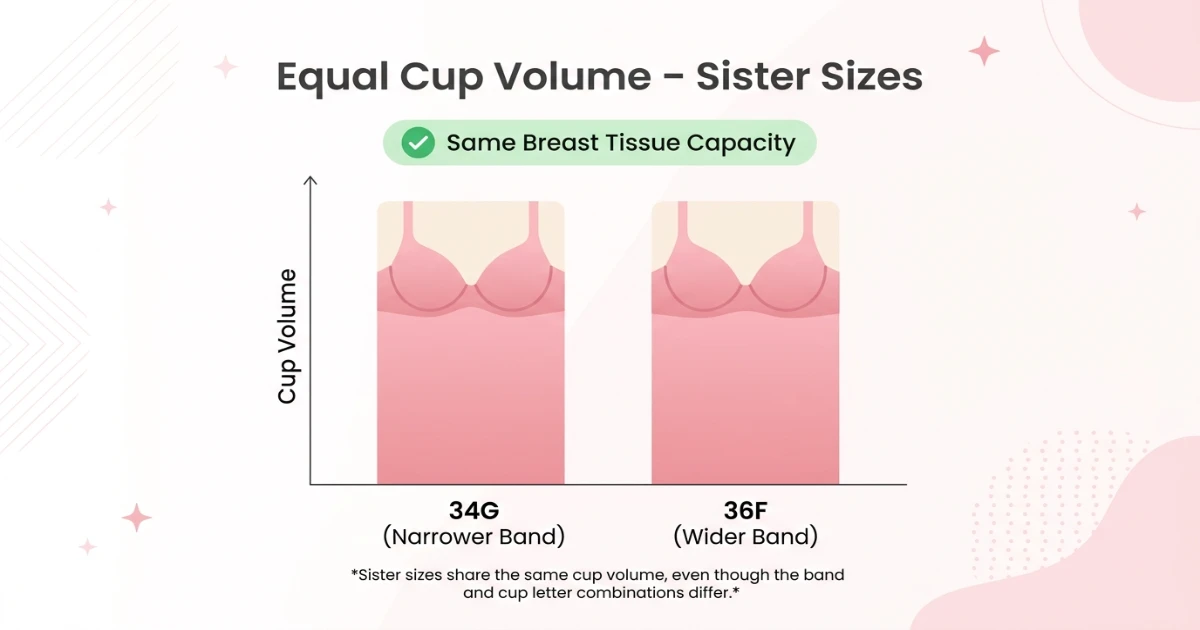
Cup letters in bra sizing are ratios, not fixed measurements. Each letter represents the number of inches by which the bust exceeds the underbust. The key insight behind sister sizing is that when the band increases by one size — adding approximately 2 inches of circumference to the base — dropping one cup letter offsets that increase, keeping the total enclosed volume roughly constant.
- 1″ = A | 2″ = B | 3″ = C | 4″ = D | 5″ = DD | 6″ = DDD/F | 7″ = G | 8″ = H
A 34G means the bust is 7 inches larger than the underbust on a 34-inch frame. A 36F means the bust is 6 inches larger than the underbust on a 36-inch frame. The wider base of the 36 frame compensates for the smaller cup differential — producing a cup space that contains approximately the same breast tissue volume as the 34G.
The Volume Equivalence Visualised
≈ Equal cup volume — same sister size family
The critical distinction: this is not the same as comparing 34G to 36G. Moving to 36G while keeping the G letter would add one full cup size of volume on top of the wider band — a significantly larger bra. 36F is the correct sister, not 36G. See our cup size visuals page for a detailed breakdown of how volume changes across band and cup combinations.
Measurement Breakdown: 34G vs 36F
| Size | Underbust (Band) | Bust (Fullest Point) | Cup Difference | Cup Volume |
|---|---|---|---|---|
| 34G | ~29–30″ (74–76 cm) | ~37″ (94 cm) | 7″ (18 cm) | ≈ Equal ↔ |
| 36F | ~31–32″ (79–81 cm) | ~38″ (97 cm) | 6″ (15 cm) | ≈ Equal ↔ |
The cup differential numbers differ — 7 inches for 34G versus 6 inches for 36F — but the wider circumference of the 36 band compensates, producing approximately equivalent enclosed volume. This is the mathematical basis of sister sizing: the ratio changes, but the total cup space stays constant across sister pairs.
UK sizing: US 34G = UK 34F; US 36F = UK 36E. EU sizing: US 34G ≈ EU 75G; US 36F ≈ EU 80F. Cup letter conventions diverge significantly above DD across regions — always verify with the specific brand’s conversion chart before ordering. Use our international size charts for full reference.
The Sister Size Family: Where 34G and 36F Both Belong
Because 34G and 36F hold the same cup volume, they sit on the same rung of the same sister size ladder. Every size in the chain below holds approximately equal breast tissue volume — the band changes, the cup letter adjusts, but the total enclosed space remains constant throughout.
34G / 36F Sister Size Family
Every size in this chain is a valid substitute for 34G or 36F in terms of cup volume. The practical substitutes most women reach for are the immediate neighbours: 32H (tighter band, same volume as 34G) and 38E (looser band, same volume as 36F). Moving more than one step from your correct band size is rarely a comfortable solution — the band will anchor poorly even if the cup fills correctly. Explore the full logic on our sister sizes guide or use the sister size bra calculator to generate your own ladder.
Real Fit Differences Between 34G and 36F
Band Fit: Where the Two Sizes Actually Differ
Cup volume is equivalent between 34G and 36F, but band performance is not. A 34G band is engineered for a 29–30 inch ribcage — it grips firmly, runs level front to back, and anchors the substantial weight of a G cup breast without transferring load to the shoulder straps. On a 31–32 inch ribcage, the same 34G band will feel uncomfortably tight from the first wear, potentially causing red marks under the arms and difficulty breathing deeply.
The 36F band is built for a 31–32 inch ribcage and delivers the same anchoring function on that wider frame. On a 29–30 inch ribcage, it will ride upward at the back within hours — and at G/F cup sizes, where breast tissue is heavy, that band failure translates directly into aching shoulders, posture strain, and bra straps that dig in by midday. Band fit is non-negotiable at this cup size. Never compromise on it to avoid ordering a less common size.
Underwire Width and Breast Root
The 34G underwire is set for a narrower chest wall — the wire channel is positioned closer to the centre and curves forward more steeply. The 36F underwire is wider, designed for breast tissue that roots more broadly across a larger ribcage and spreads more laterally toward the armpits. Wearing a 36F when you have a 34-inch ribcage means the wire ends will extend onto bare ribcage beyond your breast tissue — the leading cause of side-poking and underarm irritation that many large-cup wearers mistakenly attribute to the cup being wrong. It is almost always a band width problem. See our bra fit problems guide for a complete diagnosis checklist.
Cup Shape and Projection
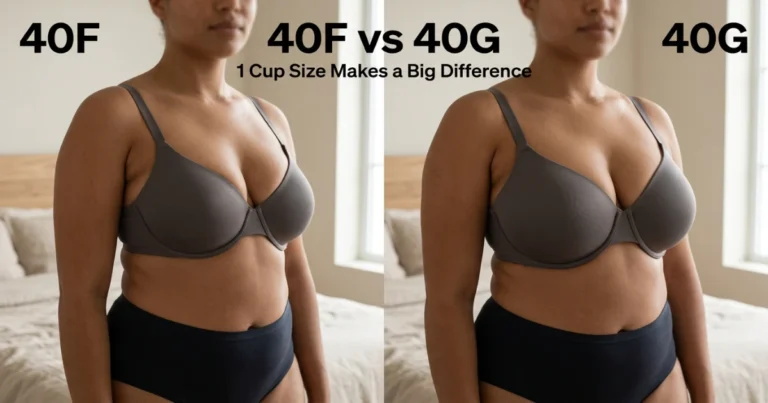
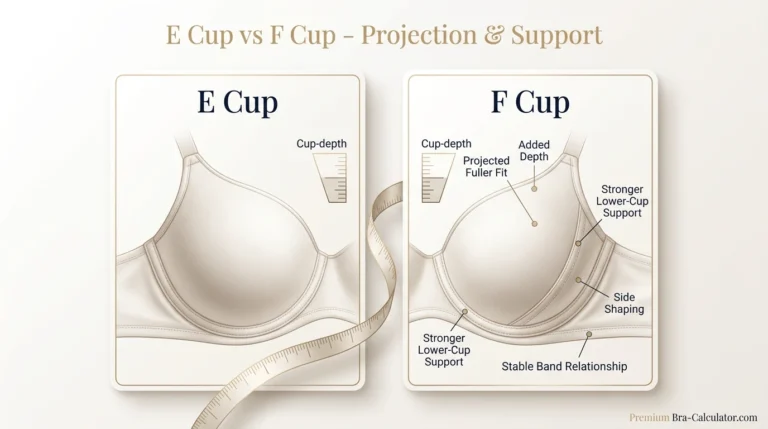
On a narrower 34-inch frame, the G cup sits with more forward projection relative to the body — the tissue is supported centrally on a tighter base. On a wider 36-inch frame, the F cup distributes the same volume more broadly, with the cups sitting slightly more to the sides. Neither shape is objectively better; both are correct for their respective frame widths. Women with narrow, projected breast shapes typically find the 34G geometry more accurate to their tissue distribution; women with wide, shallow or side-set breasts often find the 36F underwire channel better follows their natural breast boundary.
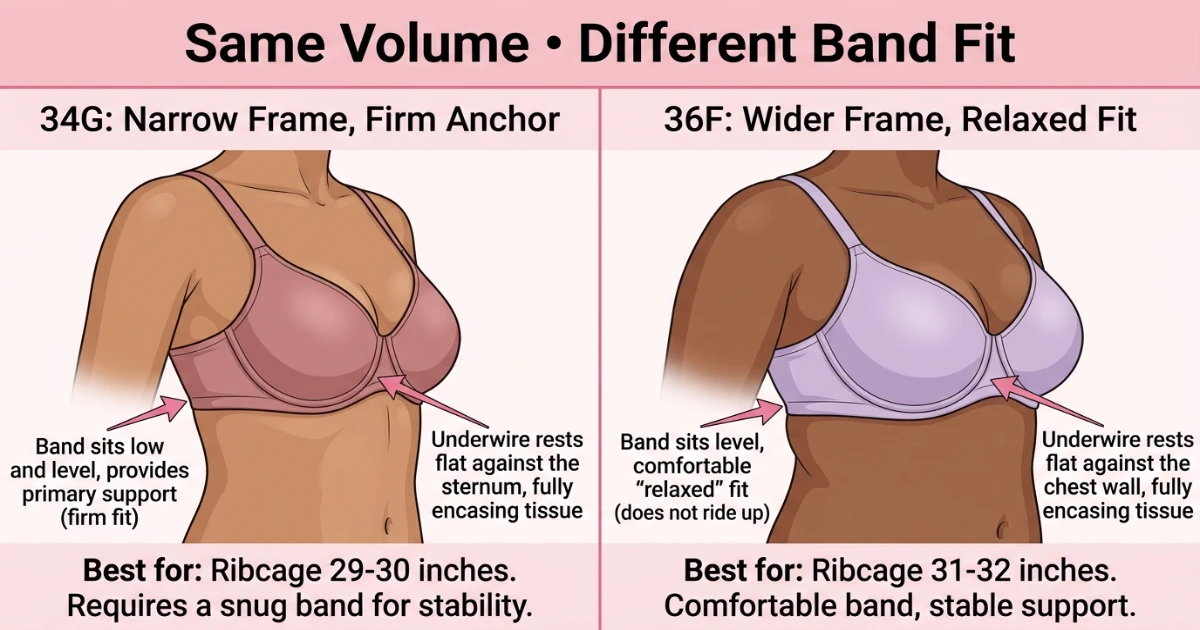
Who Should Choose 34G?
- Underbust measurement approximately 29–30 inches (74–76 cm) snugly measured.
- Bust measurement at the fullest point of approximately 37 inches (94 cm) — a 7-inch differential.
- Previously tried a 36F and experienced the band riding up the back by midday or early afternoon.
- Breast tissue sits close-set or projected on a narrower chest wall — the 34G underwire follows this contour correctly.
- Current 34G band feels correct but cups slightly overflow → try 34H on the same band, not 36F.
- In UK sizing, shop for 34F when buying from British brands such as Freya, Panache, or Curvy Kate.
Confirm your correct fit at our how to know your bra fits page.
Who Should Choose 36F?
- Underbust measurement approximately 31–32 inches (79–81 cm) snugly measured.
- Bust measurement at the fullest point of approximately 38 inches (97 cm) — a 6-inch differential on the wider frame.
- Previously tried a 34G and found the band constricting or leaving deep red marks under the arms from day one.
- Breast tissue has a wider root and spreads toward the underarms — the 36F underwire width matches this distribution better.
- Current 36F band feels correct but cups slightly overflow → try 36G on the same band, not a different sister size.
- In UK sizing, shop for 36E when buying from British brands.
Use our breast shape identifier and size charts to verify your best fit.
🛍️ Best Bras for 34G and 36F — Our Top Picks
G and F cup wearers need bras engineered specifically for high-volume busts — wide underwires, reinforced side panels, cushioned straps, and bands that remain level under sustained load. These two highly rated options on Amazon are available in both 34G and 36F and are built to the structural demands of this cup range.


ℹ️ As an Amazon Associate, Bra Calculator earns from qualifying purchases. Product availability and pricing subject to change.
The Sister Size Rule Applied to 34G and 36F
| Comparison Type | Example | Same Volume? | Relationship |
|---|---|---|---|
| Band up + Cup letter down | 34G → 36F | ✅ Yes | Sister sizes — equal volume |
| Band up, same cup letter | 34G → 36G | ❌ No | 36G is larger — one full cup above 34G |
| Band down + Cup letter up | 34G → 32H | ✅ Yes | Sister sizes — equal volume |
| Band up + Cup letter up | 34G → 36H | ❌ No | 36H is larger still — two full sizes up |
| Same band, cup up | 34G → 34H | ❌ No | 34H is one full cup larger on the same band |
| Same band, cup down | 34G → 34F | ❌ No | 34F is one full cup smaller on the same band |
The only correct band-change substitute for a 34G is 36F — up one band, down one cup letter. Moving to 36G adds both a wider band and more cup volume simultaneously, which is never a sister size swap. When 34G is out of stock, 36F gives you the closest possible fit; when 36F is out of stock, 34G gives you the closest alternative.
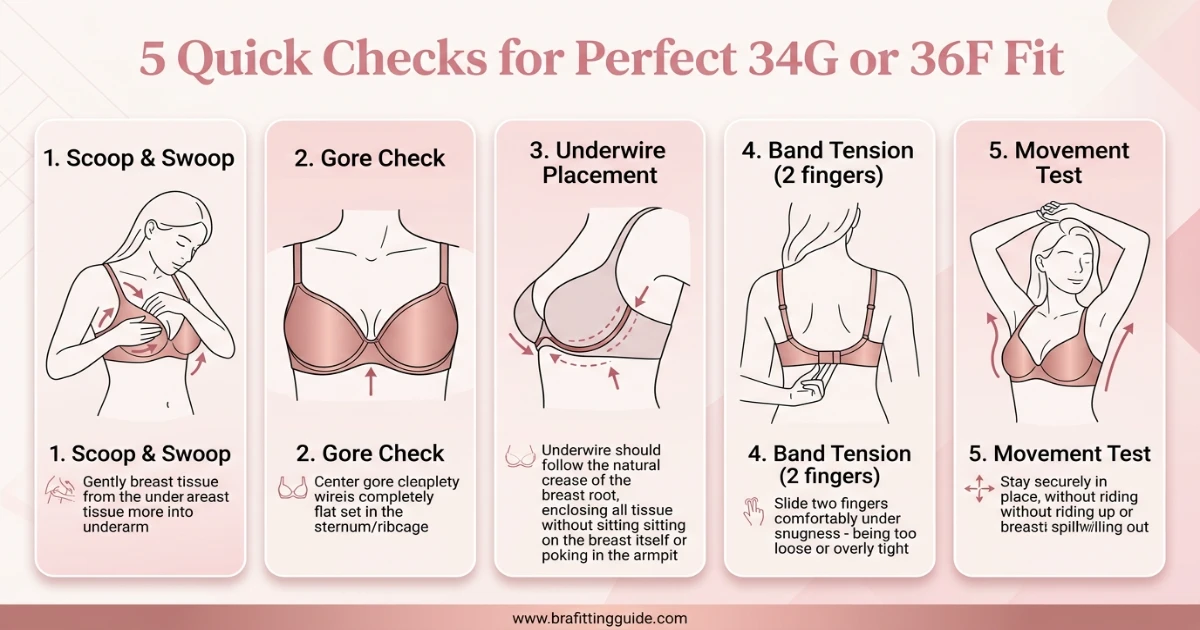
Quick Bra Fit Test: 5 Checks for G and F Cup Wearers
At G and F cup sizes, fit errors are amplified — the weight of the bust makes even minor band looseness immediately apparent, and cup volume at this size means tissue displacement causes visible discomfort within the hour. Run these five checks every time you try a new size or brand.
Lean forward and scoop all breast tissue — including the significant side fullness that migrates toward the armpits at G and F cup sizes — fully forward and upward into the cup. Overflow at top or sides after scooping means cup too small: go up one cup letter on the same band (34G → 34H or 36F → 36G). Wrinkling fabric means cup too large: go down one letter.
The centre gore must lie completely flat against the sternum throughout the day, not just when first put on. At G and F cup sizes, a floating gore is an unambiguous sign that the cup is too small. Go up one cup letter on the same band before making any other adjustment. This check takes precedence over all other signals at this cup size.
The underwire must encircle all breast tissue completely and rest entirely on firm ribcage at every point. At G and F cup sizes, check wire width specifically: the wire should begin and end precisely at the natural outer edge of your breast tissue. Wire sitting on bare ribcage beyond the breast = underwire too wide, likely from a 36F on a 34-inch ribcage — try 34G. Wire pressing into side breast tissue = too narrow, try 36F or a wide-wire specialist style.
On the loosest hook, slide two fingers under the back band — you must feel firm, consistent resistance. G and F cup breasts are heavy. A band that is even slightly too loose at this cup size will transfer the full weight of the bust to the shoulder straps within the first hour, causing shoulder pain, posture changes, and strap dig-in that no amount of tightening resolves permanently. The band, not the straps, carries 80% of the load when correctly fitted.
Raise arms overhead, twist side to side, walk briskly for 60 seconds. In a correctly fitted G or F cup bra, the band stays completely level all around, cups remain fully in position, and straps stay on the shoulders without digging in or slipping. Any downward shift of the cups means the band is too loose — this is a band problem, not a strap problem. Do not tighten straps to compensate for a loose band at this cup size.
Still unsure whether 34G or 36F — or a completely different size — is right for your measurements? Get a precise answer in seconds.
Try the AI-Powered Bra Size Calculator →34G vs 36F: Full Side-by-Side Comparison
| Feature | 34G | 36F |
|---|---|---|
| Band Size | 34 (29–30″ / 74–76 cm underbust) | 36 (31–32″ / 79–81 cm underbust) |
| Cup Letter (US) | G — 7″ (18 cm) over underbust | F (DDD) — 6″ (15 cm) over underbust |
| Cup Letter (UK) | F | E |
| EU Approximate | 75G | 80F |
| Cup Volume | ≈ Equal ↔ | ≈ Equal ↔ |
| Bust Measurement | ~37″ (94 cm) | ~38″ (97 cm) |
| Sister Size? | ✅ Yes — same volume family | |
| Underwire Width | Narrower — close-set breast root | Wider — broader breast root |
| Band Tightness | Tighter — correct for 29–30″ ribcage | Looser — correct for 31–32″ ribcage |
| Full Sister Family | 32H — 34G — 36F — 38E — 40DD — 42D | |
| If cups too small | Try 34H (same band, next cup) | Try 36G (same band, next cup) |
| If cups too large | Try 34F (same band, prior cup) | Try 36E (same band, prior cup) |
| If band too tight | Try 36F (sister size — same volume) | Try 38E (sister size — same volume) |
| If band too loose | Try 32H (sister size — same volume) | Try 34G (sister size — same volume) |
| Best For | Underbust ~29–30″, narrow chest wall | Underbust ~31–32″, wider chest wall |
| Availability | Specialty retailers and online | Wider availability — more mainstream stocking |
People Also Ask: 34G vs 36F — Answered
Are 34G and 36F the same size?
34G and 36F are sister sizes — they hold approximately the same cup volume on different band sizes. The band is wider in the 36F, and the cup letter is smaller, but the two changes cancel each other out in terms of enclosed volume. They are not identical bras: band fit and underwire width differ meaningfully. The correct size depends entirely on your underbust measurement.
Are 34G and 36F sister sizes?
Yes — 34G and 36F are confirmed sister sizes. Moving up one band from 34 to 36 and dropping one cup letter from G to F follows the sister size rule exactly. They share the same sister size family: 32H, 34G, 36F, 38E, 40DD, 42D. All sizes in that chain hold approximately equal cup volume.
Which is bigger — 34G or 36F?
Neither holds more cup volume — they are sister sizes with approximately equal breast tissue capacity. The 36F bra is physically wider due to its larger band, but the enclosed cup space is equivalent. On a narrow frame, the 34G cups appear more projected; on a wider frame, the 36F distributes the same volume differently. Volume is equal; fit is not — that depends on your ribcage.
Can I substitute 36F for 34G?
Yes — 36F is the correct sister size substitute when your 34G is unavailable. Cup volume will be approximately equal. The 36F band is 2 inches wider, which means it will feel looser on a 29–30 inch ribcage. If the looser band causes the bra to ride up your back during the day, return to 34G — the band fit is not correct on your frame regardless of the cup volume match.
What is 34G in UK sizing?
34G in US sizing is equivalent to 34F in UK sizing. US and UK cup letters diverge above DD: the US scale goes DD, DDD/F, G, H while the UK scale goes DD, E, F, FF, G, GG. US G corresponds to UK F. When shopping Freya, Panache, Curvy Kate, Elomi, or any other UK brand, a US 34G wearer should look for 34F.
What is 36F in UK sizing?
36F in US sizing is equivalent to 36E in UK sizing. US F (also labelled DDD) corresponds to UK E. The UK sister size of 36E is 34F UK — which is the same bra as US 34G. This confirms the sister size relationship: UK 34F and 36E are sisters, just as US 34G and 36F are sisters.
My 34G band feels too tight — should I try 36F or 36G?
If your 34G band feels too tight but the cups fit correctly, try 36F — not 36G. The 36F is the sister size: it gives you the next band size up while preserving the same cup volume. Moving to 36G would give you a wider band AND more cup volume simultaneously, which is only correct if both your band and cups are too small. Change one variable at a time.
My 36F cups feel too small — should I try 36G or 34G?
If your 36F cups feel too small but the band fits correctly, try 36G on the same band. Do not switch to 34G — that has less cup volume than your 36F, not more. 34G is the sister size down from 36F (tighter band, same volume). Going to 34G when your cups are overflowing gives you a tighter band with no additional cup space, which solves neither problem.
Is 34G a common bra size?
34G is considered a large cup size on a relatively narrow band — a combination that mainstream retailers stock inconsistently. Budget chains and department stores rarely carry it. Specialist full-bust brands (Freya, Elomi, Panache, Goddess) and online retailers offer the widest selection. If you struggle to find 34G in stores, its sister size 36F has broader mainstream availability, though the band fit will be looser on a 29–30 inch ribcage.
How do I know my correct bra size?
Measure your underbust snugly for your band and your bust at the fullest point for your cup. Subtract underbust from bust — a 7-inch differential = G cup on any band; a 6-inch differential = F cup. Verify fit with five checks: level band, flat gore, underwire on ribcage matching breast root width, two fingers under back band, no movement during activity. Use our bra size chart calculator for a measurement-based recommendation.