30DDD vs 32DD: Sister Size Guide — Same Cup, Different Band
Updated 2026 · Expert bra-fit reviewed · 8-minute read
Choose the fit signs you notice in the band, cups, center and straps. We’ll turn them into a practical next step for 30DDD.
Private fit check — your answers stay in your browser and are used only for this on-page guidance. Nothing is stored or submitted.
Quick Answer
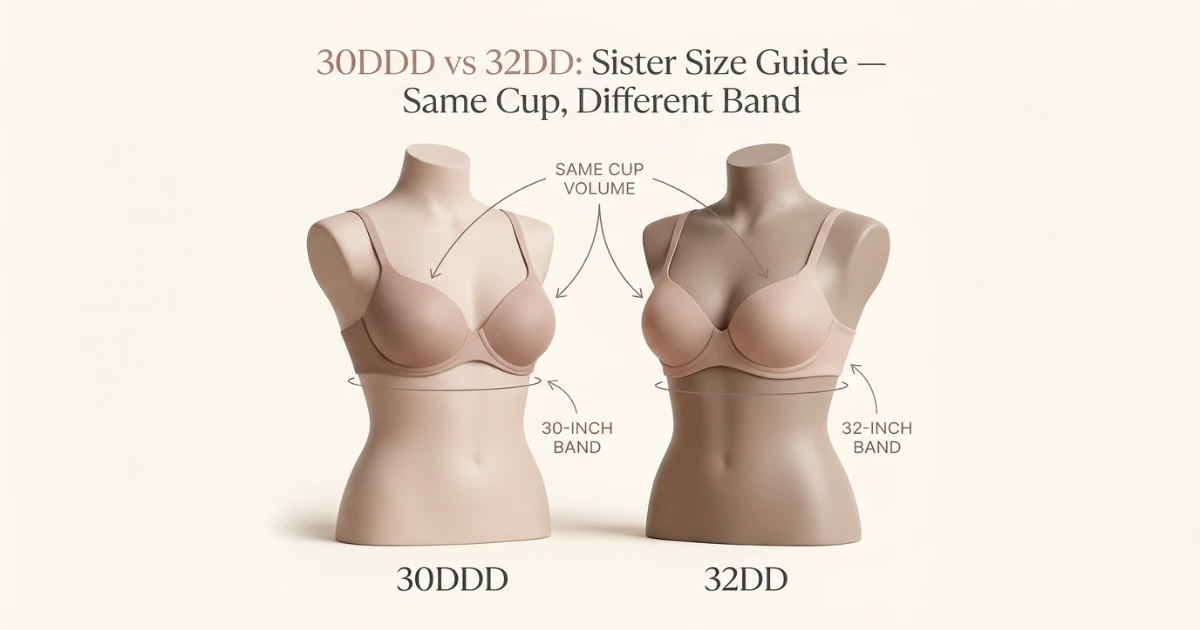
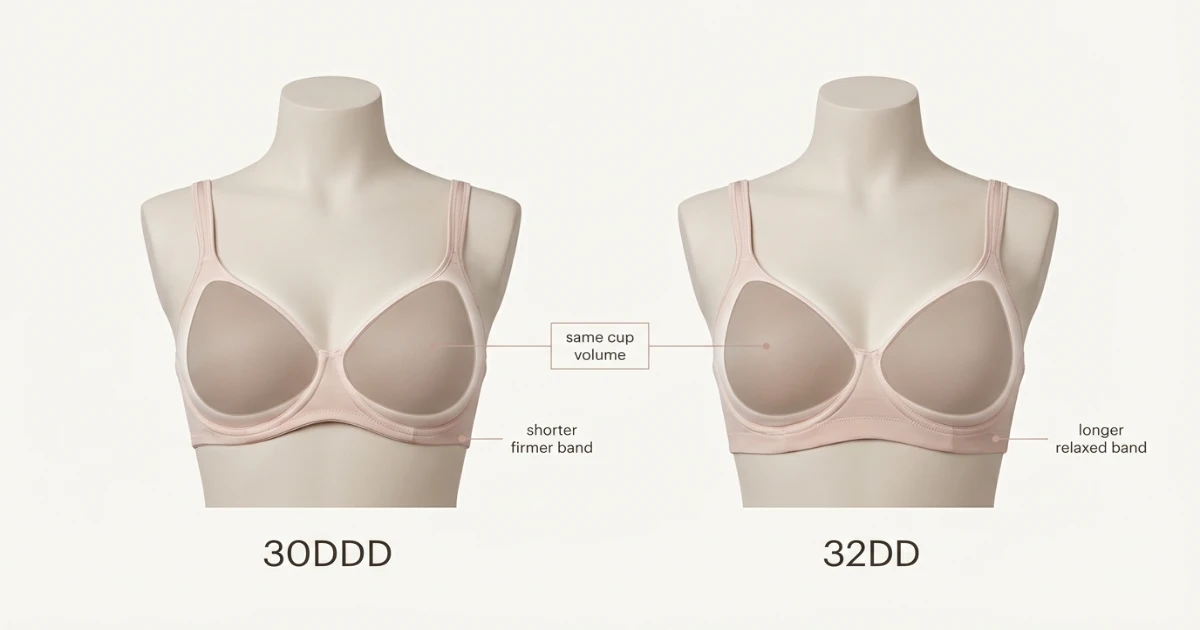
30DDD and 32DD are sister sizes — they hold the same cup volume. The only meaningful difference is the band: a 30DDD wraps around a 30-inch rib cage with a firm fit, while a 32DD accommodates a 32-inch rib cage with a slightly relaxed feel. If your 30DDD band is uncomfortably tight but your cups fit well, sizing out to 32DD gives you the same cup room with a looser, more comfortable band. Conversely, if your 32DD band rides up, a 30DDD will feel more supportive without changing what your cups look or feel like.
Key Takeaways
- 30DDD and 32DD are confirmed sister sizes — the cup volume in both is mathematically identical.
- The band difference is exactly 2 inches: 30 vs 32 inches around the rib cage.
- Moving from 30DDD to 32DD gives a looser band; moving the other way gives a firmer band.
- DDD (US) = F (UK/AU) — so 30DDD is the same as 30F in UK sizing.
- Sister sizing is useful when your exact size is out of stock or you need to fine-tune band tightness.
- The cup letter changes (DDD → DD) when the band goes up, but cup volume remains constant.
- Use the Sister Size Bra Calculator to instantly find all equivalents for your size.
Understanding Sister Sizes
Sister sizes are pairs (or groups) of bra sizes that contain the same total cup volume even though the band number and cup letter are both different. The principle behind them is simple: when you increase the band by one step (2 inches), you decrease the cup letter by one step to maintain the same volume — and vice versa.
This works because cup letters are relative to the band size, not absolute measurements. A DD cup on a 32-inch band encloses exactly the same amount of space as a DDD cup on a 30-inch band, because the larger band offsets the smaller letter.
The simple rule: Go up one band size → go down one cup letter to keep the same volume. Go down one band size → go up one cup letter to keep the same volume. A full explanation with interactive examples is available in the sister sizes guide.
Sister sizing is most useful in three situations: when your exact size is not available in the style you want; when you want a tighter or looser band feel without changing how your cups fit; or when you’re between sizes and trying to decide which direction to round. However, sister sizes are not a permanent replacement for your true size — they’re a fit tool, not a shortcut. To find your actual measurements, visit the how-to-measure guide.
Measurement Breakdown: 30DDD vs 32DD
Here is how both sizes map to standard measurement formulas:
| Measurement | 30DDD | 32DD |
|---|---|---|
| Band size | 30 inches | 32 inches |
| Bust–band difference | 5 inches | 5 inches |
| Approximate full bust | ~35 inches | ~37 inches |
| Cup letter (US/CA) | DDD | DD |
| Cup letter (UK/AU) | F | E |
| Cup volume | Equal | Equal |
| Sister size relationship | ✓ Confirmed sister sizes | |
Notice that the full bust measurement differs by approximately 2 inches between the two sizes. This is because the larger band already adds circumference — the cups don’t need to add extra projection to reach the same volume. This is one reason why shopping with your band measurement as a reference (rather than your full bust alone) is so important. The bra size charts offer a complete breakdown across all sizes.
Band Difference: What 2 Inches Actually Feels Like
The 2-inch difference between a 30 and 32 band might sound small, but on the body it produces a noticeable change in how firmly the bra anchors to your torso — and anchoring is everything in bra fit.
Ideal for 28–30″ rib cage
Ideal for 30–32″ rib cage
In a well-fitted bra, the band provides 80% of all support. A band that is too loose — even by 2 inches — shifts that load onto the straps and cups, which causes shoulder digging, cup distortion, and back-of-band riding. Here’s what to expect from each band size in everyday wear:
30-inch band (30DDD):
- Feels firm and close to the body; may feel restrictive if your rib cage measures closer to 31–32 inches.
- Stays in place all day without riding up the back.
- Provides maximum lift and upward support from the band alone.
- Should fit on the loosest hook when new, with room to tighten as the band stretches over time.
32-inch band (32DD):
- Feels comfortable and breathable; may feel loose if your rib cage measures closer to 29–30 inches.
- More forgiving for fluctuating rib cage measurements (bloating, breathing, posture shifts).
- Better choice if you find 30-inch bands leave red marks after extended wear.
- Should also fit on the loosest hook when new.
If you experience persistent band-fit problems — riding up, digging in, or the band twisting — the bra fit problems guide covers the most common band issues and their solutions.
Cup Volume Comparison: Are the Cups Really the Same?
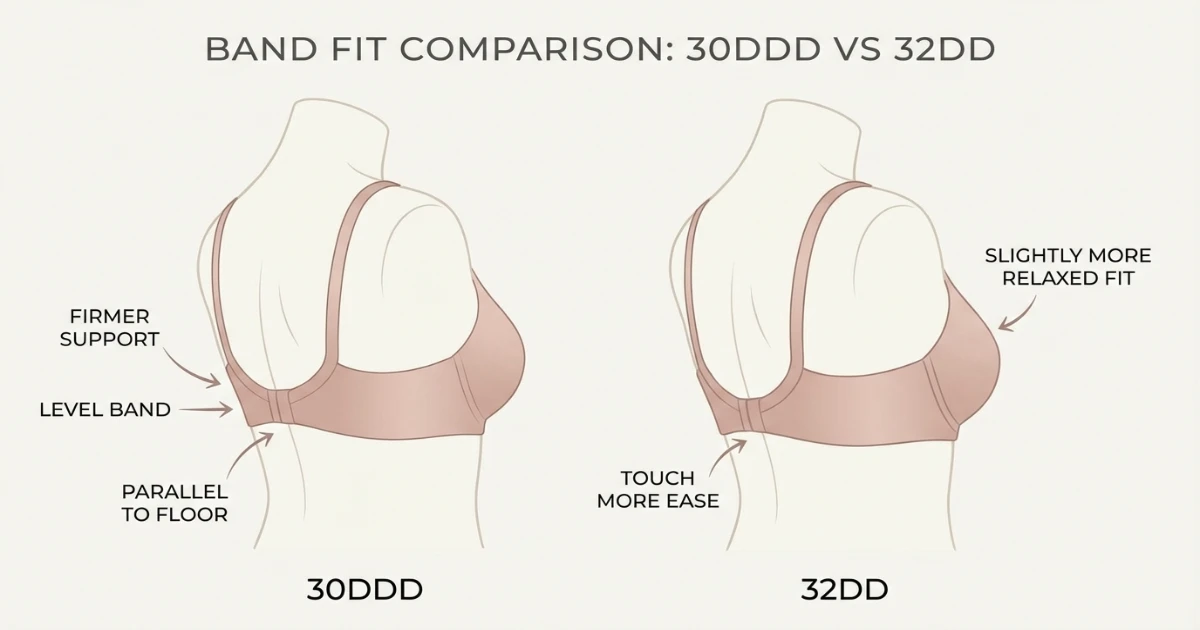
Yes — with one important clarification. The total enclosed volume is the same, but the cup shape may differ slightly between the two sizes depending on the brand and style. Here is why:
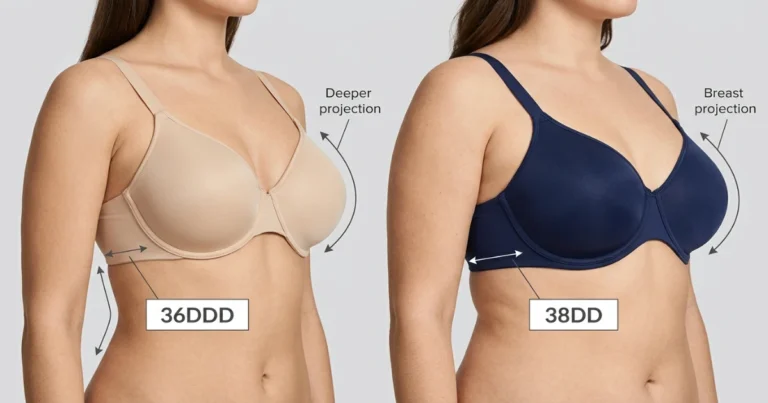
- Projection vs spread: On a narrower 30-inch band, cups tend to be more projected (deeper front to back) and narrower side to side. On a 32-inch band, the same volume is distributed across a slightly wider base, so cups may appear shallower and wider.
- Underwire width: The underwire in a 32DD will typically be about 1–1.5 cm wider than in a 30DDD, which matters for women with a wide breast root.
- Strap placement: Straps sit slightly further apart on the wider 32 band, which can affect how they sit on the shoulders.
In practical terms, if you have narrow-set, projected breasts you may find 30DDD cups suit your shape better — even if 32DD offers technically equivalent volume. Conversely, wide-set breasts may find the broader 32DD underwire more comfortable. The cup size visuals guide shows how different breast shapes interact with cup depth and width.
Key insight: Sister sizing works best as a band-comfort adjustment. If your cups fit in 30DDD but your band is the problem, 32DD is a reliable fix. If your cups also have fit issues, a fresh measurement is the better starting point — try the AI Smart Fit Bra Calculator for a personalized recommendation.
Fit Differences You’ll Actually Notice
Beyond the numbers, here is what distinguishes daily life in a 30DDD versus a 32DD:
You may prefer 30DDD if:
- Your rib cage measures between 28 and 30 inches snugly under the bust.
- You participate in high-impact activities (running, HIIT) and want maximum band anchoring.
- You’ve tried a 32DD and the band rides up toward your shoulder blades within hours.
- You prefer a firm, “barely there” feeling of support where the band does most of the work.
- Shoulder straps dig in when wearing a 32DD — a classic sign the looser band is offloading weight upward.
You may prefer 32DD if:
- Your rib cage measures between 30 and 32 inches snugly under the bust.
- Your 30DDD band leaves visible red marks or indentations after a full day of wear.
- You feel short of breath or restricted in the 30DDD, particularly after meals or during seated activity.
- Your body fluctuates in size and you want band extenders to remain optional rather than necessary.
- Styles you love simply aren’t available in 30DDD and 32DD fits the cup well enough.
Who Should Choose 30DDD vs 32DD?
✓ Choose 30DDD if you…
- Measure 28–30″ at the rib cage under bust.
- Need firm band support for active or full days.
- Find 32″ bands consistently ride up your back.
- Have been measured as 30DDD or 30F (UK).
- Prefer close-fitting, high-support underwire styles.
- Your 32DD straps dig in from carrying band load.
✓ Choose 32DD if you…
- Measure 30–32″ at the rib cage under bust.
- Find the 30DDD band uncomfortably tight or restrictive.
- Notice red band marks or skin irritation after wear.
- Have been measured as 32DD or 32E (UK).
- Need more style choice (32DD has wider retail availability).
- Your body fluctuates and you need band flexibility.
Still uncertain? A two-measurement check takes under two minutes: measure your underbust snugly (band number) and your full bust relaxed, then subtract. If the gap is 5 inches and your band is near 30, you’re a 30DDD. If near 32, you’re a 32DD. Or skip the math entirely — the AI Smart Fit Bra Calculator does it for you and accounts for shape, preference, and style type.
Sister Size Ladder: The Full Equivalent Chain
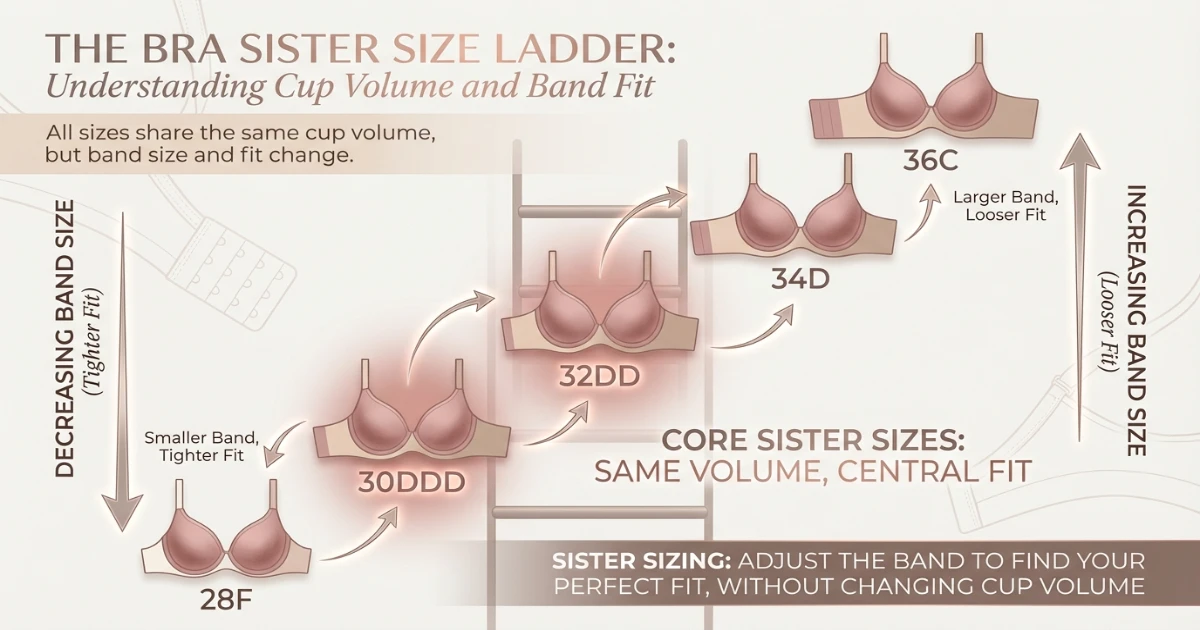
Both 30DDD and 32DD belong to the same sister size family. Here is the full ladder of equivalent cup-volume sizes, moving from the smallest band to the largest:
Moving up the ladder (larger band, smaller cup letter) gives progressively looser bands for the same cup volume. Moving down the ladder gives progressively firmer bands. As a rule of thumb, sister sizes more than two steps away from your true size will likely feel noticeably off — the band will be either too loose to support properly or too tight to wear comfortably all day. Explore the full interactive version at the sister sizes guide or run your measurements through the sister size bra calculator.
Quick Fit Test: 30DDD or 32DD?
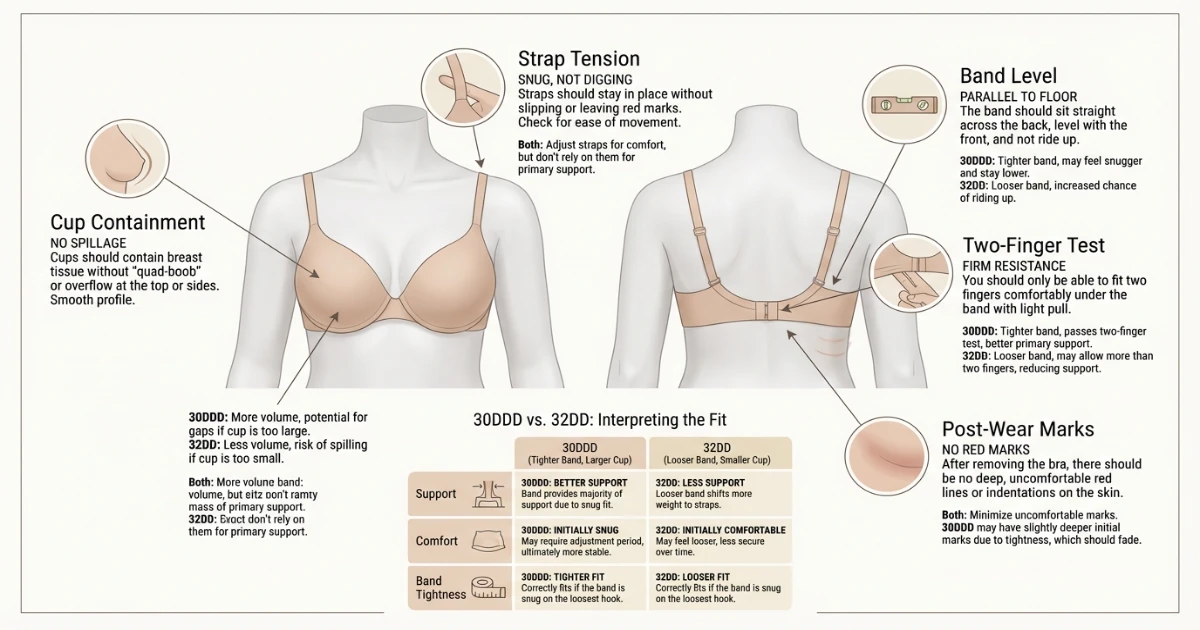
Put on your current bra and work through this five-point check to identify whether your size — or its sister — is the better fit:
- Band rise test: Lift both arms above your head. Does the back band stay level and horizontal? If it climbs toward your shoulder blades, the band is too large — try the 30DDD. If it stays put, the band size is working correctly.
- Two-finger test: Slide two fingers flat under the back band. They should slide in with mild resistance. Easy glide means the band is too large (consider 30DDD); you can’t fit two fingers means it’s too small (consider 32DD).
- Cup spillage test: Check for breast tissue overflowing the top or sides of the cup. If you overflow, you need a larger cup — but since both 30DDD and 32DD share the same cup volume, first confirm your band is correct before changing cup size.
- Strap test: Loosen your straps until they feel very slack. Does the bra still feel supportive? If it collapses immediately, the band is doing insufficient work — a sign the band may be too large and a firmer 30DDD is needed.
- Mark test: Remove the bra after 6+ hours of wear and check your rib cage. A faint pink line is normal. Deep red grooves or pressure marks that take more than 30 minutes to fade indicate the band is too tight — 32DD is the better choice.
For more detailed fit diagnostics and common bra problems, visit the bra fit problems guide.
30DDD vs 32DD: Full Comparison Table
| Feature | 30DDD | 32DD |
|---|---|---|
| Band measurement | 30 inches | 32 inches |
| Bust–band difference | 5 inches | 5 inches |
| Cup letter (US/CA) | DDD | DD |
| Cup letter (UK/AU) | F | E |
| Cup volume | Equal | Equal |
| Sister sizes | 28F · 34D · 36C | 28F · 30DDD · 34D |
| Band feel | Firm, close-fitting | Relaxed, more ease |
| Best rib cage measurement | 28–30 inches | 30–32 inches |
| Retail availability | Specialist retailers | Wider availability |
| UK equivalent | 30F | 32E |
| Cup projection tendency | Deeper, narrower | Slightly wider base |
| Ideal for | Firm support, active wear | All-day comfort, flexibility |
For a visual side-by-side across a wider range of sizes, the breast size comparison tool lets you explore how cup volume scales visually from size to size.
People Also Ask
Is 30DDD the same as 32DD?
Yes. 30DDD and 32DD are sister sizes, which means they contain the same cup volume. The difference is in the band: 30DDD has a 30-inch band for a firmer fit, while 32DD has a 32-inch band for a more relaxed fit. The cups enclose the same amount of breast tissue in both sizes.
What is the sister size of 30DDD?
The primary sister sizes of 30DDD are 28F (smaller band, larger cup letter) and 32DD (larger band, smaller cup letter). Extending further along the ladder: 34D and 36C also share the same cup volume. All of these sizes enclose equivalent breast volume, though band feel and cup shape will differ. Use the sister size bra calculator for the full list.
What is 30DDD in UK sizing?
30DDD (US) is equivalent to 30F in UK sizing. The UK sizing scale does not use DDD — it uses E for what the US calls DD, and F for what the US calls DDD. When shopping UK or European brands such as Freya, Panache, or Curvy Kate, look for 30F to find the same cup volume as a US 30DDD.
Should I size up to 32DD if my 30DDD band is too tight?
Yes — if the cups of your 30DDD fit well but the band leaves deep marks, feels restrictive, or is difficult to fasten, sizing out to 32DD is the correct sister-size adjustment. You will get the same cup volume with a 2-inch wider, more comfortable band. Make sure to start on the loosest hook in the new 32DD size.
Will sister sizing change how my cups look or feel?
Slightly. While the total cup volume is the same in sister sizes, the cup shape can vary. A 30DDD cup tends to be slightly more projected (deeper front to back) and narrower at the base. A 32DD cup distributes the same volume over a slightly wider base. Women with projected, narrow breasts may find 30DDD cups more comfortable; those with wide-set breasts may prefer the 32DD’s wider underwire.
Is 30DDD a hard size to find in stores?
30DDD is a narrow-band size that is not typically stocked in mainstream retail. Specialist lingerie brands — particularly UK-based labels like Freya, Panache, and Bravissimo, who list it as 30F — offer the widest selection. Online retailers with full-size-range inventory are usually the most reliable source. This is one practical reason why some women use 32DD as a mainstream-accessible sister size substitute.
How do I know if I need a 30DDD or a 32DD from measurements?
Measure your rib cage snugly just under the bust. If the number is close to 30 inches, you are likely a 30-inch band wearer (30DDD). If the number is close to 32 inches, a 32-inch band is your true fit (32DD). Both sizes require the same 5-inch bust–band difference for the cup to fit correctly. The measurement guide walks through the technique step by step.
Can I wear a 32DD if I normally wear a 30DDD?
Yes, but with caveats. A 32DD will feel noticeably looser in the band. If your actual rib cage measures 30 inches, the 32DD band may not provide adequate support and could ride up during wear. To compensate, some women tighten to the innermost hook — but this is a short-term fix, not ideal long-term. Sister sizing works best when your rib cage measurement falls between the two band sizes, or when the primary goal is finding a preferred style that isn’t available in 30DDD.
Related Bra Size Comparisons
Explore adjacent sister-size pairs and cup-volume comparisons to deepen your understanding of how bra sizing works across the scale:
The Bottom Line
30DDD and 32DD are genuine sister sizes — they hold exactly the same cup volume and differ only in how firmly they wrap around your torso. Choosing between them comes down to one number: your underbust measurement. If it falls near 30 inches, 30DDD gives you the snug, anchored support of a true 30-inch band. If it falls near 32 inches, 32DD delivers the same cup room with a band that won’t leave marks or feel restrictive through a long day.
When in doubt, measure first. A fresh underbust and full bust measurement takes less than two minutes and removes the guesswork entirely. Visit the how-to-measure guide for a full walkthrough, explore your sister size options with the sister size calculator, or let the AI Smart Fit Bra Calculator analyze your measurements and preferences to recommend the ideal size in under a minute.