30D vs 32C: Are These Sister Sizes?
If you have ever gone up a band size and wondered which cup letter to pair it with, or if someone told you that 30D and 32C hold the same amount of breast tissue, you have landed in exactly the right place. These two sizes are genuine sister sizes — but that does not mean they feel identical on your body. This guide explains exactly what they share, where they diverge, and how to decide which one actually belongs in your drawer.
Choose the fit signs you notice in the band, cups, center and straps. We’ll turn them into a practical next step for 30D.
Private fit check — your answers stay in your browser and are used only for this on-page guidance. Nothing is stored or submitted.
Quick Answer
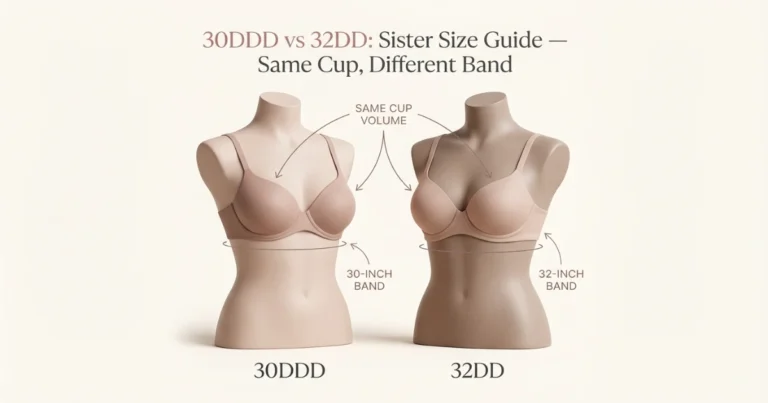
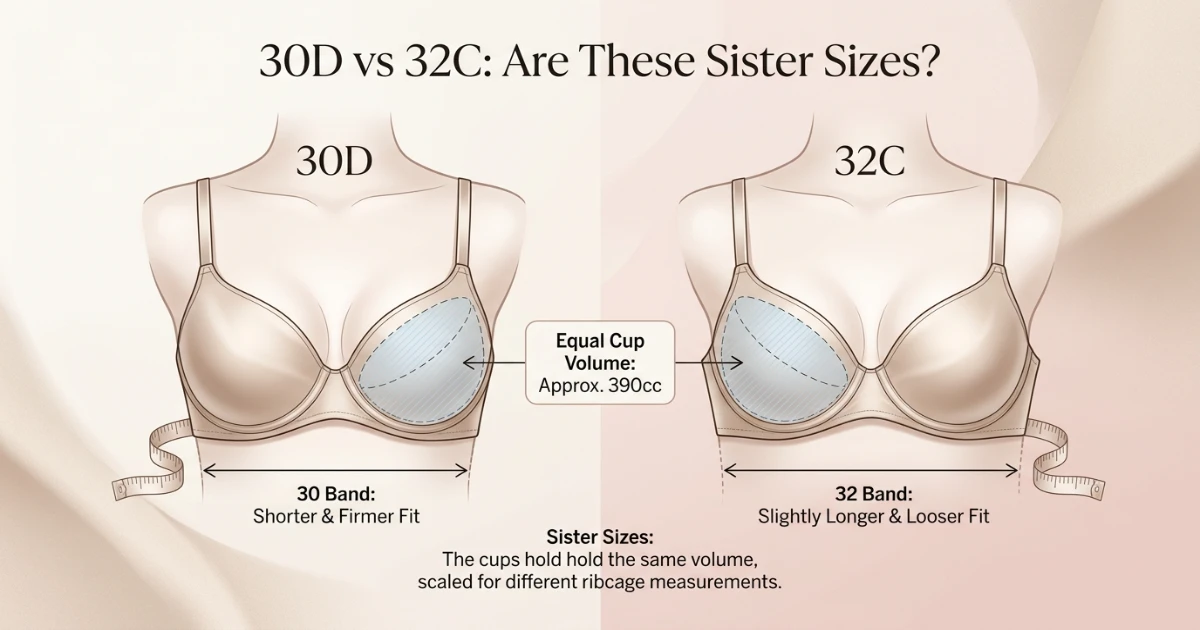
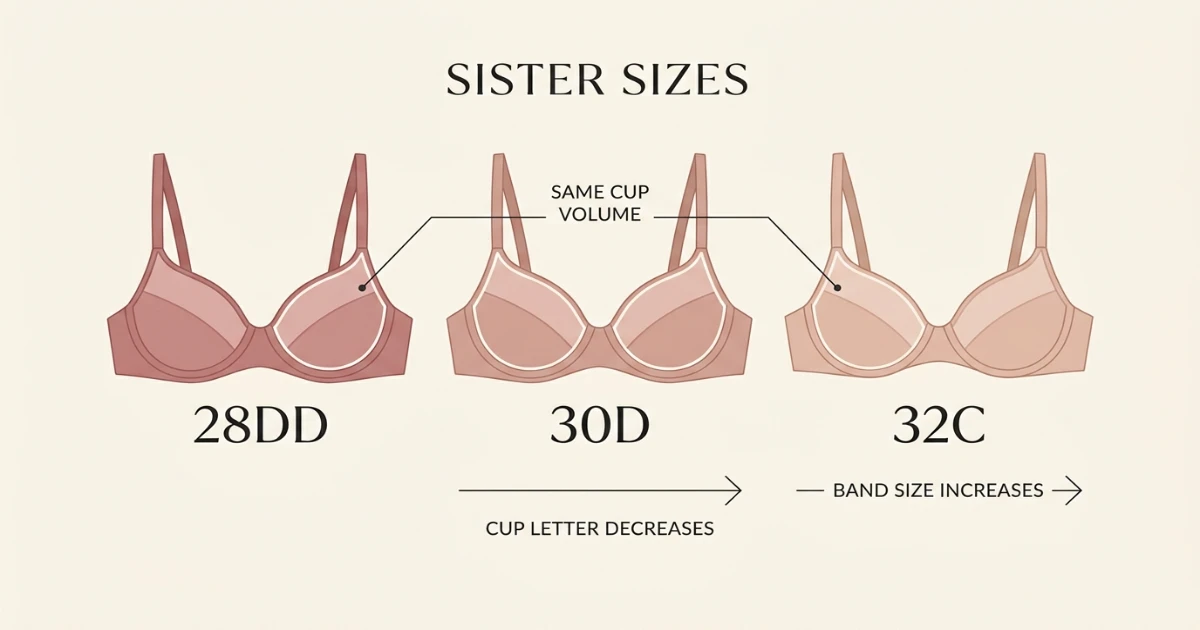
Yes — 30D and 32C are sister sizes. They contain the same cup volume, meaning the same amount of breast tissue fills both cups equally. The difference is the band: a 30D has a snugger, firmer 30-inch band, while a 32C sits on a slightly looser 32-inch band. Same cup volume, different band feel. If the cup of one fits perfectly but the band does not, the other sister size is your fix.
Key Takeaways
- Equal cup volume: 30D and 32C hold the exact same amount of breast tissue in the cup — this is the definition of a sister size.
- Different band tightness: The 30D band measures 30 inches; the 32C band measures 32 inches. The 30D will feel noticeably firmer against the ribcage.
- Different cup letters, same physical space: The D cup on a 30 band and the C cup on a 32 band are mathematically equivalent in volume.
- Support differs: A tighter 30D band provides more of the structural support load. A 32C distributes that load differently, relying slightly more on straps.
- Sister sizing helps when your size is hard to find: Many retailers skip 30-band sizes — knowing 32C is your sister size keeps your options open.
- Shape and style matter too: Even when volume is equal, the cut of specific bra styles can make one sister size fit better than the other on your particular body.
- Start with measurements, then refine: Use your underbust and bust measurements as a starting point, then trust how the bra actually feels on your body.
The Sister Size Concept: What It Actually Means
Sister sizing is one of the most useful — and most misunderstood — ideas in bra fitting. Here is the core principle in plain language: when you increase the band size by one step, you decrease the cup letter by one step, and the physical cup volume stays the same. The reverse is also true: decrease the band, increase the cup letter, same volume.
Every time you go up one band size, go down one cup letter to keep the same cup volume. Every time you go down one band size, go up one cup letter. 30D → 32C (same volume). 30D → 28DD (same volume).
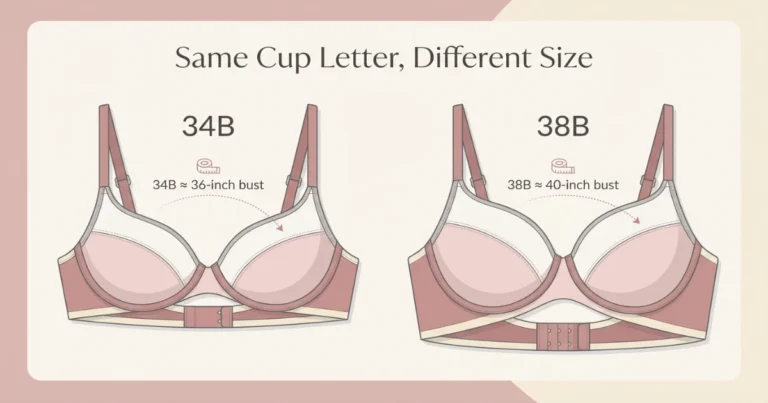
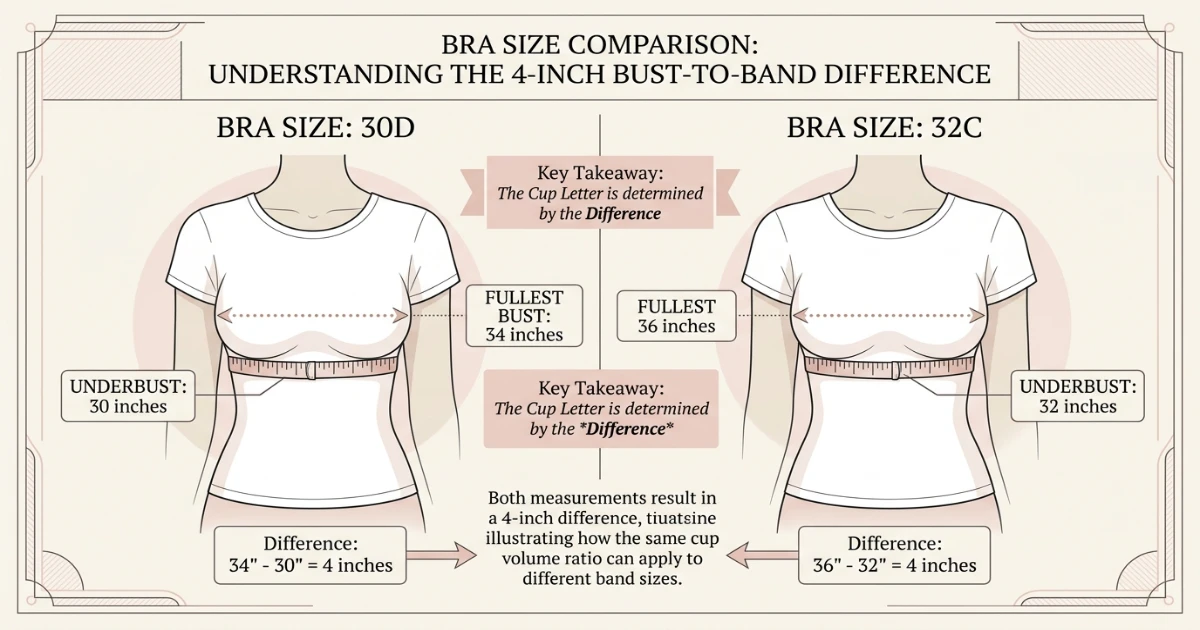
This works because cup size is not an absolute measurement — it is a ratio. The cup letter describes how many inches of difference exist between your underbust and your fullest bust measurement. A 30D has a 4-inch differential. A 32C also has a 4-inch differential. The underbust numbers are different, but the differential — and therefore the cup volume — is identical.
Where this gets practically useful: if you measure as a 30D but cannot find it in a store, 32C carries the same cup volume. If the 32C band is too loose in wear, the 30D is your true fit. You can explore the full sister size matrix at the sister sizes guide or run your own numbers through the sister size bra calculator.
Measurement Breakdown: 30D vs 32C Side by Side
Let’s ground this in actual numbers. These figures follow standard US bra sizing conventions and are the reference point for understanding what each size represents on a tape measure.
Underbust: ~30 in / ~76 cm
Bust (fullest): ~34 in / ~86 cm
Cup differential: 4 inches
Tighter bandUnderbust: ~32 in / ~81 cm
Bust (fullest): ~36 in / ~91 cm
Cup differential: 4 inches
Roomier bandThe cup differential — 4 inches in both cases — is what makes these sizes equivalent in volume. The raw bust measurements differ (34 inches vs 36 inches) because the underbust anchoring point is different, but when you subtract the band from the bust in each case, you always land on the same 4-inch D-cup differential.
For someone whose actual underbust measures 30 inches, the 30D is the correctly fitted size. For someone whose underbust measures 32 inches, the 32C is correct. They simply happen to need the same cup volume despite having different ribcage sizes. If you want to double-check your own measurements, the how to measure your bra size guide walks you through the process step by step, and you can verify your results with the bra size chart calculator.
The Band Difference: Why Two Inches Matters More Than You Think
Two inches of band length sounds small. In practice, it is one of the most significant factors in how a bra performs throughout your day.
Firmer fit
More ribcage hug
Band does more work
Slightly looser
More comfort flex
Straps bear more load
What a 30-Inch Band Feels Like
A well-fitting 30-band should feel snug — you should be able to slip two fingers underneath it, but it should not slide up your back when you raise your arms. The firmness is intentional: bra fitting experts consistently point out that 80–90% of a bra’s support should come from the band, not the straps. A properly snug 30-band does exactly that job.
If a 30-band feels uncomfortably tight — leaving marks after just a few hours or making it difficult to breathe deeply — your underbust may actually measure closer to 32 inches, and the 32C would serve you better.
What a 32-Inch Band Feels Like
A 32-band sits with a bit more ease against the ribcage. For many women, especially those who find firm bands restrictive or who have a ribcage that measures between 30 and 32 inches depending on posture and breathing, the 32C feels immediately more comfortable. The trade-off is that a looser band may ride up the back over time, particularly if the straps are doing too much of the lifting work.
Fitting guidance recommends always starting on the loosest hook when a bra is new — the band stretches with wear, and the tighter hooks are there to extend the bra’s lifespan. A new 32C should feel comfortably snug on the outermost hook from day one.
Cup Volume Comparison: Equal in Space, Different in Structure
The cup volume in 30D and 32C is equal by definition — that is the entire premise of sister sizing. But “equal volume” does not mean the cups are physically cut in exactly the same way across every bra style and every brand.
differential
differential
Where the Subtleties Show Up
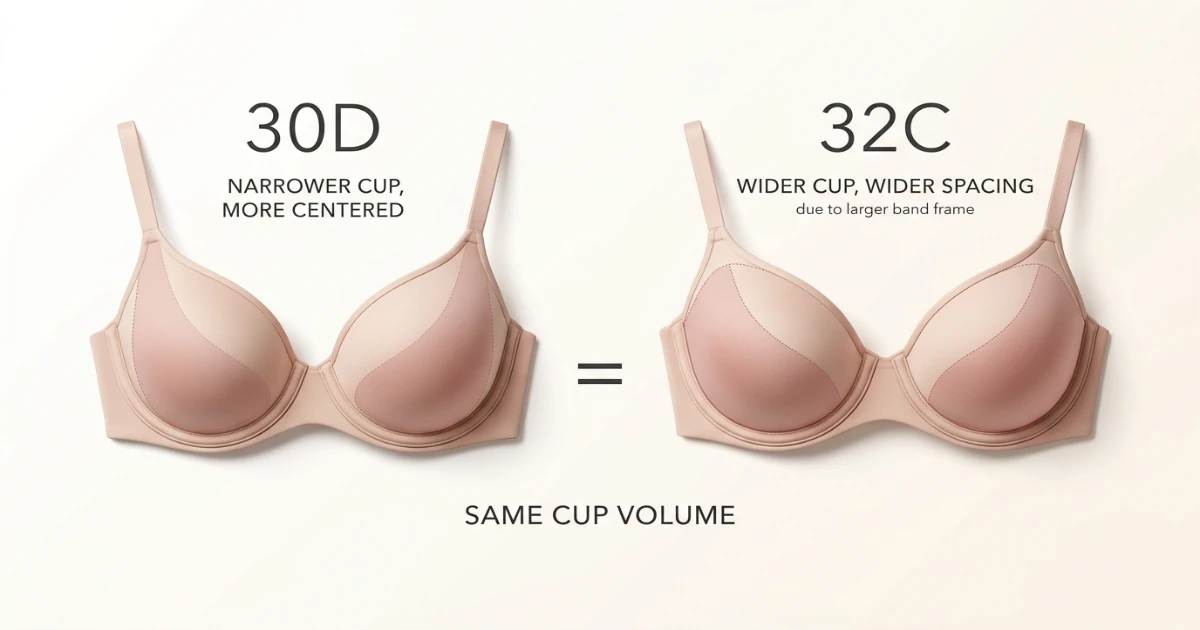
Cup volume equality is a mathematical truth, but bra manufacturers do not always cut their cups in perfect mathematical increments. A 32C in a T-shirt bra from one brand may have slightly wider cup wings or a shallower projection than a 30D in a balconette from another brand — because the cup shape is also designed around the expected body proportions for that band size.
This is why some women find that 32C fits them beautifully in full-coverage styles but 30D works better in balconettes or plunge cuts. The underlying volume is the same; the three-dimensional shaping of the cup can differ. Seeing visual comparisons across cup sizes is genuinely helpful here — the cup size visuals guide gives you a clear picture of how volume scales across sizes.
Fit Differences You Will Actually Feel
Despite equal cup volumes, the wearing experience of a 30D and a 32C can feel meaningfully different. Here is what to pay attention to when you try both.
Band Fit and Back Comfort
The 30D band wraps more firmly around the ribcage. If you have a true 30-inch underbust, this firmness translates directly to better lift and support — the band acts almost like an invisible infrastructure holding the whole bra in place. If your underbust is closer to 32 inches, that same band will feel uncomfortably constrictive and may cause the underwire to sit painfully against your ribs.
The 32C band provides a more relaxed circumference. On a genuine 32-inch underbust, this is the ideal fit: firm enough to stay in place, flexible enough to be comfortable for a full day of wear. On a 30-inch underbust, however, a 32C band may ride up at the back and fail to anchor the cups correctly against the chest.
Strap Behaviour
A properly fitting band does most of the lifting. In a well-fitted 30D, straps should barely need adjustment — the band is holding the structure. In a 32C where the band is slightly loose for your ribcage, you may find yourself tightening the straps to compensate, which leads to shoulder digging and strap slipping by the end of the day.
Cup Projection and Coverage
On the body, the cups of both sizes hold the same volume — but because the 30D’s band is shorter, the underwire channel is narrower. This means the cups of a 30D sit slightly closer together and may provide a different neckline presentation than a 32C in the same style. Women with closer-set breast tissue often find 30D underwires frame their shape better; those with wider-set tissue sometimes prefer the broader underwire spacing of a 32C.
For a complete troubleshooting guide on these kinds of fit signals, the bra fit problems guide covers band riding, strap slipping, cup gaping, and more with practical fixes for each issue.
Who Should Choose 30D — and Who Should Choose 32C?
Choose 30D if…
- Your underbust measures 29–30 inches snugly.
- A 32C band consistently rides up your back during the day.
- You need maximum band support for an active lifestyle.
- You have a petite or narrow ribcage with fuller bust tissue relative to your frame.
- Straps in your 32C constantly slip or need tightening.
- You prefer a more structured, uplift-focused fit.
Choose 32C if…
- Your underbust measures 31–32 inches naturally.
- A 30D band feels tight or leaves visible marks after a few hours.
- You find firm bands physically uncomfortable or restrictive.
- You are between band sizes and prefer the comfort of a slightly looser fit.
- Most mainstream retailers in your area do not carry 30-band sizes.
- You need the same cup volume but in a more widely available size.
It is worth noting that if your underbust genuinely measures 30 inches, choosing 32C as a permanent solution — rather than as an occasional alternative — may gradually affect your posture and support. The how to know if your bra fits checklist gives you a reliable way to evaluate whether your current band is doing its structural job properly. And if you are unsure which breast shape you have, the breast shape identifier can point you toward the bra styles that work best for your tissue distribution — which sometimes matters more than band size alone.
The Sister Size Ladder: Where 30D and 32C Sit
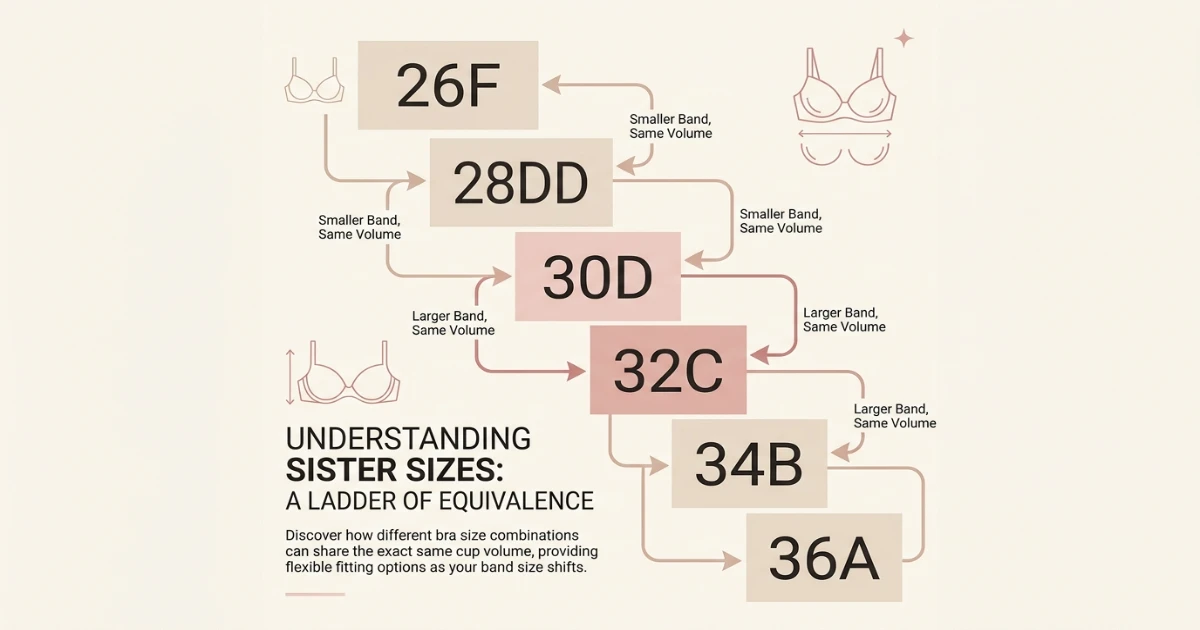
Sister sizes form a diagonal chain across the full bra size grid. Every size on the same diagonal shares identical cup volume. Here is the ladder centered on 30D and 32C, showing the two rungs above and below for context.
Notice that 34B and 36A carry the same cup volume as 30D and 32C — a fact that surprises many people, since B and A cups are culturally perceived as “small.” Cup letters are only meaningful alongside their band number. You can see the full size grid and all sister size relationships at the bra size charts page.
Quick Bra Fit Test: 30D or 32C?
Put on whichever size you currently own and run through these checks. This takes under two minutes and will tell you clearly whether the band is right for your ribcage.
- Slide two fingers under the back band. It should feel snug but not painful — you should have to stretch your fingers slightly to fit them underneath. If the band slides easily around the ribcage, it is too loose for your body.
- Raise both arms above your head. Does the back band ride up toward your shoulder blades? A well-fitted band stays parallel to the floor. If it rides up, the band is too large — try the 30D.
- Check the center gore (the bridge between the cups). It should lie flat against your sternum. A floating gore can indicate a cup issue, but a band that is too large is also a common cause.
- Look at your underwire placement from the side. The wire should sit fully behind your breast tissue, flat against the ribcage. If it pokes forward or lifts away from your chest wall, the band may be too loose to anchor it correctly.
- Assess strap pressure at the end of the day. Straps should not leave marks or dig into your shoulders. If they do, the band may be too loose and the straps are overcompensating for the lack of band support.
Still unsure whether 30D or 32C is your best fit? Our AI-powered bra size calculator uses your exact measurements to recommend the most accurate size for your body.
Try the AI Bra Size Calculator →30D vs 32C: Full Comparison Table
| Feature | 30D | 32C |
|---|---|---|
| Band size | 30 inches / 76 cm | 32 inches / 81 cm |
| Bust measurement | ~34 in / ~86 cm | ~36 in / ~91 cm |
| Cup differential | 4 inches (D cup) | 4 inches (C cup on 32 band) |
| Cup volume | Equal — these are sister sizes | |
| Band feel | Firm, supportive | Slightly roomier, more flexible |
| Support source | Primarily from band | Band + slightly more from straps |
| Underwire width | Narrower spacing | Slightly wider spacing |
| Retail availability | Less common (30 band is niche) | Very widely available |
| Best for underbust | 29–30 inch ribcage | 31–32 inch ribcage |
| Who it suits | Petite ribcage, active lifestyle, needs firm support | Average ribcage, prefers comfort flex, mainstream shopping |
| Sister sizes | 28DD, 32C, 34B | 30D, 28DD, 34B |
People Also Ask: 30D vs 32C
Are 30D and 32C the same size?
They are the same cup volume — this is what makes them sister sizes. Both have a 4-inch cup differential between underbust and fullest bust. However, they are not the same size overall: the 30D has a shorter, firmer band (30 inches) while the 32C has a slightly longer, looser band (32 inches). The cup fits the same; the band fit is different.
Is 30D bigger than 32C?
No — 30D and 32C hold identical cup volumes. Neither is bigger than the other in the cup. The only meaningful size difference is the band: the 30D band is 2 inches shorter (and therefore firmer) than the 32C band. If you’re asking about total bra size, a 32C has a larger overall circumference because of its longer band.
Can I wear 32C instead of 30D?
Yes, if your underbust genuinely measures closer to 32 inches, or if you cannot find 30D in your preferred brands. The cup will hold the same volume of tissue. However, if your underbust truly measures 30 inches, a 32C band may be too loose to provide adequate support and may ride up during wear. Use it as a temporary alternative, not a permanent replacement, if the band size doesn’t match your body.
Why is 30D hard to find in stores?
Most mainstream lingerie retailers focus their inventory on mid-range band sizes (32–38) because they represent the largest share of their customer base. The 30-band is considered a specialist size. This is exactly why sister sizing matters — knowing that 32C is your volume equivalent opens up far more shopping options while you seek out specialist retailers that carry 30-band sizes.
What is the sister size of 30D?
The immediate sister sizes of 30D are 28DD (one band smaller, one cup larger) and 32C (one band larger, one cup smaller). Extending the chain further: 26F and 34B also share the same cup volume. All of these sizes hold an equivalent amount of breast tissue in the cup — only the band length changes.
How do I know if I need a 30D or 32C?
Measure your underbust snugly. If it measures 29–30 inches, 30D is your correct size. If it measures 31–32 inches, 32C is correct. Then try both: the right one will have a band that stays parallel to the floor, sits snugly without pain, and does not ride up when you raise your arms. The cups should feel the same in both — it is the band that will guide your decision.
Does cup size change when you go from a 30 band to a 32 band?
Yes — the cup letter changes, but the cup volume stays the same if you follow the sister size rule. Going from a 30 to a 32 band means dropping one cup letter (D becomes C) to maintain equivalent volume. If you simply go up a band without adjusting the cup, you will end up with more cup volume than you had before, which typically causes gaping and poor support.
Is 30D a small bra size?
In absolute terms, 30D is a petite-to-modest bra size. The 30-inch band indicates a narrow ribcage, and the D cup on that band holds a proportionally modest amount of volume — far less than a D cup on a 36 or 38 band. Cup letters only indicate volume relative to a specific band, not an absolute breast size. A 30D is significantly smaller in total volume than a 36D, despite sharing the same cup letter.
Related Bra Size Comparisons
Understanding sister sizes is a skill that pays off across your entire bra wardrobe — not just for this one size pairing. Once you know how the sizing grid works, you can decode any size comparison quickly and shop with much more confidence.
If you want to see how 30D and 32C each compare to adjacent sizes — like 30C vs 30D, or 32C vs 32D — the breast size comparison hub has detailed guides for dozens of pairings. You can also use the bra size chart calculator to locate any two sizes on the full grid and understand their relationship at a glance.
And if you have not measured yourself recently — or you’ve been wearing the same size for years without a professional fitting — the measurement guide is the best place to start fresh. Bra size can genuinely change with weight shifts, hormonal changes, and even changes in posture, so revisiting your measurements every year or two is a worthwhile habit.