28C vs 28D: What’s the Real Cup Size Difference? (2026 Guide)
Choose the fit signs you notice in the band, cups, center and straps. We’ll turn them into a practical next step for 28C.
Private fit check — your answers stay in your browser and are used only for this on-page guidance. Nothing is stored or submitted.
Quick Answer
28D is one cup size larger than 28C. Both bras use the same 28-inch band — the only difference is in the cup. A 28D cup accommodates roughly one additional inch of bust measurement compared to 28C, giving it a deeper bowl, slightly wider underwire, and more room for breast tissue. If your 28C cups feel snug, cause spillage, or leave visible marks on your breast tissue, moving up to 28D is the natural next step.
Key Takeaways
- 28D is one cup size up from 28C — the band measurement stays exactly the same at 28 inches.
- The difference in bust measurement between the two sizes is approximately one inch (about 2.5 cm).
- On a 28 band, a D cup is not a large size — cup size is always proportional to band size, never absolute volume.
- If your 28C cups overflow, dig in, or cause a double-bulge across the top, you almost certainly need to go up to 28D.
- If your 28D cups wrinkle, gap, or feel empty, you likely need to go back down to 28C — or reconsider your breast shape and bra style.
- Sister sizes: 28C shares cup volume with 26D and 30B; 28D shares cup volume with 26DD and 30C.
- 28-band bras in both sizes are available through specialist retailers — mainstream stores often start at 32 band.
Understanding Bra Cup Letters: Where Do C and D Fit?
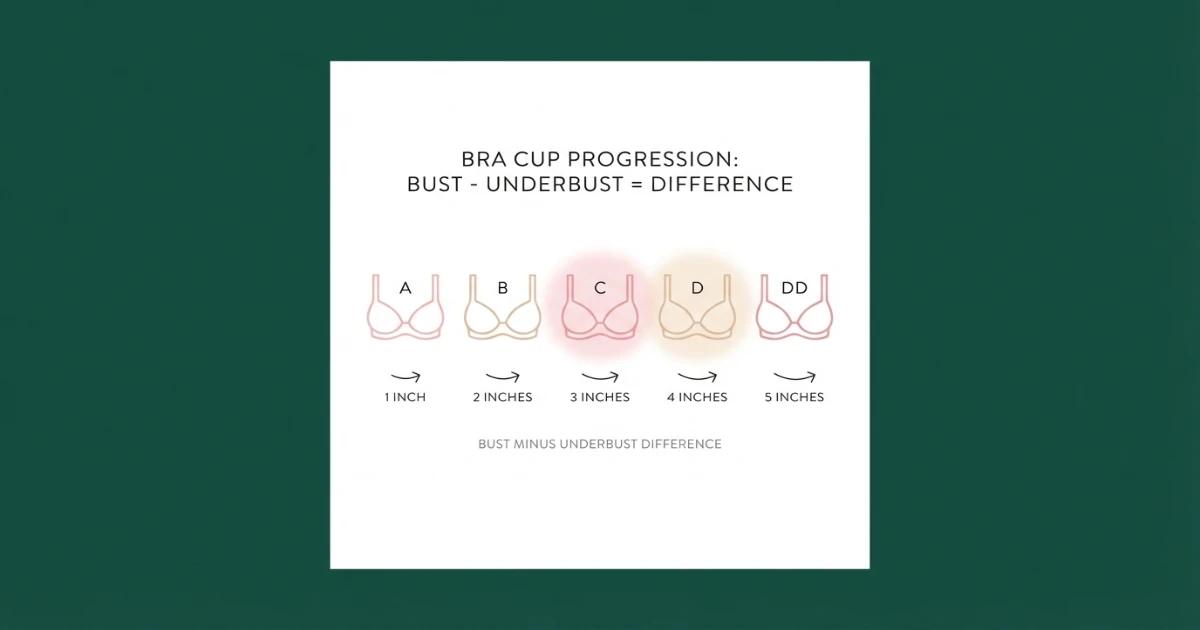
Cup letters feel straightforward until you start wearing different sizes and realize A, B, C, D don’t mean what you thought. In US bra sizing, each letter represents roughly one inch of difference between your underbust and bust measurements — A is one inch, B is two, C is three, D is four. That’s it. C and D are simply the third and fourth positions in a sequence that continues well past DD, E, F, G, and beyond.
Moving from C to D: What Actually Changes
Going up from C to D means your bust measurement is one inch further from your underbust than before. In practical terms, the cup becomes slightly deeper from front to back, the underwire widens marginally to follow the outer curve of the breast, and the overall cup holds a bit more volume. It’s a meaningful change — but not a dramatic one. Women often agonize over the decision between adjacent cup sizes when trying them on would answer the question in about thirty seconds.
Cup Size Is Relative — Always
A D cup on a 28 band is physically a much smaller bra than a D cup on a 36 band. The letter describes a ratio, not a fixed volume. This is the single most important thing to understand about bra sizing, because it’s what causes most women to end up in the wrong size. A woman wearing a 28D has a petite ribcage with a proportionate bust — there’s nothing unusual or extreme about that combination.
If you’ve been assuming D means “large,” it might be worth revisiting what size you’re actually wearing. Our bra size chart shows exactly how cup letters scale against every possible band size, which makes the proportional relationship much easier to see.
Measurement Breakdown: 28C vs 28D
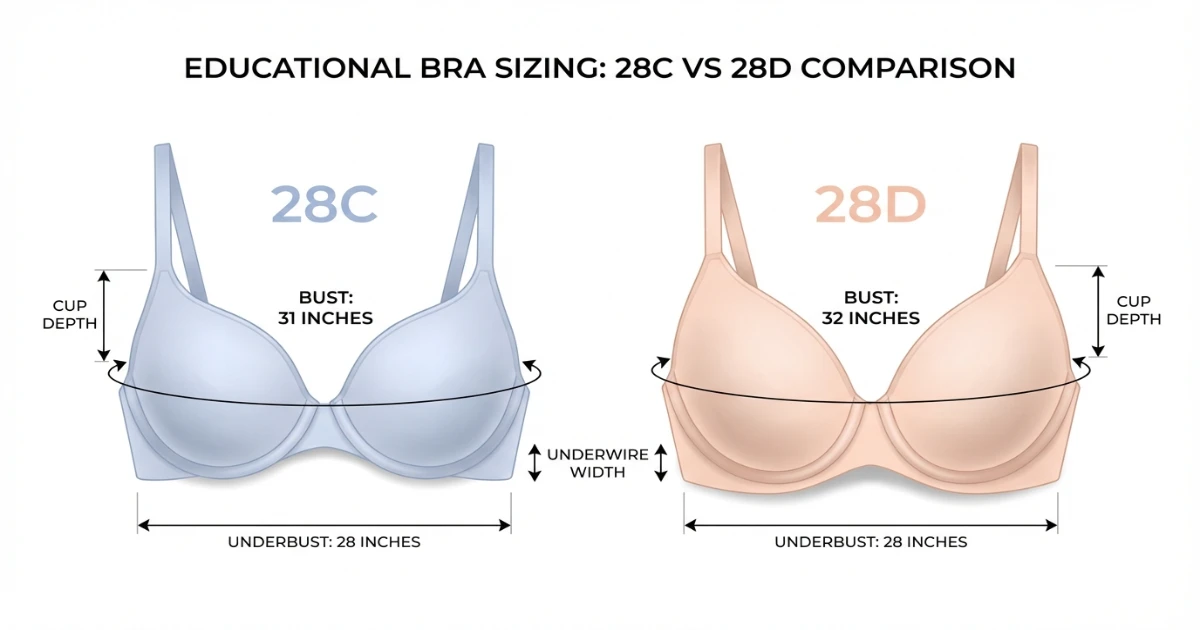
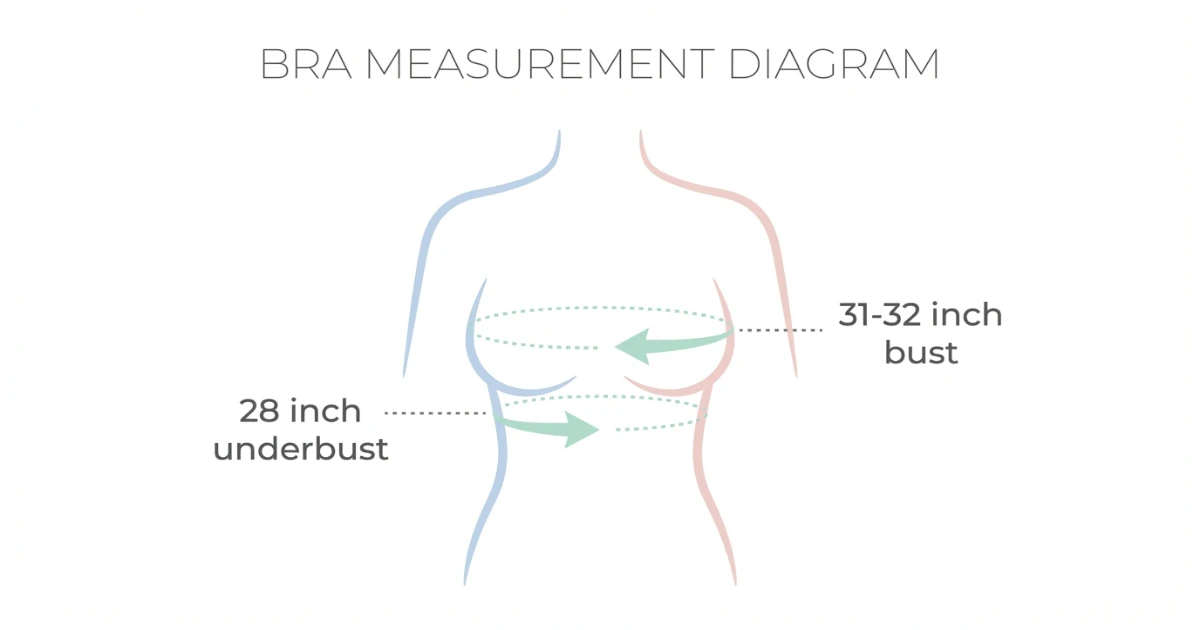
Numbers ground the comparison in something concrete. In US sizing, you calculate your cup size by subtracting your underbust measurement from your bust measurement. Three inches of difference = C cup. Four inches = D cup. Here’s how that lands for these two sizes:
28C
Underbust: ~28 in / ~71 cm
Bust: ~31 in / ~79 cm
Difference: ~3 in / ~7.5 cm
Cup: C (3rd position)
28D
Underbust: ~28 in / ~71 cm
Bust: ~32 in / ~81 cm
Difference: ~4 in / ~10 cm
Cup: D (4th position)
That one-inch difference at the bust is the entire distinction between these two sizes. At 28 inches of underbust, that inch of tissue matters — it affects how the cup contains your breast, whether the underwire sits correctly on the chest wall, and how much pressure (or none at all) you feel across the top of the cup.
Measuring tip: Your bust measurement should be taken at the fullest part of your chest — not pulled tight, but sitting snugly without compressing tissue. Many women get an inaccurate reading because they either stand too rigidly or measure over a padded bra. For the most reliable result, measure without a bra or wearing a non-padded, well-fitting bra and lean slightly forward so tissue falls naturally into the measuring tape.
If you haven’t measured yourself recently — or if the bra you’re wearing has been fitting oddly — it’s worth taking fresh measurements before you order anything new. Our how to measure for a bra guide walks through every step and explains how breast shape affects which measurement technique is most accurate for you.
Cup Volume Difference: How Much Larger Is 28D?
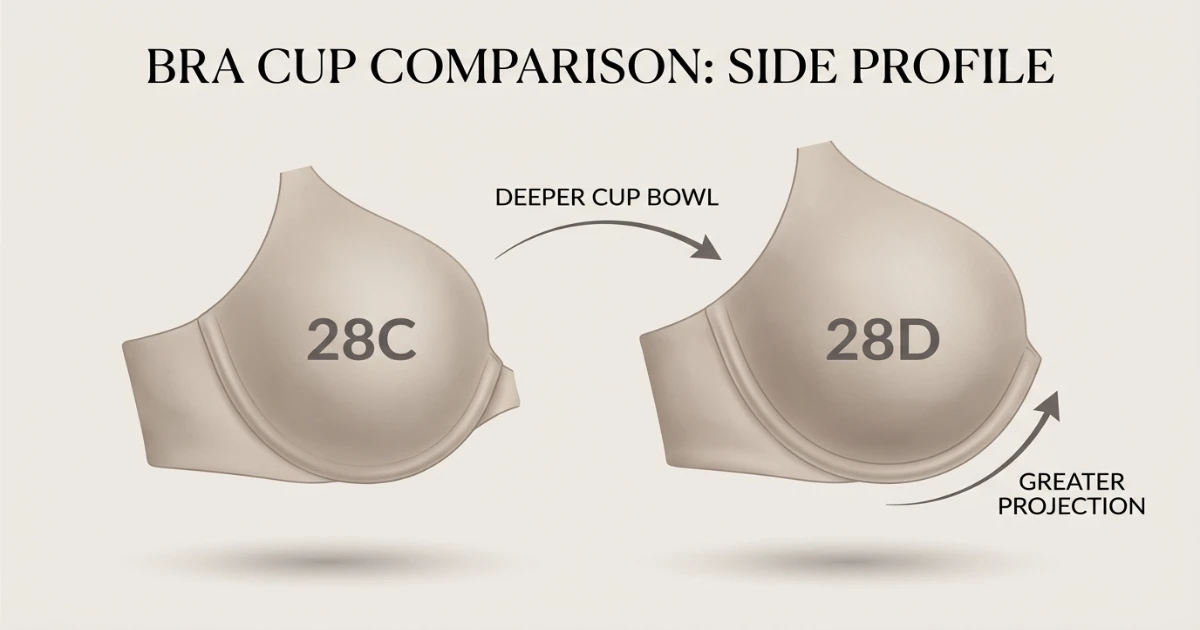
One cup size sounds like a small jump. In many cases it is — but the effect on fit is disproportionately large when you’re near the threshold between two sizes. The 28D cup is deeper from the underwire to the top of the cup, and the underwire itself tends to be fractionally wider to follow the natural breast root more accurately. This extra depth is exactly what allows the cup to house breast tissue that a C cup would compress or push upward.
What That Looks Like in Your Hand
If you hold a 28C bra and a 28D bra side by side, the cups of the D are visibly deeper when you look at them in profile. The D cup has more forward projection — room that allows rounder or more projected breast shapes to settle into the cup completely, rather than pressing against the fabric and spilling over the top edge.
For shallow breast shapes — tissue that spreads wider and sits close to the chest wall — that extra depth may actually be too much. The breast tissue doesn’t project forward enough to fill the D cup, leaving the top of the cup empty and the underwire unable to anchor properly. This is one reason why cup size and breast shape are inseparable when you’re trying to find a good fit.
How Volume Relates to Bra Style
It’s also worth knowing that the same cup size can feel quite different across bra styles. A plunge 28D cuts lower at the center, which reduces the effective cup height. A full-coverage 28D encloses more tissue. A balconette 28D shapes differently again. If a 28D in one style feels too large but a 28C in that same style feels too small, you may simply need a different style in your correct cup size rather than a different cup size entirely.
See how C and D cups compare visually across different breast shapes on our cup size visuals page. And if you want to cross-reference your measurements with the right size, the bra size chart calculator gives you a fast, accurate starting point.
Fit Differences You’ll Actually Notice
The numbers are one thing. Here’s how the difference between 28C and 28D shows up when you actually put a bra on.
Signs Your 28C Is Too Small
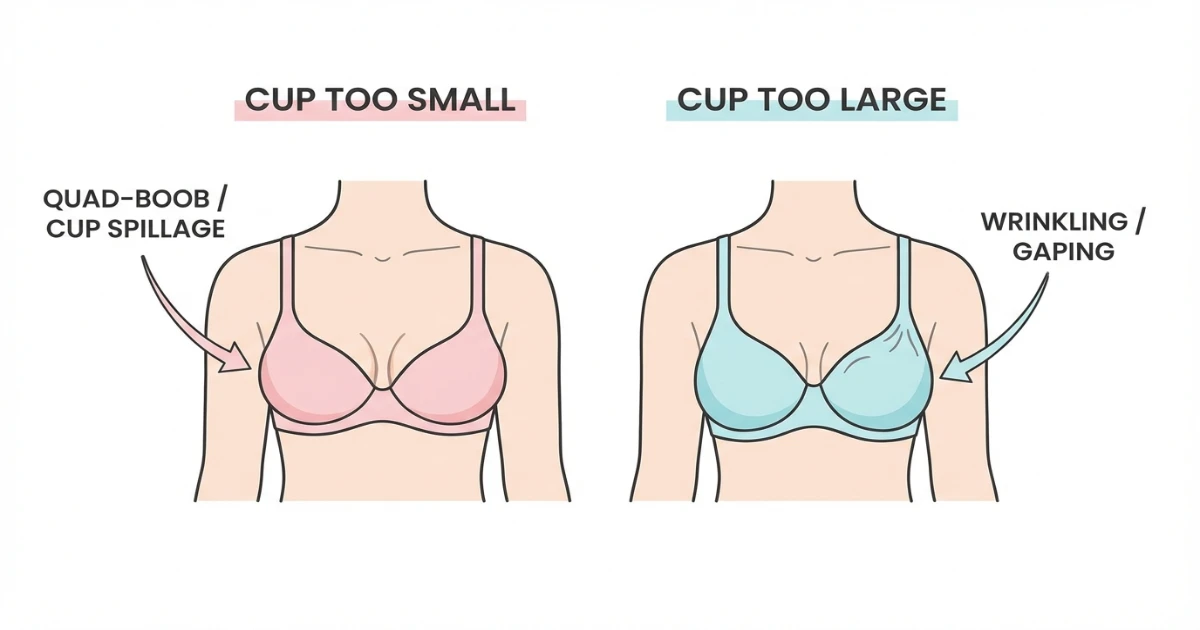
Spillage at the top or sides of the cup is the clearest indicator. When breast tissue is pushed upward over the top edge of the cup or squeezed sideways under the armpit, the cup cannot contain the volume it needs to. This isn’t fixable with a different strap adjustment or bra style — the cup needs to be larger.
The quad-boob effect — a visible horizontal ridge across the cup where breast tissue bulges over the fabric — is almost always a sign of a cup that’s one size too small. The top edge of the cup is cutting into breast tissue rather than lying flat against the chest above it. Moving to 28D typically resolves this immediately.
Underwire sitting on breast tissue rather than the chest wall around it is a subtler but more important sign. The underwire should encircle the breast at its base, sitting on firm chest and rib structure. When the cup is too small, the underwire can’t travel far enough back to reach the chest wall — it ends up pressing into soft tissue, which is uncomfortable over a full day of wear.
Straps digging into your shoulders often trace back to a cup problem, not a strap problem. When the cup is too small, tissue escapes upward and the straps compensate by pulling harder. Loosening the straps doesn’t fix it — sizing up in the cup often does.
Signs Your 28D Is Too Large
Cup wrinkling or puckering across the fabric means there isn’t enough breast tissue to fill the available space. This is common for women with shallower breast shapes or smaller bust measurements who measured right on the border of C and D. The fix is usually dropping back to 28C, or exploring a different bra style that suits shallower projection.
Underwire floating away from the chest wall and sitting on top of breast tissue (rather than anchoring beneath it) is another sign the cup is too large — the breast root isn’t wide enough to push the underwire outward into the correct position.
For a comprehensive breakdown of what each fit symptom means and how to address it, our bra fit problems guide is an essential read.
Who Should Choose 28C?
The 28C is likely the right fit if:
- Your underbust measures right around 28 inches and your bust measures approximately 31 inches.
- You’ve tried 28D and find the cups consistently wrinkle or gape at the top, regardless of bra style.
- You have a shallower breast shape — tissue that spreads wide and sits close to the chest wall rather than projecting forward. Shallow tissue fills a C cup cleanly without needing the extra depth of a D.
- You have soft, relaxed, or less dense breast tissue that doesn’t hold a rounded projection naturally.
- You find that the D cup underwire keeps popping forward off your chest wall, unable to find a firm anchor point.
Breast shape is one of the most underrated factors in cup sizing. Two people with identical measurements can end up in different cup sizes because their breast tissue sits and projects differently. Our breast shape identifier can help you figure out your natural shape and which bra styles and cup depths suit it best.
Who Should Choose 28D?
The 28D is the better fit if:
- Your bust measures approximately 32 inches against a 28-inch underbust.
- Your 28C cups cause spillage — breast tissue escaping over the top, the armpit, or the sides of the cup.
- You have rounder or more projected breast tissue that needs cup depth to sit inside the bra rather than against it.
- You notice the underwire of your 28C pressing into the sides of your breast tissue rather than clearing it cleanly.
- You have fuller upper-pole breast tissue — roundness above the nipple line — which needs cup height and depth to be properly housed.
- Your 28C straps are always digging in, no matter how you adjust them, suggesting the cup is working too hard to compensate for tissue it can’t contain.
If you want a definitive checklist to run through with any bra before you remove the tags, our how to know if your bra fits guide covers every point of the fit check in plain, practical language.
Sister Sizes for 28C and 28D
Because 28-band bras can be genuinely difficult to find in physical stores, sister sizing becomes a practical tool rather than just a theoretical concept. A sister size shares the same cup volume but uses a different band size — so if a style isn’t available in 28, you have options.
28C Sister Sizes
- 26D — smaller band, same cup volume
- 28C — your true size
- 30B — larger band, same cup volume
- 32A — two bands up, same volume
28D Sister Sizes
- 26DD — smaller band, same cup volume
- 28D — your true size
- 30C — larger band, same cup volume
- 32B — two bands up, same volume
One important thing to keep in mind: sister sizes are equivalent in cup volume, but the bra’s behavior on your body does change when the band changes. Moving to a 30B (the sister of 28C) means the band is looser, which may reduce support and cause the bra to ride up at the back. Moving to a 26D means the band grips more firmly, which can feel tight if your underbust is genuinely 28 inches.
For everything you need to know about when sister sizing works and when it doesn’t, visit our sister sizes guide. To build your complete sister size chart, try the sister size bra calculator.
Quick Bra Fit Test: Do You Need to Go Up a Cup?
Run through this self-check with the bra you’re currently wearing. It takes about two minutes and will tell you clearly whether you’re in the right cup size.
- Scan the cup edge: Look down or at a mirror. Does the fabric at the top of the cup lay flat against your chest, or is breast tissue bubbling over it? Any overflow = cup too small.
- Check the underwire path: The underwire should travel all the way around your breast base and sit on firm chest wall — not on breast tissue at any point. Trace it with a finger. Underwire on soft tissue = cup too small.
- Look for the double-bulge: A ridge across the top of the cup where tissue pushes up against the fabric is a direct signal the cup can’t hold what it needs to. Go up a cup size.
- Test the center gore: The flat panel between the two cups should sit flush against your sternum. If it bridges away from your chest, the cups are too small and pulling the center forward.
- Check for wrinkling: Loose, folded fabric in the cup means too much space — either the cup is too large or the bra style doesn’t match your breast shape.
- Try the scoop-and-swoop: Lean forward 45 degrees, scoop all breast tissue from the side and underneath into the cups, then stand up straight. All tissue should now sit cleanly inside the cup with nothing left outside.
Still unsure about your bra size? Our AI-powered bra size calculator uses your measurements to recommend your best size accurately.
Try the AI-Powered Bra Calculator →28C vs 28D: Full Comparison Table
| Feature | 28C | 28D |
|---|---|---|
| Cup volume | 3-inch bust-to-underbust difference | 4-inch bust-to-underbust difference |
| Support | Firm — 28 band provides strong support | Firm — same 28 band, same support level |
| Coverage | Less cup depth; suits shallower tissue | Deeper cup; suits rounder or projected tissue |
| Spillage risk | Higher for fuller or projected breast shapes | Low when cup volume matches breast tissue |
| Gaping risk | Low for correct breast shape and volume | Higher for shallow or less projected tissue |
| Comfort | Best for shallower, spread, or relaxed tissue | Best for round, full, or forward-projecting tissue |
| Best breast shapes | Shallow, east-west, soft, or relaxed tissue | Round, full-on-top, projected, or close-set |
| Sister sizes | 26D / 30B / 32A | 26DD / 30C / 32B |
| Availability | Specialist brands and online retailers | Specialist brands and online retailers |
People Also Ask
Related Bra Size Comparisons
Brand sizing note: Bra sizing is not standardized across manufacturers. A 28C from one brand may fit quite differently from a 28C made by another, due to variations in cup depth, underwire width, band elasticity, and fabric construction. The measurements in this article follow average US and UK sizing conventions and are a general guide only. Always consult individual brand size charts and try before committing where possible.