28B vs 28C: What’s the Real Cup Size Difference? (2026 Fit Guide)
If you’ve ever held up a 28B and a 28C side by side and wondered whether one actually fits your body better, you’re not alone. For petite-banded women, the gap between these two sizes can feel confusing — especially when mainstream stores rarely even stock them. This guide walks you through exactly what separates a 28B from a 28C in terms of measurements, cup volume, and real-world fit.
Choose the fit signs you notice in the band, cups, center and straps. We’ll turn them into a practical next step for 28B.
Private fit check — your answers stay in your browser and are used only for this on-page guidance. Nothing is stored or submitted.
Quick Answer
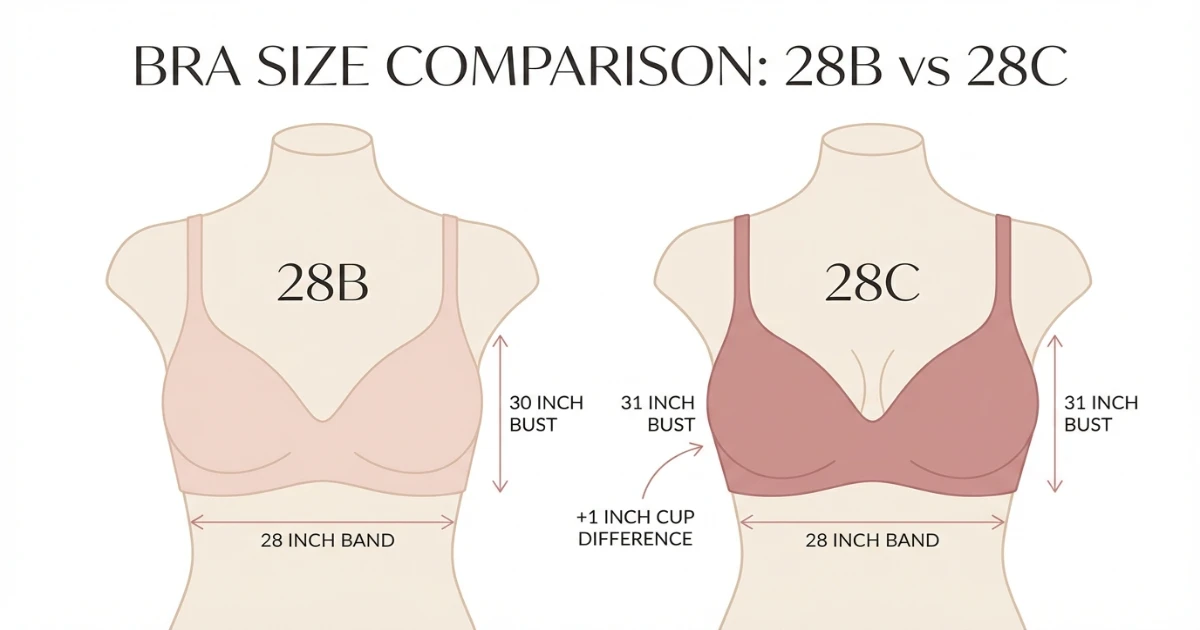
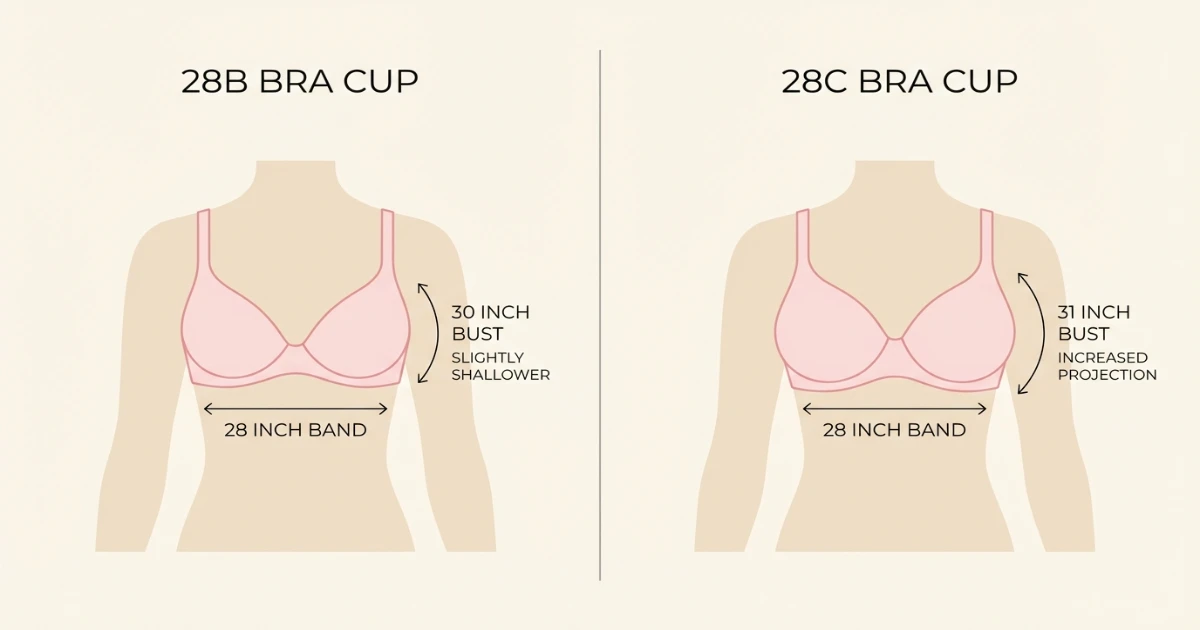
A 28C has one additional cup size of volume compared to a 28B, while both share the exact same 28-inch band. In practical terms, a 28C bust measurement is approximately one inch larger than a 28B — meaning the cups hold slightly more breast tissue. Neither size is large; both are considered small-to-petite on a narrow ribcage.
Key Takeaways
- Both 28B and 28C use a 28-inch underbust band — the only difference is cup volume.
- A 28C cup holds roughly one additional inch of bust circumference compared to a 28B.
- Neither size is considered large — a C cup on a 28 band is smaller in actual volume than, say, a C cup on a 36 band.
- Signs you may need to size up from 28B to 28C include cup spillage, a quad-boob effect, or underwire that sits on breast tissue.
- Signs you may need to size down from 28C to 28B include cup wrinkling, fabric gaps, or excess fabric at the top of the cup.
- Both sizes share sister sizes: 28B relates to 30A and 26C; 28C relates to 30B and 26D.
- Finding 28-band bras in physical stores is genuinely difficult — specialist brands and online retailers are your best bet.
How Bra Cup Letters Work on a 28 Band
This is the part that trips most people up: cup letters are not absolute measurements. They’re relative to the band size. Every time you go up one cup letter, the bust measurement increases by about one inch. So on a 28 band, the progression looks like this:
- 28A: ~1 inch bust–underbust difference
- 28B: ~2 inch difference
- 28C: ~3 inch difference
- 28D: ~4 inch difference
This also means a 28C is nowhere near the same volume as a 34C or 36C — those larger-banded C cups hold significantly more breast tissue. Cup size and actual breast size only make sense together. That’s why understanding the band-to-cup relationship matters so much for proper fit. You can explore a full breakdown in our bra size chart guide.
The takeaway? If you’re a petite woman with a 28-inch ribcage, a C cup is still a modest size. Don’t let the letter intimidate you into staying in a poorly fitting B.
Measurement Breakdown: 28B vs 28C
Let’s put real numbers to these sizes. Using standard US sizing (where the cup difference = bust minus underbust), here’s what each size typically corresponds to:
28B
| Underbust | ~28 in / ~71 cm |
| Bust | ~30 in / ~76 cm |
| Difference | ~2 in / ~5 cm |
| Cup depth | Shallow to moderate |
28C
| Underbust | ~28 in / ~71 cm |
| Bust | ~31 in / ~79 cm |
| Difference | ~3 in / ~7.5 cm |
| Cup depth | Moderate |
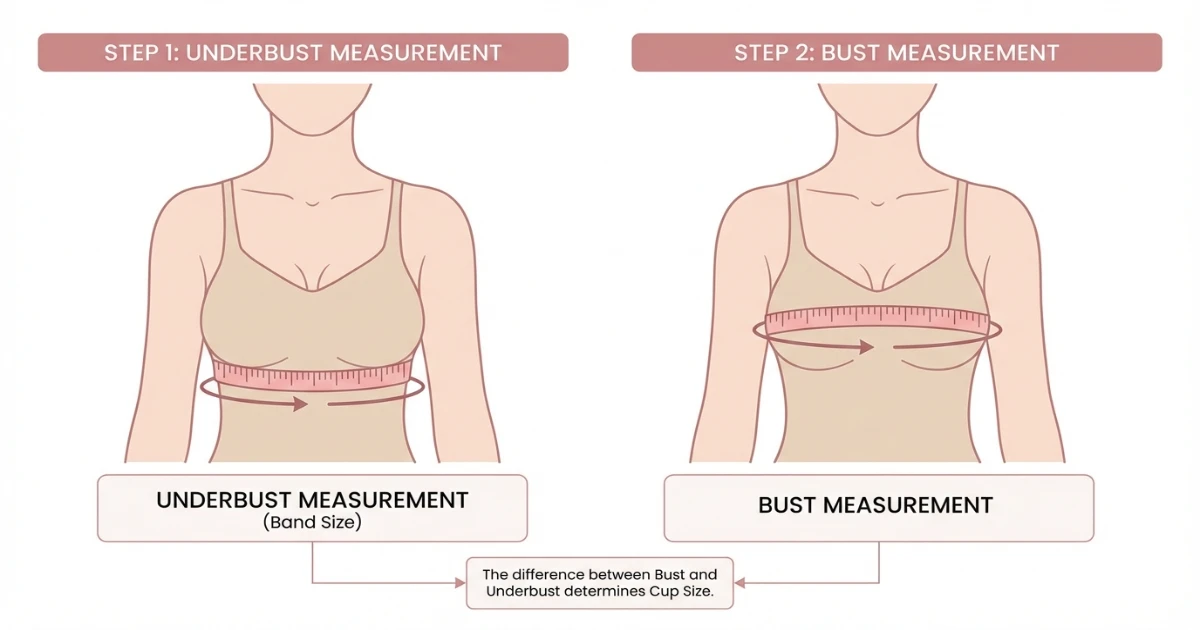
When taking your own measurements at home, always measure your underbust snugly (not tight) and your bust at the fullest point with a relaxed tape. For the most accurate result, lean forward at a 90-degree angle when measuring the bust — this ensures the tape captures the full projection of breast tissue. Our step-by-step measuring guide walks you through the whole process.
Keep in mind that these are guidelines, not laws. Different brands draft their cups differently, and your actual fit may land a half-size above or below these numbers. Using measurements as a starting point and then fine-tuning based on fit is always the smarter approach.
Cup Volume Difference: What One Cup Size Actually Looks Like
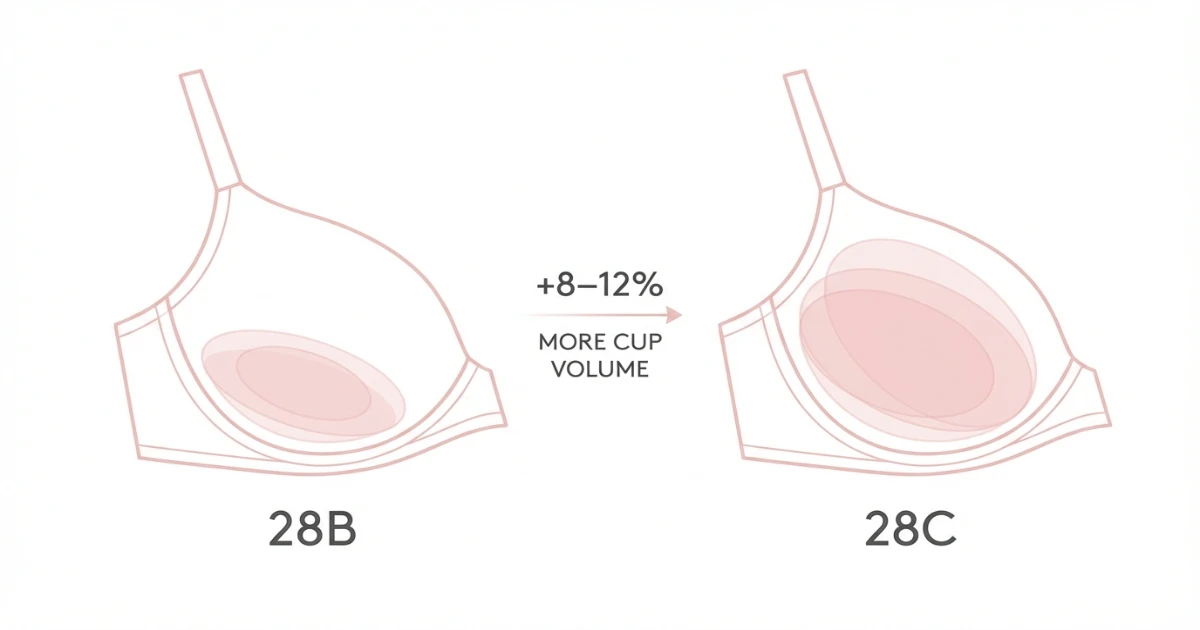
One cup size might sound like a small jump, but on a petite frame, it can make a meaningful difference in coverage, projection, and overall silhouette. A 28C cup has roughly 8–12% more internal volume than a 28B, depending on the brand’s grading.
Visually, the difference is most apparent at the top of the cup. In a 28B, the fabric will lie relatively flat against the upper chest. In a 28C, there’s a bit more depth — the cup projects further forward and fills out more of the upper-bust area. For women who notice breast tissue escaping from the top or sides of a 28B, that extra volume in a 28C can make a significant improvement.
Think of it this way: if a 28B is a shallow bowl and a 28C is a medium bowl — you still want your fruit to fill the bowl, not overflow it and not rattle around inside it.
For a more intuitive sense of what these volumes look like relative to other sizes, our cup size visual comparison and bra size chart calculator are particularly helpful tools.
Fit Differences You May Notice Between 28B and 28C
Numbers are useful, but fit is something you feel. Here’s what to look out for when deciding between these two sizes:
Signs Your 28B May Be Too Small
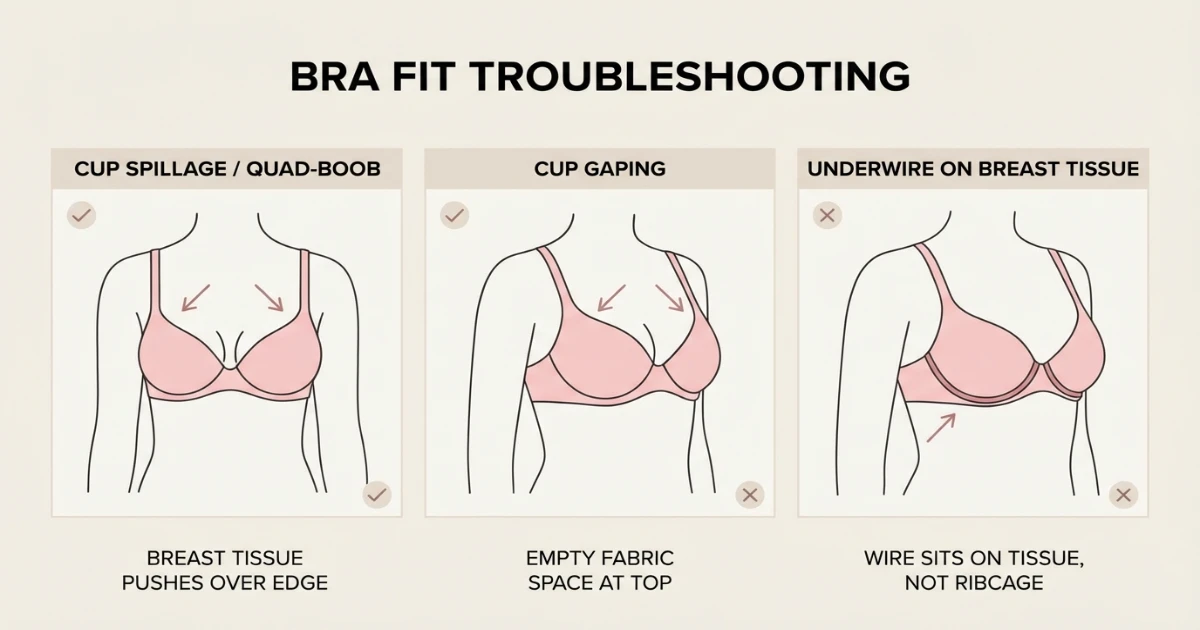
- Cup cutting into breast tissue: If the top edge of the cup digs in rather than lying flat, you’re likely a cup size too small.
- Quad-boob effect: Breast tissue pushed up and over the top of the cup is a classic sign of insufficient cup volume.
- Underwire sitting on tissue: The wire should encircle the breast completely — if it’s resting on breast tissue rather than chest wall, go up a cup.
- Side tissue escaping: Breast tissue sneaking under the armhole or out the side suggests the cup isn’t wide or deep enough.
Signs Your 28C May Be Too Large
- Wrinkling fabric: Excess material creasing at the top or sides of the cup means there’s more cup than breast to fill it.
- Mild gaping at the top: If you can press the cup inward without resistance, the cup is deeper than you need.
- Straps bearing too much weight: This can happen when the cups aren’t doing their proper job of containing breast tissue — but it can also signal that the band or cup needs adjusting.
Good fit in either size means: the band sits level around your body, the underwire rests fully on your chest wall (not on breast tissue), the center gore lies flat against your sternum, and the cups contain all your breast tissue without spillage or gaping. For a deeper look at troubleshooting, see our bra fit problems guide.
Which Size Is Right for You?
Rather than sizing by measurement alone, look at the actual signals your current bra is giving you.
Choose 28B if you…
- Have a shallow or projected-but-small breast shape
- Notice cups wrinkling or gaping in a 28C
- Prefer a lower-coverage, less projecting cup
- Have little to no tissue escaping your current B cup
- Wear balconette or demi styles comfortably at this size
Choose 28C if you…
- Experience spillage or quad-boob in a 28B
- Have fuller or rounder breast tissue that needs more depth
- Find the underwire sitting on tissue rather than chest wall
- Notice the center gore not lying flat in a 28B
- Feel the cups cutting in at the top or sides
Breast shape matters as much as measurements. Shallow breasts (wide and not very projected) often fit well in a B cup even if measurements suggest a C. Projected or fuller breasts may need the extra cup depth that a C provides. Use our breast shape identifier to get a clearer picture of your shape before shopping. And if you’re ever uncertain whether a bra is truly fitting you well, our bra fit checker covers all the key signs.
Sister Sizes: More Ways to Find Your Fit
One of the most practical tools in bra fitting is the concept of sister sizes. Sister sizes share the same cup volume but use a different band size. When your correct size isn’t available, a sister size can substitute — just be prepared for the band to feel different (tighter or looser) even if the cup volume matches.
28B Sister Sizes
- 30A — same cup, looser band
- 26C — same cup, tighter band
28C Sister Sizes
- 30B — same cup, looser band
- 26D — same cup, tighter band
For example, if a retailer doesn’t carry 28C, trying a 30B can give you the same cup volume — just know that the band will feel slightly less snug. Sister sizing is a useful workaround, but it’s not a perfect substitute for your actual size. Learn more in our sister size explainer, or use our sister size calculator to find your full range of equivalent sizes instantly.
Quick At-Home Fit Test
Put on the bra you’re testing and work through these checks. You’ll know within two minutes whether it’s your size or not.
- Band check: Slide two fingers under the back band. They should fit — but just barely. If you can fit your whole hand underneath, the band is too loose.
- Cup check: Press lightly on the center of each cup. No breast tissue should pop out above, below, or to the sides.
- Gore check: The center panel (gore) should lie flat against your sternum. If it floats away from your skin, the cups are likely too small.
- Underwire check: Run your finger along the underwire. It should trace the base of your breast tissue completely — not dig in, not sit on tissue.
- Strap check: Loosen straps until they’re just taut. If the bra still fits well, the band is doing its job. If everything falls apart, the band may be too loose.
- Lean forward test: Lean forward at the waist. All breast tissue should remain inside the cups. If it falls forward out of the cup, you likely need more cup depth.
Still not sure whether 28B or 28C is your correct size? Our AI-powered calculator takes the guesswork out of bra sizing entirely.
Try the AI Smart Fit Calculator →28B vs 28C: Side-by-Side Comparison
| Feature | 28B | 28C |
|---|---|---|
| Band fit | Identical — 28-inch underbust | Identical — 28-inch underbust |
| Cup volume | Smaller — ~30 in bust | Larger — ~31 in bust |
| Cup projection | Shallow to moderate | Moderate |
| Spillage risk | Higher if breast tissue is fuller | Lower — more volume to accommodate |
| Gaping risk | Lower for smaller busts | Higher if bust is smaller than cup |
| Support | Good for smaller bust projection | Better for fuller/rounder tissue |
| Best breast shapes | Shallow, wide-rooted, small-projected | Full, round, projected, east-west |
| Sister sizes | 30A / 26C | 30B / 26D |
People Also Ask
Yes. A 28C has one cup size more volume than a 28B. Both use the same 28-inch band, but the C cup accommodates approximately one inch more bust circumference — roughly 8–12% more internal volume depending on the brand.
The 28C bust measurement is about one inch (2.5 cm) larger than 28B. In terms of cup depth and projection, this translates to noticeably more coverage and slightly more forward projection from the chest.
No. A 28C is a small bra size overall. Because cup volume scales with band size, a C cup on a narrow 28-inch band holds far less breast tissue than a C cup on a 34 or 36-inch band. On a petite frame, 28C is a modest, small-to-medium size.
The sister sizes of 28C are 30B (same cup volume, looser band) and 26D (same cup volume, tighter band). These sizes hold equivalent breast tissue but will feel different on the body due to band tension.
In terms of cup volume, yes — 28B and 30A are sister sizes and hold approximately the same amount of breast tissue. However, the band fit is different: a 30 band is looser than a 28, so the overall feel and support level will differ.
Yes, if your bust measurement and breast tissue volume suggest a C cup. Wearing a 28C when you measure a 28B may result in cup wrinkling or gaping. Conversely, wearing a 28B when you need a 28C can lead to spillage and discomfort. Always fit to your actual measurements and physical signs, not a size preference.
Most mainstream retailers stock band sizes starting at 32 or 34. A 28-inch underbust is considered petite by industry standards, so the size range is less commercially prioritized. Specialist lingerie brands — particularly UK-based ones — are far more likely to carry 28-band styles in a broader range of cup sizes.
Yes. Cup size letters represent a proportional relationship to the band, not a fixed volume. If you go up one band size (from 28 to 30), you need to go down one cup size (from C to B) to maintain the same cup volume — this is the principle behind sister sizing.
Related Bra Size Comparisons
Take the guesswork out of bra sizing for good. Our calculator uses your measurements and fit preferences to recommend your most accurate size — including hard-to-find 28-band styles.
Find Your Perfect Size →Sizing note: Bra sizing varies between brands, countries, and manufacturing styles. The measurements and fit guidance in this article reflect general US and UK sizing standards and are intended as a starting point. Always try bras on and use your body’s feedback — not just the label — to determine the best fit for you.