Best Pregnancy Weight
Gain Calculator
Get your personalized weight gain roadmap — with breast size changes, trimester milestones, and expert guidance tailored to your body.
Your Pre-Pregnancy Details
Enter your measurements before pregnancy
Your Pregnancy Week
Drag the slider to your current week
Your Breast Size Changes
During pregnancy, breasts are often the first to change. They can grow 1–4 cup sizes and gain up to 1–3 lbs of total weight. Your band size may also increase as your ribcage expands. Finding the right fit matters more now than ever.
📏 Check Your New Bra Sizemay increase
weight gain
Personalized Recommendations
Based on your BMI category and current stage
Recommended Maternity & Nursing Bras
As your breasts grow 1–4 cup sizes during pregnancy, proper support becomes essential. These are top-rated, comfort-first options trusted by thousands of moms.

Seamless Wireless Maternity Bra
Ultra-soft, stretch fabric adapts to changing cup size. No underwire pressure on milk ducts. Ideal for 2nd and 3rd trimester comfort.
Check Price on Amazon →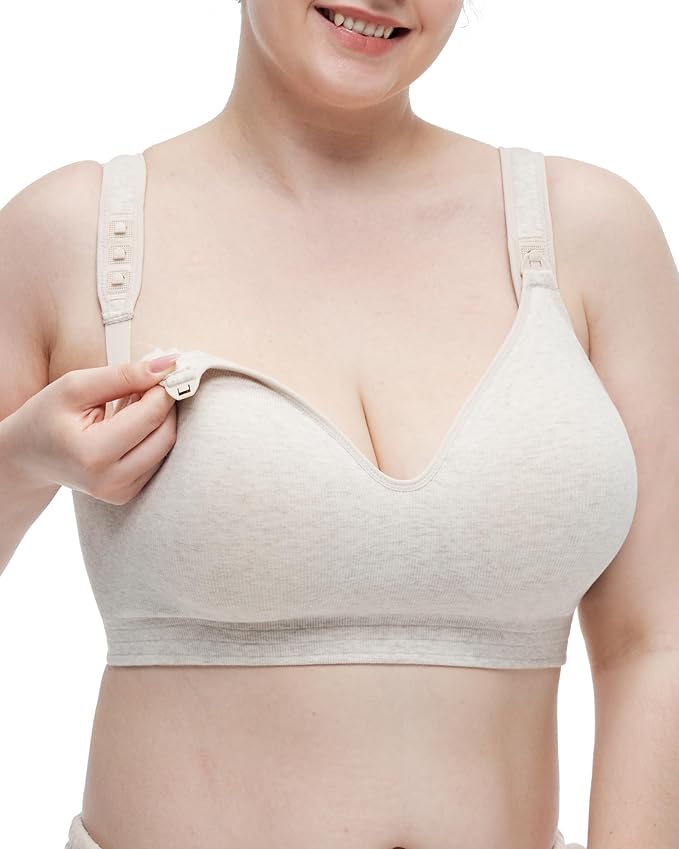
Full Support Nursing Bra
Designed for late pregnancy and postpartum. Wide band support reduces back strain as your ribcage expands. Easy one-hand clasp for breastfeeding.
Disclosure: As an Amazon Associate, we may earn from qualifying purchases at no extra cost to you.
Pregnancy Weight Gain Calculator:
How Much Should You Really Gain?
A straight-talking, week-by-week guide to healthy pregnancy weight gain — personalised by your BMI, trimester, and whether you’re carrying one baby or two.
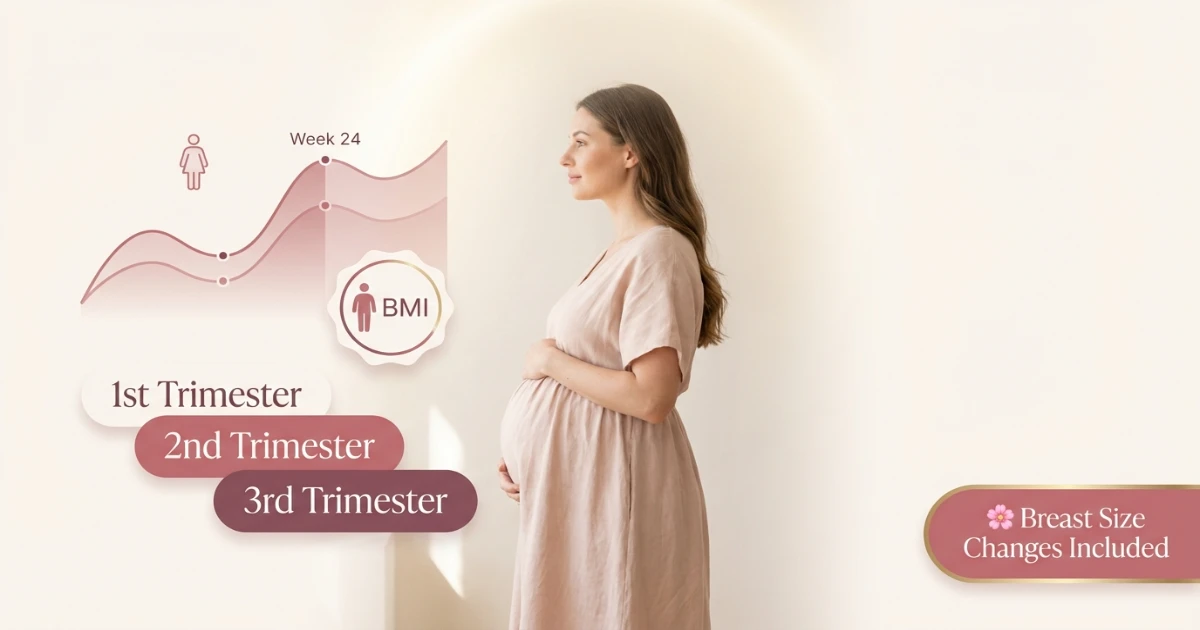
If you’ve just Googled “how much weight should I gain during pregnancy” and landed here — you’re in good company. It’s one of the most-searched questions in pregnancy, and honestly, one of the most confusing. Between well-meaning relatives, outdated advice, and the internet’s habit of serving up contradictory answers, it’s hard to know what’s actually true for your body.
Here’s the thing: there’s no single correct number that applies to every pregnant woman. The amount of weight you should gain depends on what you weighed before pregnancy, how many babies you’re carrying, and what week you’re at right now. Our calculator above handles all of that for you — but this article walks you through exactly what it means and why it matters.
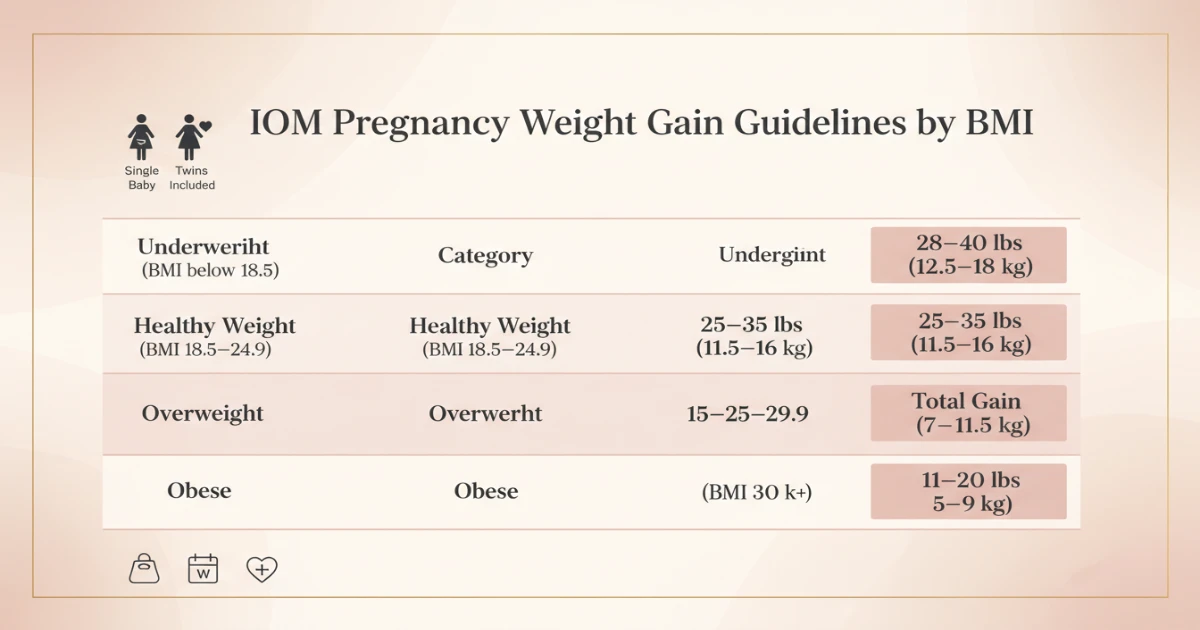
According to the Institute of Medicine (IOM), healthy-weight women (BMI 18.5–24.9) should gain 25–35 lbs (11.5–16 kg) over a full-term pregnancy. Underweight women should gain more (28–40 lbs), while overweight women should aim for less (15–25 lbs). These ranges exist to protect both maternal and infant health.
The IOM published these guidelines in 2009 and they remain the global gold standard — used by OB-GYNs, midwives, and maternal health organisations worldwide. They’re not arbitrary numbers. They’re based on decades of research linking weight gain ranges to healthy birth weight, lower complication rates, and easier postpartum recovery.
IOM Pregnancy Weight Gain Guidelines by BMI
Before you can use any pregnancy weight gain chart meaningfully, you need to know your pre-pregnancy BMI — the number that determines which range applies to you. If you’re unsure, plug your height and weight into the calculator above and it’ll work it out instantly.
| Pre-Pregnancy BMI | Category | Single Baby (Total) | Twins (Total) | 2nd/3rd Trim Rate |
|---|---|---|---|---|
| Below 18.5 | Underweight | 28–40 lbs (12.5–18 kg) | No guideline established | ~1 lb/week |
| 18.5 – 24.9 | Healthy Weight | 25–35 lbs (11.5–16 kg) | 37–54 lbs (16.8–24.5 kg) | ~1 lb/week |
| 25.0 – 29.9 | Overweight | 15–25 lbs (7–11.5 kg) | 31–50 lbs (14.1–22.7 kg) | ~0.6 lb/week |
| 30.0 and above | Obese | 11–20 lbs (5–9 kg) | 25–42 lbs (11.3–19.1 kg) | ~0.5 lb/week |
Important: These are guidelines, not strict rules. Some women gain slightly outside these ranges and have perfectly healthy pregnancies. What matters most is the pattern of gain — steady and gradual — not hitting an exact number. Always discuss your specific situation with your healthcare provider.
How to Use the Pregnancy Weight Gain Calculator
Our calculator above is designed to give you a fully personalised result in under 60 seconds — no sign-up required, no vague generic ranges. Here’s exactly how to use it:
- 1
Choose your measurement unit
Toggle between metric (kg / cm) and imperial (lbs / inches) using the button at the top of the form. The calculator automatically converts everything for you.
- 2
Enter your pre-pregnancy weight and height
Use your weight before you became pregnant — not your current weight. This is what determines your BMI category and therefore your recommended range. The calculator will show your BMI and category instantly as you type.
- 3
Enter your age and select how many babies you’re carrying
Twin and multiple pregnancies have significantly higher weight gain targets. Select “Twins” or “Triplets+” if applicable — the calculator will apply the correct IOM ranges for multiple pregnancies.
- 4
Drag the week slider to your current pregnancy week
This tells the calculator where you are in your pregnancy right now. The trimester badge will update automatically — and the results will show how much weight you’d expect to have gained so far, so you can see whether you’re on track.
- 5
Optionally enter your current weight
Adding your current weight lets you compare your actual gain to the expected range for your week. This is completely optional but gives you a richer picture of your progress.
- 6
Tap “Calculate My Results”
You’ll receive your personalised total gain range, a week-by-week chart, a breakdown of where the weight goes in your body, breast size change guidance, trimester-by-trimester milestones, and tailored recommendations for your BMI category.
Unlike any other pregnancy weight calculator online, ours includes a breast-specific section that tells you exactly how many cup sizes to expect at your current week — and links you directly to our bra size calculator so you can get properly fitted throughout your pregnancy.
Pregnancy Weight Gain by Trimester
Understanding weight gain trimester by trimester matters as much as the total number. A woman who gains 15 lbs in her first trimester and barely anything after has a very different risk profile than one who gains steadily. Here’s what a healthy pattern looks like at each stage.
First Trimester (Weeks 1–13)
The first trimester is famous for morning sickness, exhaustion, and, for most women, very modest weight gain. Most healthy-BMI women gain just 1–4 lbs total across the entire first trimester. Some gain nothing. Some actually lose a little weight due to nausea and food aversions — and that’s completely normal as long as you’re staying hydrated and taking prenatal vitamins.
Your baby is still tiny during these weeks (about the size of a lime by Week 13), so the weight you do gain is mostly coming from increased blood volume, uterine growth, and — notably — breast tissue. Many women find their bra stops fitting comfortably as early as Week 6 or 7.
Gaining more than 5–6 lbs in the first trimester can be worth mentioning to your doctor, as rapid early gain has been linked to gestational diabetes risk. This is especially relevant if you weren’t expecting twins.
Second Trimester (Weeks 14–26)
The second trimester is when most of the meaningful weight gain begins. For healthy-weight women, the IOM recommends gaining roughly 1 lb per week through this period. Nausea usually eases, appetite returns, and your baby is growing rapidly — going from a few ounces to around 2 lbs by Week 26.
This is also the trimester where your body is laying down fat reserves for breastfeeding, your blood volume is increasing significantly, and your uterus is doing some of its most dramatic growing. You’ll start to look visibly pregnant, and your centre of gravity will begin to shift — something your bra fit will reflect too.
Third Trimester (Weeks 27–40)
In the third trimester, gain continues at roughly the same pace — around 0.8–1 lb per week — but much of it is now directly attributable to the baby, who goes from about 2 lbs at Week 27 to a full-term 7–8 lbs by Week 40. Amniotic fluid volume peaks around Week 34–36, and your body is also holding more fluid generally.
Interestingly, some women find their weight plateaus or even drops slightly in the final 1–2 weeks. This is common and doesn’t signal a problem — the body often drops some fluid before labour begins.
Bra fitting tip for the third trimester: Your breasts are at or near maximum size now, and colostrum (early milk) production has likely started. Underwire bras can restrict milk ducts during this stage. A soft-cup maternity bra or nursing bra is the most comfortable and functional choice — ideally fitted at or after Week 34.
Where Does Pregnancy Weight Actually Go?
One of the most surprising things first-time mothers discover is that very little of pregnancy weight gain is actual body fat. At full term, a typical 30-lb gain for a healthy-weight woman breaks down something like this:
| Component | Approximate Weight | % of Total Gain |
|---|---|---|
| Baby | 7–8 lbs (3.2–3.6 kg) | ~22% |
| Placenta | 1.5–2 lbs (0.7–0.9 kg) | ~6% |
| Amniotic fluid | 2 lbs (0.9 kg) | ~7% |
| Uterus growth | 2 lbs (0.9 kg) | ~7% |
| Breasts | 1–3 lbs (0.5–1.4 kg) | ~6% |
| Blood volume increase | 3–4 lbs (1.4–1.8 kg) | ~12% |
| Body fluids | 3 lbs (1.4 kg) | ~10% |
| Fat & nutrient stores | 6–9 lbs (2.7–4 kg) | ~30% |
Notice that the fat stores — the part people worry about most — represent less than a third of total weight gain, and most of it is necessary to support breastfeeding. After delivery, women typically lose 10–13 lbs immediately (baby, placenta, fluids) — which is why so many new mothers are surprised that the scale doesn’t return to normal overnight.
Breast Size Changes During Pregnancy
Breast changes are often the very first sign of pregnancy — even before a missed period for some women. And throughout pregnancy, your breasts go through more structural change than almost any other part of your body. Yet this is the aspect of pregnancy weight gain that virtually no other calculator addresses. We think that’s a gap worth filling.
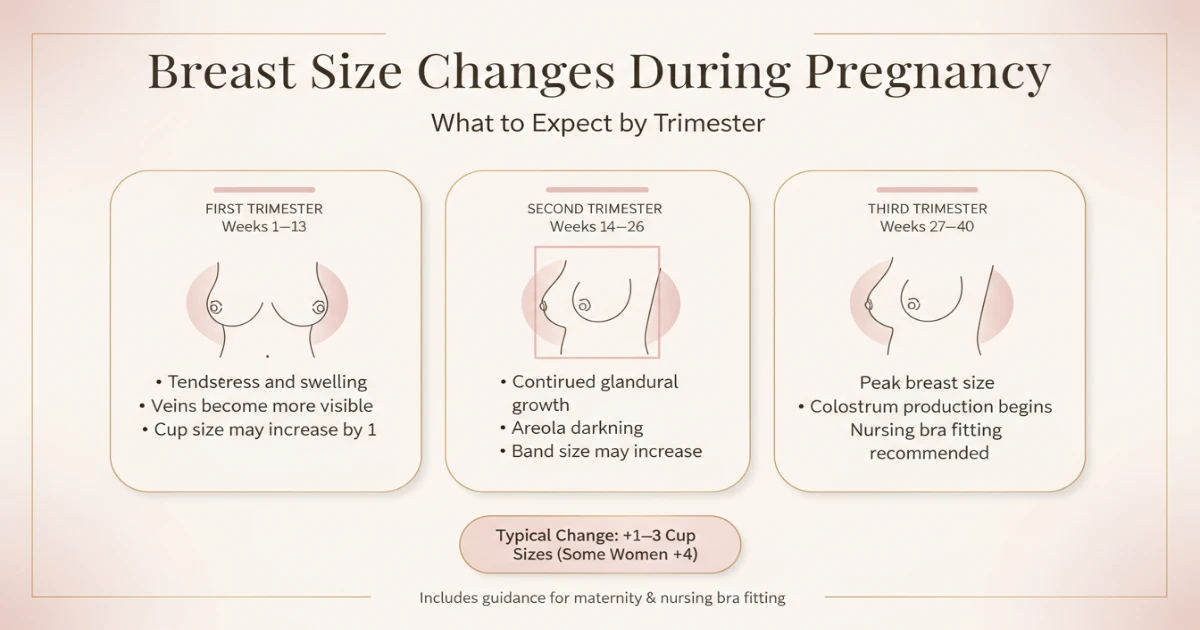
How many cup sizes will you go up?
The average woman goes up 1–3 cup sizes during pregnancy, though some women experience a full 4-cup increase — particularly those who begin with a smaller cup size or are expecting twins. This isn’t just a cup size change either. The band size (the number) often increases by 1–2 sizes too, as the ribcage naturally expands to accommodate the growing uterus.
This is why it’s not enough to just go up a cup size in your existing bra. You likely need a completely new size — both number and letter — at multiple points during pregnancy. Most specialists recommend getting re-fitted at least twice: once in the second trimester and once in the third (for a maternity or nursing bra).
An ill-fitting bra during pregnancy doesn’t just cause discomfort. It can contribute to back and shoulder pain (which is already worsened by postural changes), restrict circulation, and in later pregnancy, compress milk ducts — which can affect breastfeeding. Getting fitted correctly is genuinely one of the most practical things you can do for your comfort in the second and third trimesters.
If you’re wondering when to buy a maternity bra, the honest answer is: as soon as your current bras feel tight or uncomfortable. For most women that’s somewhere between Week 8 and Week 14. Don’t wait until you’re in pain. And don’t buy a large supply of maternity bras early on — your size will continue to change, so buying 2–3 well-fitting bras at a time is the smarter approach.
Pregnancy Weight Gain With Twins
Carrying twins changes the weight gain picture significantly — and many standard pregnancy calculators simply apply single-baby numbers with a rough doubling, which isn’t accurate. The IOM has specific twin pregnancy guidelines that our calculator applies correctly.
For a healthy-BMI woman carrying twins, the IOM recommends a total gain of 37–54 lbs (16.8–24.5 kg). That’s roughly 1.5 times the single-baby range. For overweight mothers of twins: 31–50 lbs. For obese mothers: 25–42 lbs.
The higher recommended gain for twin pregnancies reflects the need to support two placentas, two babies, a larger amniotic fluid volume, and greater blood volume expansion. Twin pregnancies also tend to be shorter — most twins are delivered between Weeks 35–38, so the gain pattern is slightly more compressed.
For twin pregnancies specifically, weekly monitoring by your OB-GYN or midwife is even more important. Weight gain that slows or stalls in a twin pregnancy can be an earlier warning sign than in single pregnancies, so staying on top of your numbers matters more.
Frequently Asked Questions (FAQs)
These are the questions real women ask most — the “People Also Ask” questions Google surfaces most often on this topic. We’ve answered every single one with the nuance they deserve.
It depends entirely on your pre-pregnancy BMI. According to IOM guidelines: underweight women (BMI below 18.5) should gain 28–40 lbs; healthy-weight women (BMI 18.5–24.9) should gain 25–35 lbs; overweight women (BMI 25–29.9) should gain 15–25 lbs; and obese women (BMI 30+) should gain 11–20 lbs.
These numbers apply to a single baby. If you’re carrying twins, add roughly 50% to each range. Our calculator above will give you the exact range for your measurements and how many babies you’re expecting.
The first trimester is typically very low-gain. For most healthy-weight women, gaining just 1–4 lbs total across all 13 weeks is normal and expected. This is because your baby is still tiny (less than 3 inches at 12 weeks), and much of your first trimester may involve nausea, vomiting, and food aversions that limit caloric intake.
Some women lose weight in the first trimester — particularly those with severe morning sickness (hyperemesis gravidarum). As long as you’re staying hydrated and your healthcare provider isn’t concerned, this is generally fine. The body compensates in the second trimester.
After the first trimester, the average rate of gain for a healthy-weight woman is roughly 0.8–1 lb (0.35–0.45 kg) per week. For overweight women, it’s closer to 0.5–0.7 lbs per week. For obese women, 0.4–0.6 lbs per week.
These weekly averages are guides — your actual gain won’t be perfectly linear. You might gain 1.5 lbs one week and 0.3 lbs the next. What matters is the overall trajectory over several weeks, not any single week’s number.
Most women experience their fastest rate of weight gain between Weeks 20 and 32. This is when the baby grows most rapidly, blood volume is at its peak expansion, and the body is actively building fat reserves for breastfeeding.
After Week 36, weight gain often slows. Some women plateau entirely in the final weeks before birth, and a small number lose 1–2 lbs as the body sheds some fluid in preparation for labour. This is completely normal.
Yes — breast tissue growth is included in your total pregnancy weight gain. On average, breasts contribute 1–3 lbs to total weight gain, representing around 5–6% of the total. This breast weight increase is due to glandular tissue development, increased blood supply, and preparation of the milk ducts.
Because breast growth is part of your total gain, it’s not something to try to avoid or reduce — it’s a healthy and necessary component. If your breasts are growing rapidly in the first trimester, that’s normal and is one of the earliest signs that your hormone levels are supporting a healthy pregnancy.
The average is 1–2 cup sizes by the end of the first trimester, increasing to 2–4 cup sizes by the third trimester. However, there’s a wide range — some women go up only one size throughout their entire pregnancy, while others experience dramatic changes, especially in the first pregnancy.
Beyond the cup size, the band size (the number in your bra size) also often increases by 1–2 sizes as the ribcage expands. This is why many women find that simply buying a larger cup in their existing band size doesn’t give them a good fit during pregnancy.
- First trimester: Cup may grow 1 size. Tenderness is common.
- Second trimester: Both cup and band size may increase together.
- Third trimester: Maximum size reached. Nursing bra fitting recommended.
Intentional weight loss is generally not recommended during pregnancy, even for overweight or obese mothers. Your baby needs a steady supply of nutrients regardless of your starting weight, and restricting calories can deprive the baby of what it needs to develop properly.
That said, overweight and obese mothers do have lower recommended weight gain ranges (15–25 lbs and 11–20 lbs respectively) — and some women with higher starting BMIs naturally gain very little early in pregnancy without any restriction.
If you’re concerned about excessive gain or want guidance on eating well without over-gaining, the best approach is to work with a registered dietitian alongside your OB-GYN, not to restrict calories on your own.
Gaining significantly more than the IOM recommended range is associated with higher risk of several complications, including:
- Gestational diabetes (high blood sugar during pregnancy)
- Preeclampsia (pregnancy-related high blood pressure)
- Larger baby (macrosomia), which can complicate delivery
- Higher likelihood of caesarean section
- More difficulty losing post-pregnancy weight
If you find you’re gaining faster than expected, speak to your midwife or OB-GYN — a referral to a dietitian is often the most helpful next step. Small dietary adjustments made early are much easier than trying to control gain in the third trimester.
Insufficient weight gain is associated with its own set of risks: low birth weight, premature birth, and developmental challenges for the baby. Underweight gain can also mean the mother’s body is not building the fat reserves needed for breastfeeding, which can affect milk supply after delivery.
If you’re gaining less than expected — especially after the first trimester — it’s worth discussing with your healthcare provider. In many cases, there’s a simple dietary explanation. In others, it can be a sign that the baby needs closer monitoring.
The simple answer: as soon as your current bra becomes uncomfortable. For most women this happens between Weeks 8 and 14, when breast tenderness and swelling become noticeable. Don’t push through discomfort — an ill-fitting bra can contribute to back pain that’s already worsened by your changing posture.
A practical schedule for most women looks like this:
- Week 8–14: First re-fit, typically moving to a maternity bra or larger everyday bra.
- Week 20–26: Second re-fit as both band and cup size continue to grow.
- Week 34–38: Third re-fit for a nursing bra (if planning to breastfeed) that also works postpartum.
Use our bra size calculator to get your current size at any point during pregnancy.
At 20 weeks, a healthy-weight woman would typically be expected to have gained around 8–12 lbs total. A gain of 20 lbs at this point is above the expected range and worth discussing with your healthcare provider — not to alarm you, but to understand what’s driving the gain and whether any adjustments would be helpful.
It’s worth noting that rapid gain in the second trimester can sometimes be related to water retention or gestational diabetes, both of which your midwife or OB-GYN can assess. In some cases it’s entirely benign. Either way, it’s better to flag it early than to wait.
A pregnancy weight gain calculator that applies IOM guidelines — like the one on this page — is accurate in the sense that it correctly calculates the recommended range for your BMI and situation. It reflects the same numbers your OB-GYN would reference.
What a calculator can’t do is account for individual medical factors — conditions like preeclampsia, gestational diabetes, IUGR (intrauterine growth restriction), or a prescribed bed rest situation all affect weight gain patterns in ways that require clinical judgement, not a formula. Use this calculator as an informed starting point for conversations with your healthcare provider, not as a substitute for medical advice.
Managing Pregnancy Weight Gain: Practical Tips That Actually Help
Reading guidelines is useful. Living with them is a different challenge entirely. Here are the tips that are consistently backed by evidence — without the moralising tone that makes pregnancy nutrition advice so frustrating to read.
The “eating for two” idea has been thoroughly debunked — in the first trimester, you don’t need any extra calories at all. In the second, an extra 340 calories per day is the general recommendation. In the third, it rises to about 450. That’s roughly two eggs and a piece of toast, not a second meal. But rather than counting calories, focus on whether what you’re eating is nutrient-dense. Protein, fibre, healthy fats, and plenty of vegetables will naturally support appropriate gain without obsessive tracking.
Water retention is a significant and unpredictable factor in pregnancy weight gain, particularly in the second and third trimesters. Your ankles swell. Your rings stop fitting. You might gain 2 lbs in a week that’s entirely fluid. Staying well-hydrated (counterintuitively) actually helps reduce water retention, and weighing yourself at the same time of day — after emptying your bladder and before eating — gives you more consistent readings.
The evidence for exercise in pregnancy is strong — not just for weight management, but for reduced gestational diabetes risk, better sleep, reduced back pain, and shorter labour. Walking is the easiest entry point. Swimming is excellent for later pregnancy because it takes pressure off your joints and spine. Most healthy pregnant women can safely continue their pre-pregnancy exercise routine with modifications — always confirm with your provider if you’re unsure.
Daily weighing during pregnancy creates anxiety without useful data — the day-to-day fluctuations from fluid, food, and bowel movements easily dwarf any real trend. Weekly weighing, at the same time and day each week, gives you a much more honest picture of your trajectory without the noise.
Don’t forget your bra size is changing too. As your weight increases, your band and cup measurements shift — sometimes significantly. An ill-fitting bra creates discomfort, exaggerates back pain, and (in late pregnancy) can compress developing milk ducts. Use our bra size calculator to check your fit at each trimester.
A Note From Us
Pregnancy is one of the most remarkable things a human body can do — and your body is going to change in ways that can feel overwhelming, confusing, and sometimes just plain uncomfortable. Weight is just one of those changes. The numbers exist to guide and protect, not to judge.
We built this calculator — and this article — because we believe women deserve accurate, personalised information delivered without the usual mix of anxiety and ambiguity. You should know what’s normal for your body. You should know that your bra size is probably changing too, and that getting fitted correctly is one of the most genuinely practical things you can do for your comfort right now.
Use the calculator. Read the chart. Ask your midwife or doctor about anything that doesn’t look right. And take good care of yourself — you’re doing something extraordinary.
🔢 Use the Calculator