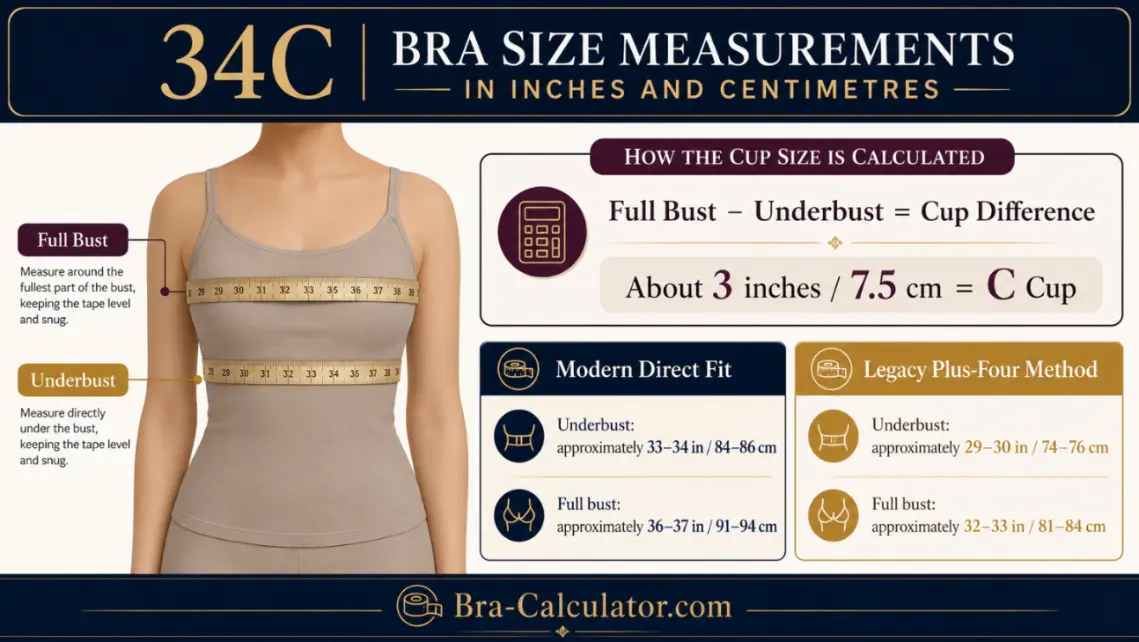
A 34C bra size fits an underbust of roughly 33–34.5 inches and a bust of 36–37.5 inches. The “34” represents the band, and the “C” reflects a 3-inch difference between bust and underbust. Fit depends on band tension, cup containment, and wire placement — not the letter alone.
- Underbust: ~33–34.5 in (snug, not compressed)
- Bust: ~36–37.5 in
- Difference: ~3 in
That’s the starting range most people land in. Brands vary, so these numbers point you to a size to try — not a guaranteed fit off the rack.
Quick fit checklist (30 seconds):
- Band stays level on loosest hook
- Gore tacks flat
- No spill / no gap
- Wire sits on ribcage crease, not tissue
- Straps don’t carry the weight

Table of Contents

What 34C Bra Size Actually Means
A bra size has two parts that only make sense together: the band and the cup. Get one wrong and the whole thing fails, no matter how good the bra looks on a hanger.
The Band: 34
The band number is the size label designed to fit your underbust range (measured firm and level under the bust). The band does the heavy lifting — roughly 70–80% of the support comes from here, not the straps. When it’s right, it sits level across your back, doesn’t shift when you raise your arms, and holds firm without cutting in.
The most common fitting mistake: going up a band size because it feels more comfortable, then tightening the straps to compensate. That pushes all the support onto your shoulders, which is exactly what a well-fitting band is supposed to prevent.
The Cup: C
The letter tells you the difference between your bust and underbust measurements — not how large your breasts are in any absolute sense. A C cup means roughly a 3-inch gap. That’s all it is.
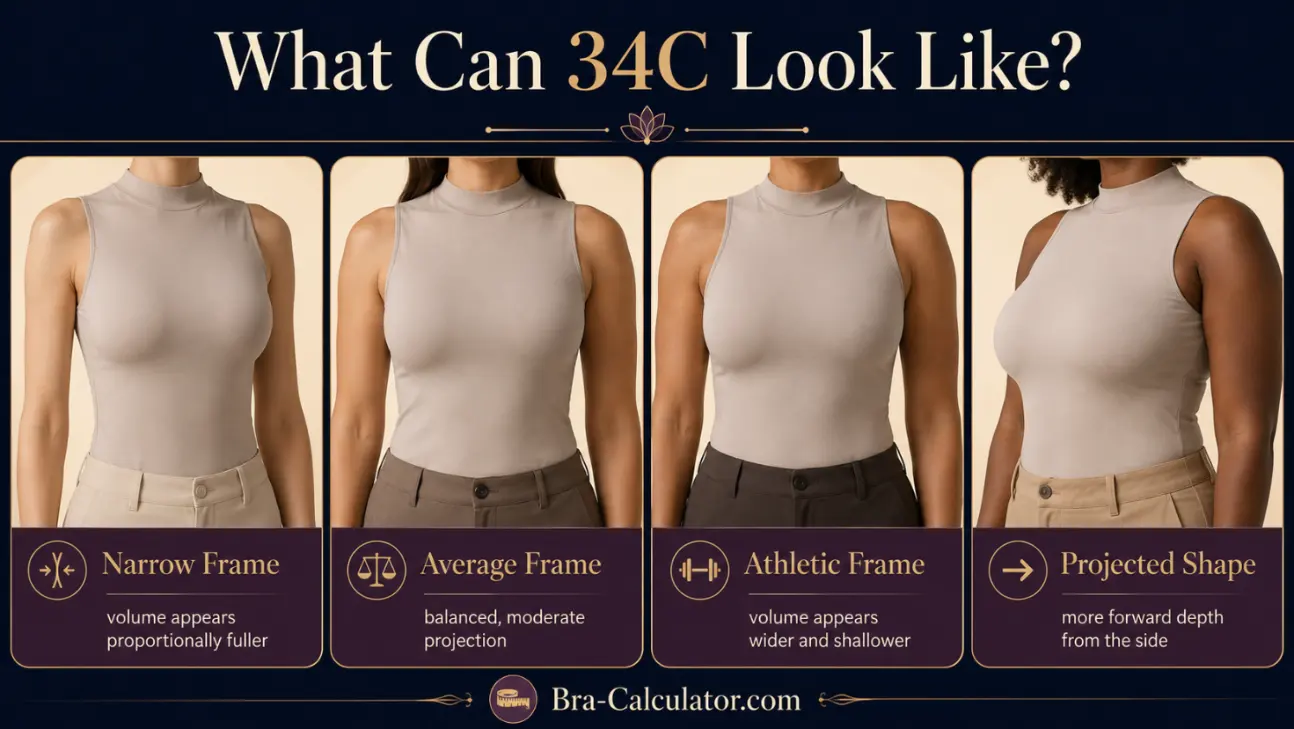
Cup letters scale with the band. A C cup on a 34 band holds a different volume than a C cup on a 38. Two women both wearing a “C cup” can look completely different, because they may be in entirely different volumes. This is why “C cup” as shorthand for breast size doesn’t really hold up.
The Volume
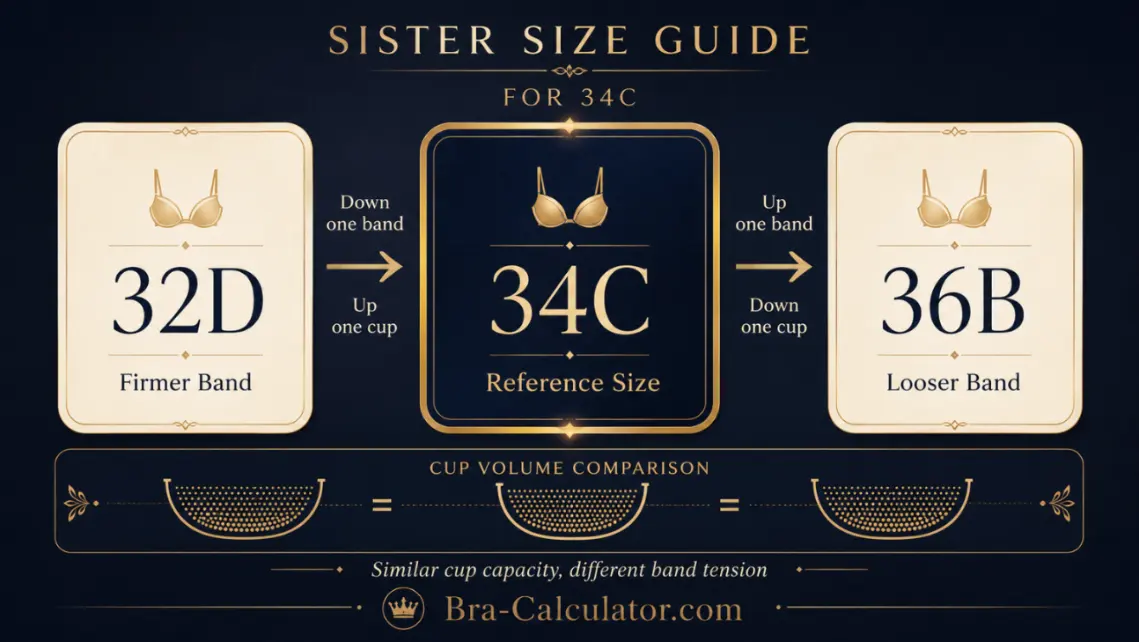
Because cup volume is tied to band size, bra fitting uses sister sizes — different band/cup combinations that hold similar breast volume. More on those below, but the underlying principle matters here: 34C is a pair of numbers, not a standalone measurement.
34C vs. 34B vs. 34D — Fast Comparison
Same band, different cup volume. If you’re deciding between neighboring sizes:
| Size | Cup Difference | What It Means |
|---|---|---|
| 34B | ~2 inches | Less cup volume than 34C |
| 34C | ~3 inches | The reference point in this guide |
| 34D | ~4 inches | More cup volume than 34C |
Spilling out of your cups? Try 34D before assuming you need a whole new band size. Cups gaping or wrinkling? Try 34B, or look for a style with a more closed-top cut — sometimes it’s shape, not size.

This comparison block answers one of the most searched questions around this size, so it’s worth pausing here before you shop.
How to Measure Yourself
You need a soft fabric measuring tape. Skip padded bras for this — measure without a bra, or in a thin, non-padded one.
Step 1 — Measure Your Underbust (Band Base)
Stand tall. Wrap the tape directly under your bust, keeping it level across your back. Pull it firm — a snug hug, not squeezed — then exhale gently and read the number. Round to the nearest whole inch.
Modern fitting rule: Most current brand guides use your rounded underbust measurement as your band size directly. If your underbust reads 33 inches, you’re likely a 34 band. No adding 4 or 5 inches needed.
Some older size charts and a handful of brands still use the “add 4 inches” formula — if you’re shopping from a brand with legacy sizing or you come out between band sizes, check that brand’s specific guide. The method varies, and it’s the reason a 34 in one brand can fit like a 36 in another.
Step 2 — Measure Your Bust
Wrap the tape around the fullest part of your chest, usually at nipple height. Keep it parallel to the floor. Don’t pull it taut — let it lay flat without pressing into the tissue.
Step 3 — Find Your Cup Size
Subtract your underbust from your bust. Each inch of difference is one cup size:
| Difference | Cup |
|---|---|
| 1 inch | A |
| 2 inches | B |
| 3 inches | C |
| 4 inches | D |
| 5 inches | DD/E |
A 3-inch gap with a 34-inch underbust = starting point of 34C. From here, you try it on and use the fit checklist below to confirm or adjust. If you’d rather skip the math, use our Bra Size Calculator to confirm your band and cup before trying sizes in-store.
How to Check If Your 34C Fits
Measurements give you a first size to try. The fit check tells you if it’s actually working.
The Band
Hook it on the loosest set of hooks. The band should run straight across your back — not angled up toward your shoulder blades. Slide two fingers under the back of the band: they should fit, but with resistance. More than two fingers with room to spare means the band is too loose. Can’t get two fingers in at all? Too tight.
Lift both arms overhead. The band should stay put. If it rides up, the band is too loose — even if it felt fine when you first put it on.
The Cups
All breast tissue should sit inside the cup: front, sides, and top.
- No tissue overflowing the top edge or escaping near the armhole
- No cup fabric pulling away from your skin (gaping)
- No wrinkles in the cup (excess space)
- The center gore (the panel between the cups) flat against your sternum, not floating

The Underwire
The wire should follow the natural crease at the base of your breast — not sit on breast tissue, not press into your ribs, not dig into your underarm. If it consistently pokes in one spot even in the correct size, that’s usually a wire shape problem, not a size problem. Different styles have different wire geometries.
The Straps
Straps are for fine-tuning, not for holding everything up. If you’re tightening them constantly or finding red grooves by midafternoon, the band isn’t doing its job. Adjust until they lay flat on your shoulders and pass the shrug test — they shouldn’t slide off when you roll your shoulders back.
Overall
A well-fitting 34C should feel stable, quiet, and non-distracting. If you’re tugging at it, re-adjusting, or thinking about taking it off before noon, something is off — whether that’s the size, the style, or how that particular brand cuts its bras.
Common Fit Problems and Their Fixes
Most fit issues trace back to one or two things. Here’s how to read what your bra is telling you:
Spillage over the top of the cup — cup too small. Go up to 34D.
Cups gaping or wrinkling — cup too large, or the style is too open at the top for your breast shape. Try 34B, or a more closed-top style in the same size.
Band riding up your back — band too loose, even if the cups feel fine. Size down in the band and up in the cup: 32D keeps roughly the same volume. If this happens regularly, review our guide on why your bra band rides up and how to correct it properly.

Band feels too tight but cups are right — try a sister size with a larger band. 36B holds similar cup volume on a looser band.
Side spillage near the armhole — cup too small, or the style has insufficient side coverage. Try 34D, or a style built with more side panel depth.
Underwire digging into ribs or sternum — usually the cup is too small to push the wire past your breast tissue. Try a larger cup, or a different wire shape (balconette wires sit differently than T-shirt bra wires).
Strap grooves on your shoulders — the band isn’t carrying the load. The fix is almost never wider straps — it’s a better-fitting band.
If you’re between sizes (most people are)
- If you spill → size up cup first (34D)
- If you gap → size down cup or change style (34B or closed-top cup)
- If band rides → 32D
- If band digs → 36B
Sister Sizes — When to Try a Different Band
Sister sizes share similar cup volume but redistribute it across a different band. When a 34C is close but doesn’t feel stable and forgettable, sister sizing is the first thing to try.
Primary sister sizes for 34C:
| Band | Cup | Notes |
|---|---|---|
| 32 | D | Narrower, deeper cups — good if 34 band rides up |
| 34 | C | Your reference size |
| 36 | B | Wider, shallower cups — good if 34 band digs in |
Extended sister sizes (less common, but valid):
| Band | Cup | Notes |
|---|---|---|
| 30 | DD | For smaller frames needing firmer hold |
| 38 | A | For wider frames with the same cup volume |
Sister sizes keep cup volume similar, but the wire width and cup shape change with the band — so fit can still differ.

One thing to keep in mind: “similar cup volume” doesn’t mean identical fit. When the band changes, so does the wire width and cup shape. A 32D will have narrower, deeper cups than a 36B — same volume, different geometry. So sister sizing works better for some breast shapes than others. Try before you commit. For a detailed breakdown of how 36B compares in shape and support, see our complete 36B bra size guide before changing bands.
When to use a sister size:
- The cups feel right but the band consistently shifts or digs in
- A specific brand runs tight or loose in the band
- You’re between band sizes and need to find your direction
Not sure how sister sizing works across bands? See the full sister size chart for a visual breakdown of equivalent volumes.
Choosing the Right Style for Your Shape
Sizing tells you the volume. Style tells you the shape. Two people in 34C can need completely different bras depending on how their breast tissue is distributed.
By Breast Shape
Fuller on top (tissue sits above the nipple): Open-top styles like balconettes tend to fit better. Full-coverage cups can flatten and compress rather than lift.
Fuller on bottom (tissue sits below the nipple): Deeper cups with more structure below the underwire give better lift. T-shirt bras and full-coverage styles work well.
Wide-set (noticeable space between the breasts): Balconettes with wider strap placement match the natural spacing. Plunge styles often leave the center gore floating rather than flat.
Close-set (breasts sit near together at center): Plunge bras work here because the gore is lower and narrower. Standard T-shirt bra wires can press into the sternum.

By Style
| Style | Best For |
|---|---|
| T-shirt / seamless molded | Fitted tops, daily wear, smooth silhouette |
| Plunge | Deep V-necks, wrap styles, close-set breasts |
| Balconette | Square or wide necklines, wide-set breasts |
| Full coverage | Long days, heavier tissue, work wear |
| Push-up | Occasional/evening wear, added projection |
| Wireless bralette | Low-impact days, soft tissue, relaxed fit |
| Strapless / convertible | Off-shoulder, strapless, backless outfits |
| Sports bra | Exercise, high impact, all-day active wear |
A rotation of four or five styles covers most wardrobe needs without asking one bra to do everything: an everyday seamless, a plunge, a strapless, and a sports bra is a solid starting lineup.
Two bras that usually fit 34C *right* (stable band, clean cups)
If your 34C is close but not “forgettable,” these two styles cover the most common needs: smooth everyday + structured lift.
Seamless T-Shirt Bra for 34C (Invisible Under Tops)
Made for fitted tees: smooth finish, stable band feel, and molded cups that help reduce gaping on everyday 34C wear.
- Works best when you want a clean silhouette (no texture)
- Helps if your cups slightly gap in open-top styles
- Good “baseline bra” to test if 34C is truly your size
daily tees + smooth tops
Supportive Balconette for 34C (Lift + Better Shape)
Great when you want lift and a defined shape. Balconette geometry can help wide-set or fuller-on-bottom 34C breasts feel more “locked in.”
- Stronger lift than many molded T-shirt bras
- Helpful if you get side spillage in low-coverage cuts
- Better for square / wide necklines and dressier outfits
lift + structured shape
Affiliate note: If you buy through these links, we may earn a small commission at no extra cost to you.
Fabric and Occasion
Fabric
Cotton is breathable and soft, good for heat or sensitive skin. Can add visible volume under thin, clingy fabrics — keep that in mind under fitted tops.
Microfiber sits thin and smooth under T-shirts or button-downs. Nearly invisible under fitted clothes. Less breathable than cotton for long wear.
Lace has some natural stretch, which is useful if your breasts are slightly different sizes. Shows through sheer or smooth fabrics, but works well under looser tops and dresses.
Memory foam cups mold to your shape over time. Worth trying if molded cups leave a gap at the front because your tissue is soft or less projected.
Moisture-wicking blends matter in sports bras — they pull sweat away from skin and cut down on chafing. Worth prioritizing if you’re active or run warm.

Care note: lace, microfiber, and memory foam cups hold their shape significantly longer when hand-washed and line-dried. Frequent machine washing — even gentle cycles — stretches band elastic faster than wear alone.
Matching Bra to Occasion
This isn’t about aesthetics — it’s about function. A strapless for off-shoulder outfits keeps straps hidden. A seamless molded cup under a fitted knit prevents texture from showing through. A high-impact sports bra during exercise reduces bounce, which matters for ligament health over time.
For long days on your feet or hours of travel, a firmer band and wider straps reduce fatigue at the shoulders and upper back. The band does the lifting — if it’s doing its job, the straps coast.
How Your Size Shifts Over Time
A 34C at 25 isn’t guaranteed to be your size at 35 or 50. That’s not a flaw — it’s just how bodies work.
What moves band and cup size:
- Weight changes (band and cup can shift at different rates)
- Pregnancy and breastfeeding (sometimes significantly, and may not return to pre-pregnancy measurements)
- Hormonal changes — medication, menopause, even the natural cycle can affect fullness week to week
- Strength training or changes in body composition around the chest and back
- Aging — breast tissue becomes softer and less projected over time; a cup that fit at 30 can gap at 50 even at the same label size
Remeasure every 6–12 months, or after any notable body change. Don’t assume last year’s size is still correct.
How Long a Bra Lasts
Most bras hold their support for roughly 6–12 months of regular rotation. The band elastic breaks down with washing and wear — the reason a band that started snug on the loosest hook eventually feels loose on the tightest. Rotating three or four bras extends the life of each one.
Signs to replace: you can pull the back band more than a few centimeters from your body, the cups have lost their shape, the underwire has shifted or broken through the casing, or you’re uncomfortable even in a freshly-clasped bra.
International Size Conversions
Bra sizing isn’t standardized across countries or brands. Use this table as a starting reference, then verify with the specific brand’s size guide — especially for Japanese and Korean sizing, where letter conventions differ from Western systems.
| Region | Approx. Equivalent to US 34C |
|---|---|
| US / Canada | 34C |
| UK | 34C |
| EU | 75C |
| France / Spain | 90C |
| Italy | 3C |
| Australia / NZ | 12C |
| Japan / Korea | Often 75C range — confirm with brand chart |
Why it matters: two bras with matching label conversions can still fit differently because wire width, cup depth, and fabric stretch vary by manufacturer. A converted “34C” from a Japanese brand may be cut narrower than the same label from a US brand.
Japan / Korea note in particular: Some brand charts shift the letter system in ways that don’t map cleanly to standard Western conversions. When shopping Japanese lingerie brands, Triumph’s international guide is a useful cross-reference — but always treat it as a starting point, not a guarantee.

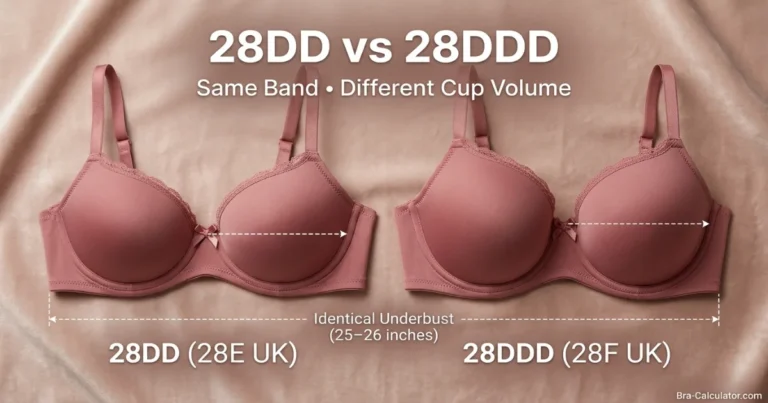
On DD vs. E: UK sizing uses E where US sizing uses DDD or F. The cup volume is the same — the letter is not. When buying from UK brands in extended cup sizes, double-check the letter, not just the number. France/Spain use different numbering (often band +15), which is why 75C (EU) becomes ~90C (FR/ES).
Frequently Asked Questions
What does 34C mean in a bra? The 34 is your band size — the circumference of your ribcage in inches, measured under your bust. The C is your cup — the difference between your bust and underbust measurements, in this case roughly 3 inches. The two numbers only make sense together. The band handles most of the support; the cup contains the breast tissue.
Is 34C a big or small cup size? Medium, in most contexts. But “big” and “small” depend on who’s wearing it. Cup volume is tied to band size — a C cup on a 34 band is a different volume than a C cup on a 30 or 38 band. On a petite frame it may look fuller; on a broader frame, more modest.
What are the sister sizes for 34C? The primary sister sizes are 32D (similar volume, smaller band) and 36B (similar volume, larger band). Extended sisters include 30DD and 38A. Use them when the cups fit but the band doesn’t, or when a specific brand runs consistently tight or loose.
Why does my 34C fit differently in different brands? Because sizing isn’t standardized. Brands differ in cup depth, wire shape, fabric stretch, and construction. A 34C from one brand can fit closer to a 34B or 34D from another. It’s not you — it’s the manufacturing variation. Finding brands that consistently work for your shape is worth noting for future shopping.
How do I know if my 34C band is too loose? Put it on the loosest hook. It should sit straight across your back and stay there when you raise your arms. Two fingers should fit under the back band, with resistance. If you can pull the band several centimeters away from your body, or if you’ve already moved to the tightest hook after a few months of regular wear, the band is done.
How often should I check my size? Every 6–12 months as a baseline, or after any significant body change: pregnancy, breastfeeding, weight shift, new medication, menopause. Fit drifts gradually, and it’s easy to keep wearing a size that no longer works just because it used to.
34C is close but not stable and forgettable. Start with adjacent cups (34B or 34D) before changing the band. If the band is the issue, try primary sister sizes — 32D if the band is too loose, 36B if it’s too tight. Fit is a process of narrowing down, not finding one magic number. If you’re considering this switch, read the full 34B size guide to understand how the cup depth and wire width differ from 34C.
Final Thoughts on 34C Bra Size
A 34C is a useful starting point, not a fixed identity. The number and letter narrow down your options — they don’t guarantee fit. A bra that actually fits holds firm without digging in, stays put without adjustment, and stops demanding your attention twenty minutes into the day.
If your current 34Cs do that, you’re set. If they don’t, the framework here — band, cup, sister sizes, style, shape — gives you a clear path to find ones that will. Remeasure when your body changes, try new styles when your wardrobe does, and don’t let a tag number overrule how something actually feels.
Last reviewed: February 2026. Sizing guidance reflects current fitting standards; individual brand cuts and sizing conventions vary.