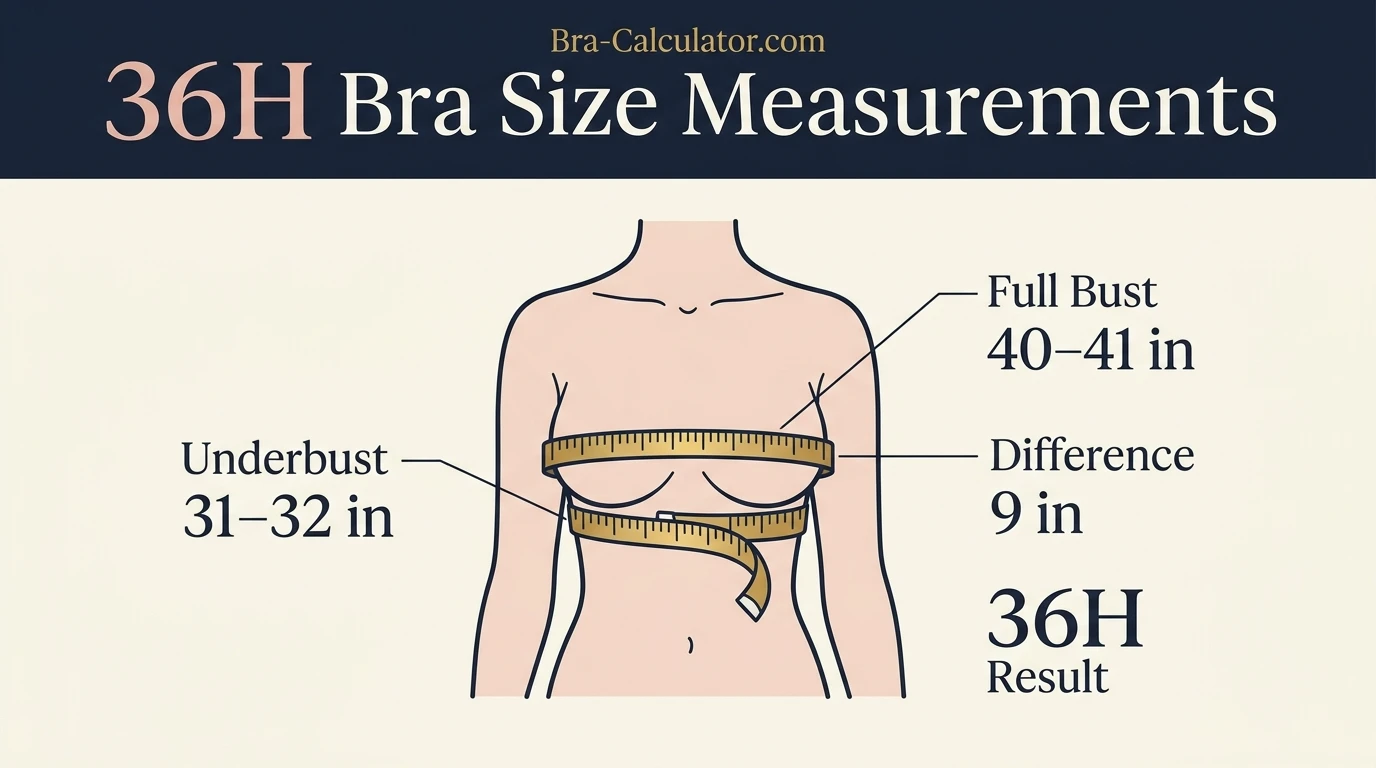
A 36H bra size usually means your underbust is around 31–32 inches (79–81 cm) and your full bust is around 40–41 inches (102–104 cm). That is about a 9-inch difference, which creates H cup depth on a 36 band. 36H is a fuller-bust size with strong projection, deep cup needs, and higher support requirements than 36G. A well-fitted 36H bra should anchor from the band, fully contain breast tissue, reduce shoulder strain, and prevent top, side, or center spillage.
36H at a Glance
| Attribute | Detail |
|---|---|
| Band Size | 36 inches — usually fits 31–32″ underbust / 79–81 cm |
| Full Bust Measurement | 40–41 inches / 102–104 cm |
| Cup Difference | About 9 inches / 22.5 cm — H cup level |
| General Category | Fuller-bust size / very deep cup volume |
| Sister Sizes | 34I tighter band · 38G looser band |
| Common Fit Issue | Loose band, floating gore, side spillage, strap digging, shallow cups |
| Best Bra Styles | Full-support, side-support, seamed balconette, deep plunge, minimizer |
| US Size Note | May be 36K or 36H depending on brand sequence |
| UK Size | 36H |
| AU / NZ Size | Usually 14H |
What Is a 36H Bra Size?
36H is a fuller-bust bra size that combines a 36 band with deep H cup capacity. In measurement terms, it usually fits someone with a snug underbust around 31–32 inches and a full bust around 40–41 inches. The difference between those two numbers is about 9 inches, which places the cup in the H range in UK-style sizing.
The number 36 describes the band. This part of the bra wraps around your ribcage and should provide most of the support. At H cup depth, the band is not just a comfort detail — it is the foundation of the whole fit. If the band rides up, the straps start carrying weight, the cups tilt forward, and the bust can feel heavier than it should.
36H is not just “an H cup.” Cup letters scale with band size. A 30H, 34H, 36H, and 40H do not hold the same physical volume. A 36H has more total cup volume than a 32H and less than a 40H. That is why band and cup must always be read together.
36H often fits people who previously wore sizes like 38G, 40F, 38DDD, 36G, or 40E and still had spillage, floating gore, strap pain, or unstable support. When 36H is correct, the bra should usually feel more secure — not heavier — because the tissue is contained, lifted, and supported by the band.
36H Bra Measurements
To confirm 36H, measure your underbust and full bust carefully. Fuller-bust sizes are sensitive to small measurement errors because one inch can move you toward 36G or 36I.
About 9 inches difference = H cup level on a 36 band
| Nearby Size | Typical Underbust | Typical Full Bust | When It Fits Better |
|---|---|---|---|
| 36G | 31–32″ | 39–40″ | If 36H cups wrinkle, gape, or feel too deep |
| 36H | 31–32″ | 40–41″ | Your reference size |
| 36I | 31–32″ | 41–42″ | If 36H spills or the gore floats |
| 34I | 29–30″ | 38–39″ | If 36H cup volume fits but band rides up |
| 38G | 33–34″ | 41–42″ | If 36H band feels too tight but cup volume is right |
Wrap the tape directly under your bust. Keep it level and snug. For 36H, this usually reads around 31–32 inches.
Measure around the fullest part of your bust. Do not flatten tissue, especially if your bust is projected, soft, or full at the center.
If your full bust is about 9 inches larger than your underbust, you are likely around H cup level on a 36 band.
The cups should fully contain tissue, the band should stay level, and the center gore should sit flat or close. If there is spillage, try 36I. If there is empty space, test 36G or a different cup shape.
36H Measurement Visual
What Does 36H Look Like?
A 36H usually looks full, projected, and highly noticeable. It has more cup depth than 36G and usually needs bras that lift from the base, contain side tissue, and prevent the bust from collapsing forward or spreading outward. But 36H does not look identical on every body.
On a taller or broader frame, 36H may look full but proportional. On a shorter torso, the same size can appear more prominent because there is less vertical space between shoulders, bust, and waist. On a wide-set shape, the volume may sit more toward the sides. On a projected shape, the bust may come forward strongly even in a supportive bra.
In clothing, 36H usually benefits from bras with real architecture: deep lower cups, supportive side panels, a firm band, and straps that stabilize rather than carry the entire weight. A good 36H bra can create a lifted, centered silhouette. A poor fit can create spillage, side bulging, strap grooves, or a low heavy look.

Full-Support Bra — Lift, Containment & Comfort for 36H
- Best for daily stability at H cup depth
- Helps reduce bounce, shoulder pressure, and breast heaviness
- Works best with firm bands, deeper cups, wide straps, and side support
- Ideal when shallow fashion bras spill, flatten, or collapse

Lift & Shape Bra — Side Control and Rounded Shape for 36H
- Helps bring fuller side tissue forward
- Creates a rounded, lifted silhouette under clothing
- Useful for wide-set, soft, projected, or bottom-heavy breast tissue
- Choose a deep cup version to avoid center or top spillage
Full and Balanced
On a fuller frame, 36H often looks full but proportional when lifted correctly from the band.
Full supportWider Chest Wall
Volume may spread wider across the chest. Side-support and seamed cups help bring tissue forward.
Side controlMore Visual Presence
36H may appear more prominent on a shorter torso because the bust occupies more vertical space.
Lift mattersDeep Cup Need
Projected 36H tissue needs deep cups. Shallow cups can cause overflow, gore floating, and wire pressure.
Deep cupsIs 36H Considered Large?
Yes, 36H is generally considered a fuller-bust size. It has strong projection, significant cup depth, and more visible volume than sizes like 36D, 36DD, 36F, or 36G. But “large” does not mean impossible to fit, uncomfortable, or unusual.
Many people wearing 36H have spent years in sizes like 38G, 40F, 38DDD, or 36G because those sizes were easier to find in stores. But when the cup is too small or the band is too loose, the bra can feel heavier than it should. A correct 36H often feels lighter because the tissue is contained, lifted, and supported by the band.
36H is full, but the right bra should not feel punishing. Good support comes from a stable band, deep cups, wide straps, and construction that matches your breast shape.
If 36H feels painful, unstable, or too heavy, check the band, cup depth, wire width, and sister sizes before assuming the size itself is wrong.
36H Sister Size & Fit Problem Visual
36H Sister Sizes
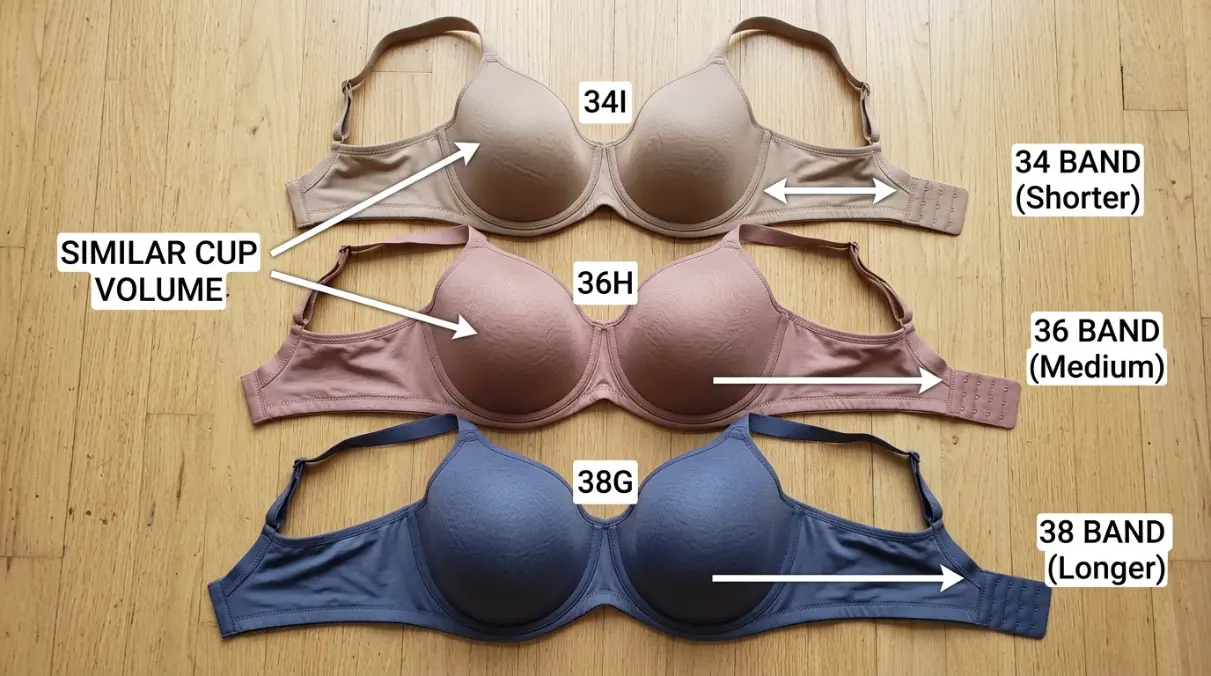
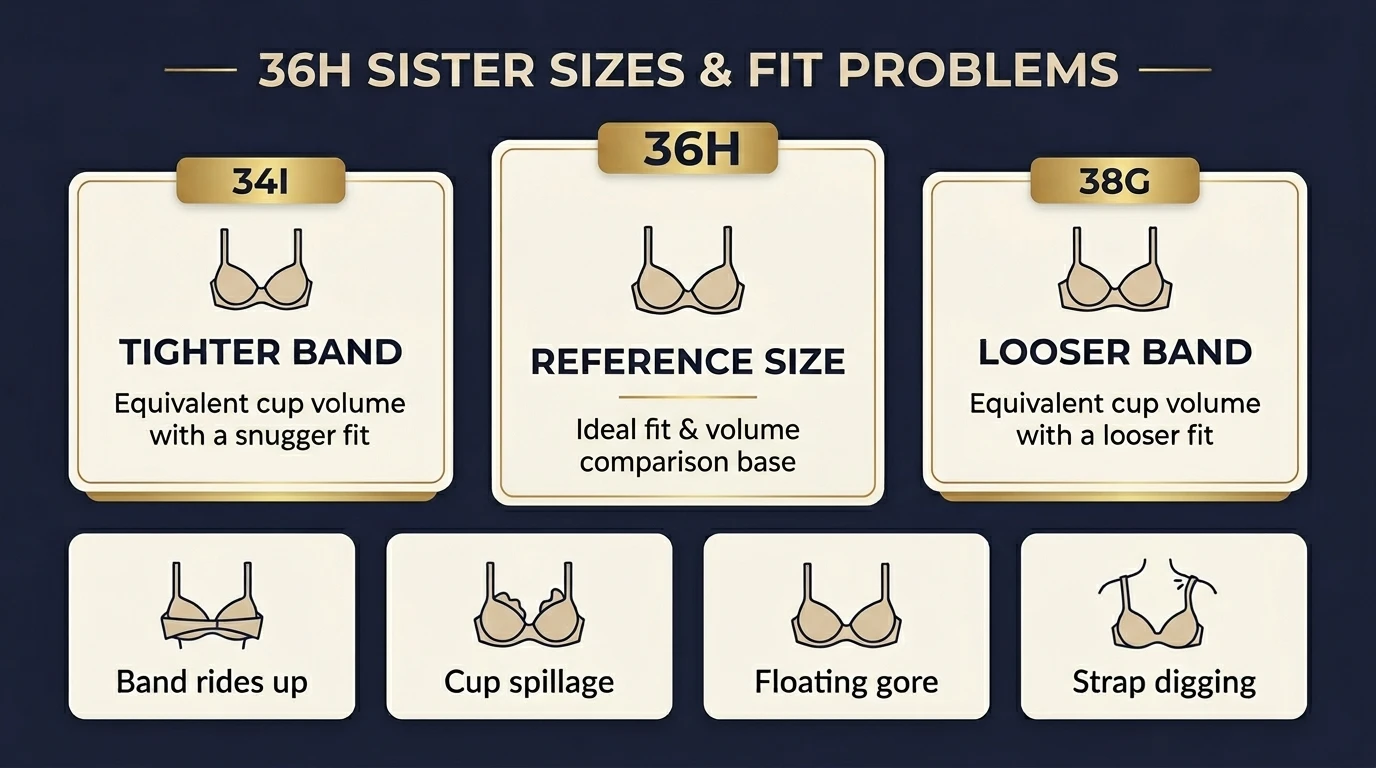
Sister sizes keep similar cup volume while changing the band. At 36H, this matters because small band errors can create big comfort problems. If the cup volume feels right but the band feels wrong, sister sizing lets you adjust the ribcage fit without losing cup capacity.
If your 36H cups feel right but the band rides up, try 34I. If the 36H band feels too tight but the cup volume feels right, try 38G. The cup volume stays similar, but the band fit and support change.
Rule: Down one band → Up one cup | Rule: Up one band → Down one cup | Example: 36H ≈ 34I ≈ 38G.
| Tighter Sister Size | Reference Size | Looser Sister Size |
|---|---|---|
| 34I | 36H — You | 38G |
| 32J | 36H | 40F |
36H vs Other Sizes
These comparisons help you decide whether 36H is truly your best fit or whether 36G, 36I, 34I, or 38G would work better.
- About 9-inch bust difference
- One cup larger than 36G
- More depth and containment
- Better if 36G spills at top, sides, or center
- Same 36 band
- One cup smaller
- Less depth and projection
- Better if 36H wrinkles or feels too deep
- One cup smaller than 36I
- Correct if cup edge sits smooth
- Should contain all tissue without spillage
- Same 36 band
- More cup depth
- Try if 36H spills or underwire sits on tissue
- Reference size
- Good for 31–32 inch underbust
- Looser than 34I
- Sister size — similar cup volume
- Tighter band
- Try if 36 band rides up
- Firmer band than 38G
- Better for 31–32 inch underbust
- More secure support
- Sister size — similar cup volume
- Looser band
- Use only if 36 band feels genuinely tight
Best Bra Styles for 36H
At 36H, bra construction matters more than style name. The best bras have a firm band, deep cups, strong lower-cup support, wide straps, and enough side control to keep tissue forward. Decorative bras can still work, but only if the structure is built for fuller-bust sizing.
Best for daily lift and comfort. Choose deeper cups, firm bands, wider straps, and reinforced lower-cup support.
Excellent for 36H because it brings side tissue forward and creates a cleaner centered silhouette.
Seamed construction usually gives better lift than shallow molded foam, especially when the cups are deep enough.
Helpful if the center gore feels too tall, but the plunge must still have enough depth for H cup volume.
Useful when you want less forward projection. Avoid styles that painfully flatten tissue or push it into the sides.
Usually too flat for 36H. It can cause overflow, floating gore, tissue compression, or cup collapse.
Common Fit Problems with 36H
The 36 band is too loose or stretched out. At H cup volume, this transfers weight to the shoulders quickly.
The cup is too small, too shallow, or too closed at the top. Center spillage often means not enough depth near the gore.
The cup may be too large, too tall, or wrong for your breast shape.
This usually means the band is not doing enough support work. Straps should stabilize, not carry the full weight.
The wire may be too narrow, or the cup may not have enough depth at the outer edge.
A floating gore can mean the cups are too small, too shallow, or not suitable for close-set/full-center tissue.
International Size Conversion for 36H
36H can be confusing internationally because US, UK, EU, and brand-specific charts may use different cup-letter sequences. Always confirm the brand’s own chart before ordering.
Important: fuller cup letters vary more than basic sizes. A UK 36H may not match a US 36H in every brand. Use the Global Bra Size Converter and Brand Size Decoder before buying international bras.
Related 36H Tools & Guides
Use these supporting pages to confirm your measurements, compare 36H with nearby sizes, and solve common fuller-bust fit problems.
| Guide / Tool | Why It Helps |
|---|---|
| Bra Size Calculator | Calculate your exact band and cup size from underbust and bust measurements. |
| Cup Size Visuals | Compare H cup with G, I, J, K, and fuller cup sizes visually. |
| Sister Size Calculator | Find 36H sister sizes like 34I and 38G. |
| Global Bra Size Converter | Convert 36H across US, UK, EU, AU, and other international systems. |
| AI Smart Fit Bra Calculator | Check symptoms like gore floating, spillage, band riding up, and strap digging. |
Frequently Asked Questions
36H usually means a 31–32 inch underbust and a 40–41 inch full bust. It has about a 9-inch cup difference.
Yes, 36H is generally considered a fuller-bust size, but how large it looks depends on frame width, height, and breast shape.
The main sister sizes are 34I and 38G. 34I is tighter; 38G is looser.
They are sister sizes with similar cup volume, but 34I has a tighter band and usually gives firmer support.
Yes. 36H is one cup larger than 36G on the same band.
Choose 36H if the cups sit smooth. Try 36I if 36H spills, cuts in, or the center gore floats.
Choose 36H if the band feels secure. Choose 38G only if the 36 band feels genuinely tight but cup volume feels right.
The band may be too loose or stretched out. Try a firmer 36 band or sister size 34I.
It depends on the brand. A UK 36H may be close to US 36K in many systems, but some brands label differently.
A UK-style 36H is usually close to AU/NZ 14H.
Yes, but choose a wireless bra with a firm band, wide straps, deep cups, and strong side support.
Full-support, side-support, seamed balconette, deep plunge, minimizer, and supportive wireless bras can all work well for 36H.
Find Your Best 36H Fit
Measure your underbust and bust to confirm whether 36H, 36G, 36I, 34I, or 38G is your most comfortable match.