Best Bras for Elderly Women 2026: Comfort and Easy Dressing
Amelia B. – Bra Fit Specialist – Updated 2026 – 3 products reviewed
The best bra for older women is the Glamorise MagicLift Front-Close (34-54 band, B-J cup) for ease of dressing and all-day support. For wire-free comfort, Playtex 18 Hour Active Lifestyle. For posture support, Cortland Intimates Front-Close Posture Bra.
Changing Fit Needs With Age
Reduced Shoulder Mobility
Reaching behind to fasten a back-close bra becomes difficult. Front-close bras eliminate this problem entirely.
Skin Sensitivity
Underwire and rigid lace can irritate thinner, more sensitive skin. Soft-cup and foam-free styles are more comfortable.
Posture Changes
Forward shoulder rounding affects how bra straps sit. Wider straps and posture-support panels help counteract this.
Size Changes
Breast tissue changes with age – often becoming softer and repositioning lower. Re-measure annually; you may need a different cup shape rather than size.
Our Top 3 Picks

Glamorise MagicLift Front-Close
- Front hook-and-eye closure – no reaching behind
- Wide padded straps for shoulder pressure relief
- Extended band range to 54
- MagicLift inner sling lifts without underwire discomfort

Playtex 18 Hour Active Lifestyle
- No underwire – zero rib or stomach pressure
- Active Lifestyle lining wicks moisture
- Available in 34-50 band
- Trusted comfort bra for 50+ years

Cortland Intimates Front-Close Posture
- Posture support panels in back wings
- Front close for easy dressing
- Wide non-slip straps
- Helps counteract forward shoulder rounding
| Bra | Closure | Cup Range | Band | Best For |
|---|---|---|---|---|
| Glamorise MagicLift | Front | B-J | 34-54 | Best overall – easy dressing |
| Playtex 18 Hour | Back | B-G | 34-50 | Wire-free all-day comfort |
| Cortland Posture | Front | B-G | 36-50 | Posture support |
What to Look For
Find Your Best Bra Match
Answer a few fit questions to get bra styles matched to your support needs, breast shape and everyday preferences.
Question 1 of 5
Why it matches
What to look for
What may not work
Private fit matching: your answers are used only to build the recommendation on this page. No measurements or fit selections are submitted to Bra-Calculator.com.
This tool suggests a starting bra style, not a medical or diagnostic recommendation. Individual brands and bra models can fit differently.
Front-Close Is Best
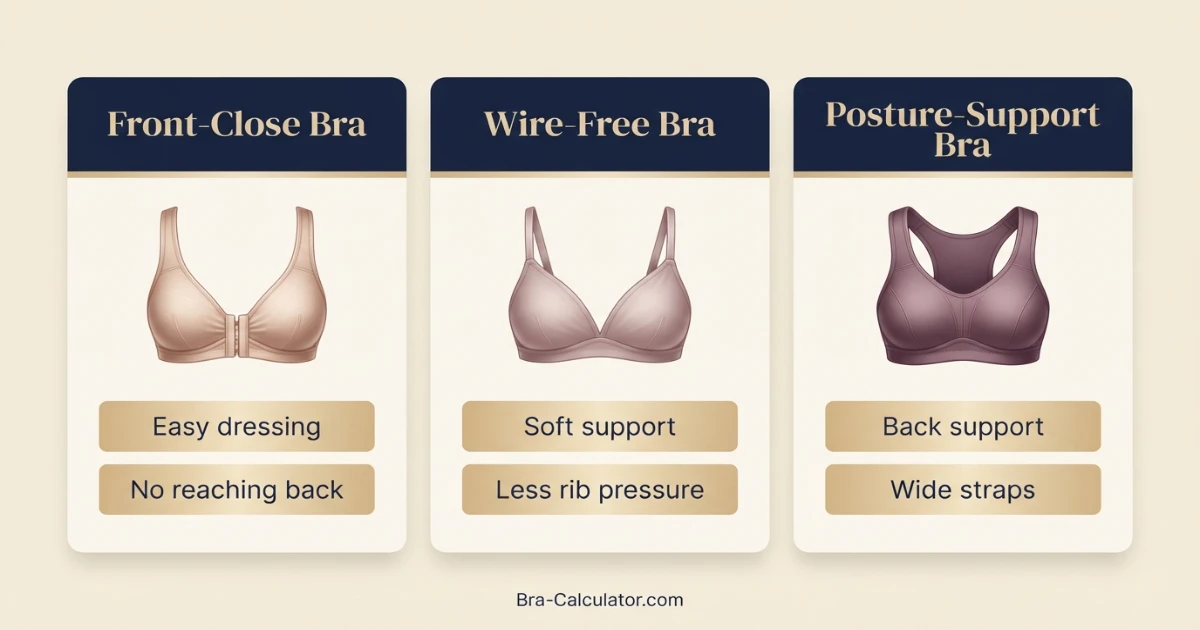
Back-close bras require reaching behind and above – difficult with shoulder stiffness or arthritis. Front hooks or front clip closures are significantly easier.
Wire-Free or Soft Wire
Hard underwires press on softer, repositioned tissue. Soft-cup or foam-lined styles offer support without pressure points.
Wide and Padded
Narrow straps dig into softer shoulder tissue. Look for straps at least 0.75 inches wide with foam padding.
Firm But Not Restrictive
Bands provide the majority of support. Firm enough to stay level but not so tight as to cause breathing discomfort – especially important for women with sensitive ribs.
Sizing Changes Over Time
Re-measure every 12-18 months. Breast tissue redistributes with age, hormonal changes, and weight fluctuation. A size worn for years may no longer be correct.
Cup shape changes too. Full-cup and soft-cup styles often suit repositioned or softer tissue better than push-up or balconette styles.
Band size may increase as torso softens. If your band rides up, try the next band size with one cup size smaller (sister size).
Visual Fit Guide
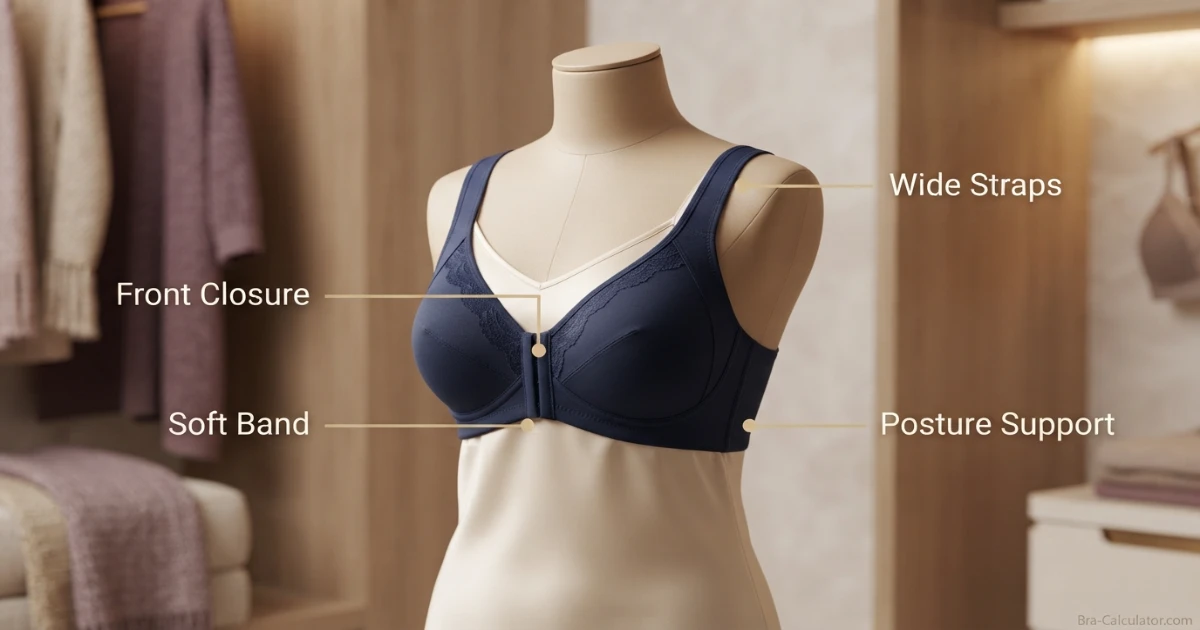
Use the visuals below to compare fit behavior, neckline coverage, and support expectations for bras for older women. They are designed to help readers make a faster decision before moving to the product cards or size checklist.
How We Chose These Recommendations
Best answer
The best bra for older women should be easy to put on, soft against the skin, and supportive without aggressive wires or narrow pressure points. Front closures, wide straps, and breathable fabrics often matter more than decorative design.
Avoid if
Avoid scratchy lace, tiny back hooks, narrow straps, and bands that roll painfully under the bust.
Fit Advice by Size & Need
A single “best bra” answer is rarely enough because the same product behaves differently across cup volumes, body frames, fabric tension, and neckline needs. Use this table as the fast decision layer before reading the individual product notes.
| Size / Need | Best Style Direction | Why It Works |
|---|---|---|
| Limited mobility | Front-close bra | Easier fastening without reaching behind the back. |
| Sensitive skin | Cotton-lined or seamless soft cup | Reduces rubbing and irritation. |
| Posture concerns | Posture-back or high-back support | Distributes tension across the upper back. |
| Fuller soft tissue | Full coverage wireless or soft wired | Keeps tissue contained without hard edges. |
When two sizes feel close, start with the band that stays level on the loosest hook and adjust cup volume next. A cup that is too small can make the band feel tight, while a band that is too loose can make even a good cup feel unsupportive.
Common Buying Mistakes
Most returns happen because the shopper chose by product name or price instead of fit mechanics. Before buying, check these common issues so the bra works with your body, outfit, and wear time.
- Choosing only the softest bra and losing all support by midday.
- Keeping old stretched bras because they feel familiar.
- Buying tiny hook-and-eye backs when shoulder mobility is limited.
- Ignoring skin checks where bands, seams, or straps rub.
Final Fit Checklist
Before you commit to a comfort bra for older women, check the fit in the conditions where you will actually wear it. A bra that feels fine for thirty seconds can behave differently after a full workday, a wedding reception, a hot commute, or an evening outfit with firm fabric.
The right choice should solve the main need for bras for older women: easy-on comfort with enough lift to feel supported without strain. If the bra creates a new problem — digging straps, rolling band, visible edges, or constant adjustment — choose a different style before choosing a different size.
- Wear-test it under the exact outfit for at least ten minutes.
- Check the side view and back view, not only the front.
- Confirm the return window before removing tags.
- Keep the first wash gentle so elastic, adhesive, or molded cups stay intact.
More Expert Fit Questions
Real-World Fit Test for Bras For Older Women
A strong recommendation should work outside a product photo. Before keeping any comfort bra for older women, test it with the exact outfit, posture, and wear time you expect in real life. Many bra returns happen because the bra looks right while standing still, but shifts after sitting, walking, hugging, reaching, or wearing a fitted fabric for several hours.
Use a three-minute mirror check first: look from the front, side, and back; raise both arms; sit down; bend slightly forward; then smooth the outfit over the cup edge. If the band rides, the cup edge shows, the centre pulls away, or the straps move toward the neck, the style may not be the best match even if the size label seems correct.
Buying Checklist Before You Order
For the best result, do not choose by cup label alone. Start with the job the bra must do, then confirm size range, return policy, fabric behavior, and whether the design matches your breast shape. This is especially important for online shopping because product images often show one model, one color, and one size range while the fit can change a lot in smaller or fuller cups.
- Front closure access.
- Wide straps that do not dig.
- Soft lower band pressure.
- Fabric that is gentle on sensitive skin.
- Check the product page size chart instead of relying only on your usual size.
- Read recent fit comments for your cup range, not just the overall star rating.
- Compare your sister size only when the band feels too tight or too loose, not when the cup shape is the real problem.
The safest buying decision is the one that solves the main fit problem first. For bras for older women, the priority is easy-on comfort with enough lift to feel supported without strain. Avoid tiny hooks, stiff wires, narrow straps, and hard seams; that usually causes the fastest disappointment after delivery.
Common Fit Problems and Fast Fixes
If the cup gaps
Try a shallower cup, shorter cup height, or a style with more flexible top-edge fabric. Gaping is often a shape mismatch, not proof that you need a smaller cup.
If the band moves
Check the band on the loosest hook. A supportive band should sit level around the body. If it rides up, support shifts to the straps and comfort usually gets worse.
If straps dig
Loosen the straps after confirming the band is firm. Straps should refine placement, not carry the full weight of the bust.
If the centre gore floats
For wired bras, a floating gore usually means the cup is too small, too shallow, or the style is wrong for your breast spacing.
Expert Buying Scenarios for Bras For Older Women
The final decision usually comes down to a real-life scenario, not a perfect product description. Two people can order the same comfort bra in the same size and have completely different results because their breast shape, ribcage angle, shoulder width, outfit fabric, and comfort tolerance are different. That is why this guide treats each recommendation as a fit solution instead of a simple ranked list.
Start with the most important job. If the bra is for a daily dressing routine, the first priority is not always maximum lift. Sometimes the better choice is a smoother edge, a lower centre front, a softer band, or a cup that disappears under fabric. A bra that gives dramatic shape but shows through the outfit is not the right bra for that use case.
Next, check the pressure points. A good fit should feel firm in the support zones and quiet everywhere else. The band should not roll, the cup edge should not dig or gape, and the strap should not carry the full weight. If you feel yourself adjusting the bra every few minutes, treat that as a fit failure even if the product is popular.
For online buying, read product details with your own body type in mind. Reviews from a very different size range can still be helpful for fabric feel, but they are less reliable for support level. Pay closest attention to comments from people who mention your band size, cup range, breast spacing, or the same outfit problem you are trying to solve.
| Scenario | What to Check | Best Decision |
|---|---|---|
| Everyday wear | Band comfort after sitting and moving | Choose stability over dramatic shaping |
| Event outfit | Visibility from front, side, and back | Choose the lowest-profile style that still feels secure |
| Sensitive skin | Seams, adhesive, lace, wire, and fabric texture | Choose soft edges and test before long wear |
| Fuller cup volume | Side containment, gore position, and strap pressure | Choose deeper cups and stronger band support |
When comparing two close options, choose the one that solves your biggest problem with the least compromise. For bras for older women, that usually means focusing on support that feels gentle and easy to put on. The right bra should make the outfit easier to wear, not create a new problem you have to manage all day.
Comfort, Care, and Long-Term Wear
Even the best comfort bra can perform poorly if it is washed harshly, dried with heat, stored folded in the wrong shape, or worn past the point where the elastic has recovered. Bra fabric is technical: elastic, mesh, foam, lace, wire casing, hook panels, and adhesive surfaces all change with heat, sweat, friction, and detergent.
For longer life, rotate bras when possible instead of wearing the same one every day. Elastic needs time to recover. If you only have one reliable style, it will stretch faster, and the band may begin to feel loose before the cups look worn. Hand washing or using a lingerie bag on a gentle cycle helps preserve the shape, especially for molded cups and structured full-bust styles.
Store molded cups open instead of folding one cup into the other. Folding can create dents that show under fitted tops. For adhesive or specialty bras, keep the protective film or case because dust weakens the grip and makes the surface feel less smooth against skin.
Replace the bra when the band rides up on the tightest hook, the cup edge curls, the straps slip even after adjustment, the wire casing becomes rough, or the fabric no longer returns to shape after washing. Those signs mean the bra is no longer giving the fit the page recommendation is based on.
Use this final rule before publishing or buying: the best bra is the one that matches front closure, shoulder comfort, soft fabrics, easy laundry. A high-rated product can still be wrong if it solves a different problem than yours. Measure first, match the style to the outfit, then use the product recommendation as the final filter.
Frequently Asked Questions about Best Bras for Elderly Women
Support Without Compromise
Fit needs change over time. Use the Bra Size Calculator to remeasure and find your current size before buying a new bra.