30DDD, 30F, and 65F all describe the same bra. US sizing uses DDD as the sixth cup letter. UK and Australian sizing uses F at this position — skipping DDD entirely. EU sizing also uses F with a metric band number. So: 30DDD (US) = 30F (UK/AU) = 65F (EU). When shopping specialist brands, look for 30F — it is the more widely used label globally for this cup depth.
A 30DDD bra size means your underbust measures approximately 25–26 inches (64–66 cm) and your bust measures 31–32 inches (79–81 cm) — a 6-inch difference that defines the DDD cup (also called F in UK/EU/AU sizing). The number anchors to your ribcage; the letter is a ratio, not a fixed volume. On a narrow 30-inch frame, DDD cup tissue is very prominently full and forward-projecting.
30DDD at a Glance
| Attribute | Detail |
|---|---|
| Band Size | 30 inches (underbust 25–26″ / 64–66 cm) |
| Full Bust Measurement | 31–32 inches (79–81 cm) |
| Cup Difference | ~6 inches (~15 cm) — DDD cup |
| Also Written As | 30F (UK / AU / EU) · 30DDD (US) |
| Sister Sizes | 28G (tighter band) · 32DD (looser band) |
| US Size | 30DDD (= 30F in some US brands) |
| UK Size | 30F |
| EU Size | 65F |
| AU / NZ Size | 8F |
| Cup Volume Equivalent | Same as 28G and 32DD |
What Is a 30DDD Bra Size?
Breaking down the number and the letter — separately.
A 30DDD sits at the intersection of two of the most systematically ignored measurements in mainstream lingerie retail: a narrow 30-inch band and a genuinely full DDD cup. The combination exists on a significant number of bodies — and is almost completely invisible on high-street shelves. For women who wear this size, finding correctly fitting bras typically means abandoning mainstream retail entirely and moving to specialist fuller-cup brands.
To understand a 30DDD precisely, the two components must be read separately. The number 30 is your band size — it anchors the entire structure of the bra to your ribcage and is responsible for the overwhelming majority of lift, support, and tissue positioning. At DDD cup volume, this is not a minor detail. A loose or incorrect band at this cup depth transfers enormous weight to shoulder straps, creating chronic neck, shoulder, and upper back strain. The band is not decorative — it is structural.
The letters DDD represent your cup size — a 6-inch ratio between underbust and full bust. This is the sixth cup size in the US labelling system, but it is simply F in UK, EU, and Australian markets. Neither designation is more correct than the other — they are regional labelling conventions applied to the same measurement. The volume described by a 30DDD is the same whether a brand calls it DDD or F.
The most important concept for 30DDD wearers to internalise: DDD on a 30-inch band is not the same physical volume as DDD on a 36-inch band. Cup letters are ratios. A 36DDD holds dramatically more tissue than a 30DDD because the same 6-inch proportion on a 36-inch circumference produces a far larger absolute volume. Your 30DDD cup is full and prominent on your narrow frame — but in the complete spectrum of bra sizes, DDD is a moderate cup depth. The alphabet extends well beyond it.
30DDD Bra Measurements
The precise measurements that define this size — in both inches and centimetres.
Difference = DDD Cup (~6 in) · Also labelled 30F in UK / EU / AU sizing
Wrap tape snugly around your bare ribcage directly beneath your breasts, level all the way around. For a 30DDD, this should read 25–26 inches (64–66 cm).
Stand naturally and measure around the fullest part of your bust without compressing tissue. Keep the tape level. For a 30DDD, this reads 31–32 inches (79–81 cm).
Bust minus underbust = cup letter. A 6-inch (~15 cm) difference = DDD cup (UK/EU/AU: F cup). With a 30 band → you’re a 30DDD.
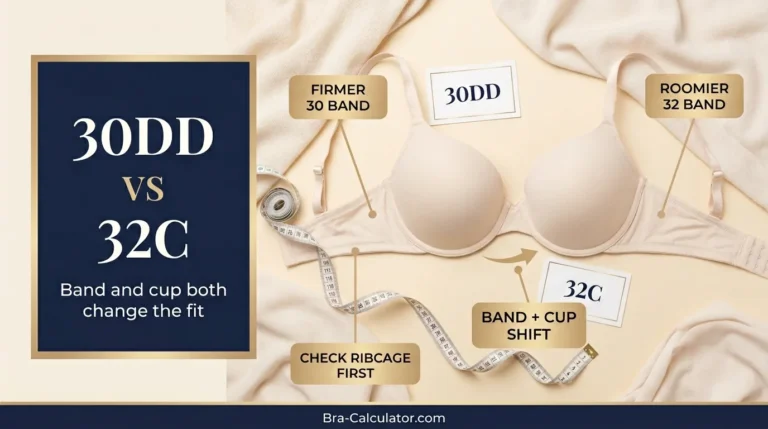
A new bra should feel firmly secure on the loosest hook with the band sitting level across your back. At DDD cup depth, even small amounts of band movement transfer substantial weight to your shoulders. If the band rides up at all, try sister size 28G for identical cup volume with a firmer anchor.
What Does 30DDD Look Like?
Cup size tells you volume — not shape. Your breast shape changes how any size looks on your body.
The most misunderstood part of bra sizing is expecting one size to look identical on everyone. A 30DDD looks entirely different depending on your height, muscle mass, and natural breast root shape. Two people can share the exact same 31-inch bust measurement and look like they are wearing completely different sizes.

Victoria’s Secret Bombshell Bra — Enhanced Definition for 30DDD
- Structured foam channels DDD cup tissue with controlled lift and definition
- Narrow 30-band anchors the garment securely against a smaller ribcage
- Deep cup construction designed for fuller volumes — verify cup depth for DDD
- Creates defined cleavage line with forward projection on a petite frame
Petite Frame
On a narrow, shorter torso, 30DDD is extremely visually prominent. DDD cup volume on a 25-inch ribcage commands a large proportion of the chest wall — projecting forward substantially and creating a very defined, full silhouette. This is the body type specialist fuller-cup brands target first and foremost.
Extremely prominentAthletic Build
Broader shoulders and pectoral muscle distribute DDD volume laterally. Even with 6 inches of cup projection, tissue can appear less forward-pointing than expected on a muscular chest. Deep-cup vertical seaming — not padding — is what restores proper three-dimensional shape on athletic builds at this volume.
Projected Shape
Deep, forward-projecting tissue on a narrow base is the classic shape for 30DDD. Seamed cups with deep, narrow construction hold this tissue beautifully — the projection is genuine and supported rather than forced. Side-support styles and three-part cups with vertical seaming are the gold standard.
Needs deep cup depthSoft / Pendulous Tissue
Softer, lower-sitting tissue at DDD volume needs maximum uplift from the underwire rather than cup padding. Full-coverage underwire styles with side-boning or power mesh panels provide the firm upward lift that softer tissue requires. Avoid wireless styles entirely at this tissue weight.
Needs firm upliftYour cup size tells you volume, not shape. And your unique breast shape affects how a bra fits far more than the letter on the tag. Two 30DDD bodies can look completely different — both are perfectly normal.
Is 30DDD Considered Large?
On a 30-inch band, DDD is proportionally very substantial. But the cultural mythology around “DDD” — inflated by decades of media framing — dramatically overstates what the letter means clinically. DDD is the sixth cup size. Bra sizing continues through E, F, G, H, I, J, K and beyond. In the full alphabet of cup sizes, DDD is in the middle third.
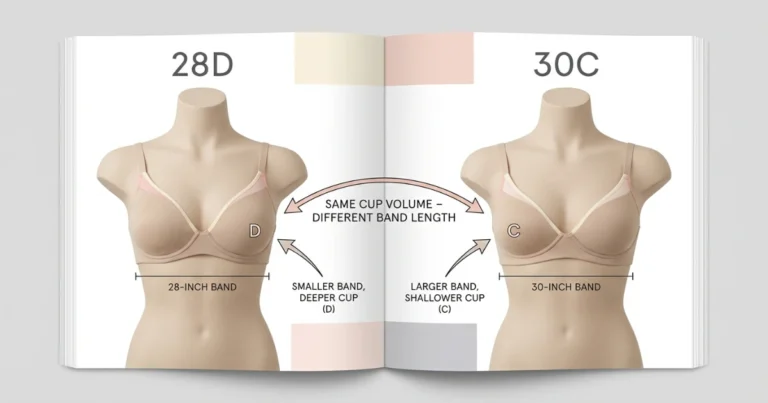
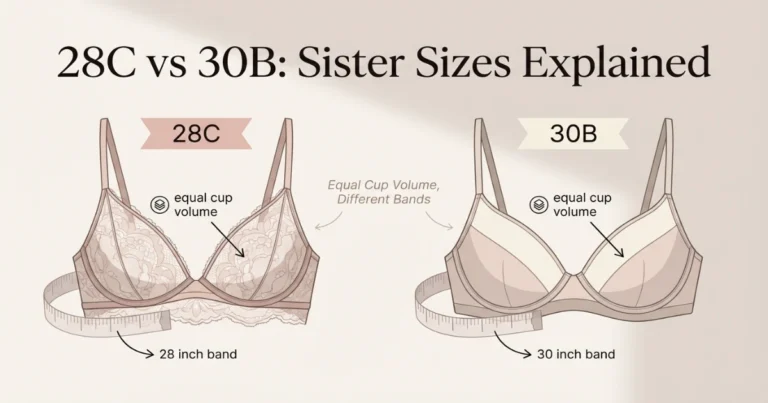
Cup volume scales with band width. A 30DDD holds the exact same tissue volume as a 28G and a 32DD — these are sister sizes. The same DDD letters on a 36 band hold substantially more absolute tissue than your 30DDD.
Culturally, DDD has been treated as an extreme size. Clinically, it is not. It is the sixth cup — one size above DD — and well within the production range of every specialist fuller-cup brand. The real challenge for 30DDD wearers is not their size; it is retail infrastructure that stops at 32 bands and D cups in most chain stores.
30DDD Sister Sizes
Same cup volume — different band and letter combinations. Your most important tool when the band is off but the cups fit correctly.
When the cups feel right but the band does not, sister sizing is the cleanest fix. You can calculate equivalent sizes instantly with the Sister Size Calculator, or read the full Sister Sizes Guide to understand why 28G and 32DD hold identical cup volume to your 30DDD.
Rule: Go up one band = go down one cup letter | Rule: Go down one band = go up one cup letter | Result: Cup volume stays identical
| Smaller Band (tighter) | Same Volume as 30DDD | Larger Band (looser) |
|---|---|---|
| 28G (US: 28DDD) | 30DDD (= 30F UK/EU) — You | 32DD |
| 26GG | 30DDD | 34D |
30DDD vs Other Sizes
Select a comparison to understand exactly how 30DDD differs from adjacent sizes.
For a broader view across the full size range, explore our Breast Size Comparison hub — covering how band width, cup depth, and sister sizing interact from AA through K cup.
- Same 30-inch band — identical ribcage fit
- 6-inch cup difference — one full cup deeper than 30DD
- Meaningfully more cup volume on the same narrow frame
- If 30DDD consistently gapes at top, drop to 30DD
- Same 30-inch band anchors both
- 5-inch cup difference — less depth and projection
- One full cup size smaller than 30DDD
- If 30DD tissue spills over top, sides or armpits — you need 30DDD
- 6-inch cup depth — very full, correctly contained at true size
- Tissue sits within cups without overflow when fitted correctly
- If you try 30G, cups will show pooling empty fabric at the top
- 7-inch cup difference — significantly more volume
- One full cup larger than 30DDD on the same narrow ribcage
- 30DDD overflow persisting at top and armpits = try 30G
- Tighter 30-inch band — superior lift and far better support
- Slightly less absolute cup volume than 32DDD
- Correct fit for a confirmed 25–26 inch underbust measurement
- 2 inches looser band — designed for a 27–28″ ribcage
- Same DDD letters but holds slightly more absolute cup volume
- Only choose 32DDD if your underbust genuinely measures 27–28 inches
- Tighter 30-inch band — critical for support at this cup volume
- Identical cup volume to 32DD — true sister size
- At DDD depth, even a 2-inch band difference creates significant support loss
- 2 inches looser band — designed for a 27–28″ ribcage
- Sister size: exact same cup volume as 30DDD
- Wearing 32DD when 30DDD is needed = chronic strap pain and poor posture
Best Bra Styles for 30DDD
At DDD cup depth on a narrow band, style selection matters more than at any smaller size. Two firm rules: underwire only, and specialist brands only.

Warner’s Cloud 9 Wireless Bra — Wire-Free Comfort for DDD Cups
- Wire-free construction eliminates underwire pressure points on a narrow ribcage
- Fuller-cup design accommodates DDD volume with genuine support from the band
- Firm elastic band delivers uplift without metal — designed for heavier cup volumes
- Best suited for low-impact days, rest days, or post-underwire irritation recovery
The definitive style for DDD cup depth. Three-part seamed construction creates precise three-dimensional shaping that moulded foam simply cannot replicate at this volume. Freya, Fantasie, and Panache all produce seamed full-cup styles specifically engineered for narrow bands with fuller cups.
Specialist balconettes at DDD cup depth provide outstanding uplift and forward projection. The horizontal underwire lifts from below and the wide cup opening frames fuller tissue beautifully. Look for balconettes from Fuller-cup specialist brands rather than mainstream designs.
Side-support construction uses firm side panels to redirect lateral tissue forward and upward — producing a rounder, more centred silhouette at DDD volume. Particularly effective for athletic builds or wide-set tissue where standard styles spread rather than shape.
A structured underwire plunge can work well for 30DDD wearers with close-set tissue and strong forward projection. Requires deep cup construction — mainstream plunge bras max out at D or DD and will overflow. Seek specialist fuller-cup plunge styles only.
Wireless bras — including structured wireless styles — cannot reliably support DDD cup volume on a narrow band for extended daily wear. Tissue migration, band ride-up, and progressive shoulder strain are inevitable. Reserve wireless styles for brief, low-activity periods only.
Victoria’s Secret, Wacoal mainstream lines, and department store brands typically end at DD cup in 30 bands. Even where 30DDD is listed, cup depth and underwire construction are often engineered for average bodies — not narrow-back fuller-cup frames. Shop Freya, Fantasie, Panache, or Curvy Kate instead.
Common Fit Problems with 30DDD
Identify what’s wrong — and what to actually do about it.
At DDD cup volume, a band that rides up is a medical-grade support failure. The entire weight of substantial breast tissue shifts immediately to shoulder straps — creating neck pain, shoulder indentations, and upper back strain that worsens progressively throughout the day.
Top gaping at DDD cup depth is almost exclusively a shape mismatch — not a size error. Moulded foam cups create a fixed cavity that does not match projected, wide-set, or pendulous tissue shapes. The foam holds a shape; your tissue has a different one.
Strap indentations at DDD cup volume always indicate a band problem — not a strap problem. Tightening straps is not the fix. When the band fails to support, straps compensate by bearing weight they were never designed to carry. The strap is a positioning guide, not a support structure.
At DDD cup depth, underwire placement is critical. The wire must sit entirely in the inframammary fold — flat against the chest wall beneath and around all breast tissue. Wire sitting on tissue causes bruising, irritation, and potential long-term discomfort. Brand underwire width varies enormously at this cup size.
Overflow at DDD cup depth is unambiguous — cups are too small. Top overflow means the cup is not deep enough. Armpit overflow means the underwire is not encapsulating the full lateral breast root against the chest wall. Both require a cup size increase.
A floating gore at DDD cup depth almost always signals wide-set tissue placement — not an incorrect cup size. Wide-set tissue at this volume physically cannot be pushed to the centre, and forcing it there with a rigid gore causes constant discomfort and skin irritation.
International Size Conversion
Ordering a European or Australian bra? Your size changes on the label — but your body doesn’t.
The full naming divergence at this cup depth: US cup labelling runs A, B, C, D, DD, DDD, DDDD… UK/EU/AU labelling runs A, B, C, D, DD, E, F, FF, G… This means US DDD = UK/EU/AU F. When shopping UK specialist brands — Freya, Fantasie, Panache, Curvy Kate, Elomi — always look for 30F, not 30DDD. For EU brands (Chantelle, Prima Donna) look for 65F. For Australian brands, look for 8F.
At this cup depth and band combination, brand selection matters more than any other factor. Use the Brand Size Decoder and the Global Bra Size Converter to navigate labelling systems accurately. Freya and Fantasie in particular are widely regarded as the benchmark for narrow-band fuller-cup engineering.
Frequently Asked Questions
The questions everyone actually searches — answered directly.
Yes — completely identical. US sizing uses DDD as the sixth cup letter. UK, Australian, and EU sizing uses F at this same position — skipping DDD entirely. So 30DDD (US) equals 30F (UK/AU) equals 65F (EU). When shopping specialist brands like Freya, Fantasie, or Panache, always search for 30F — it is the more universally recognised label for this cup depth globally.
No. 30DDD and 32DD are sister sizes with the exact same cup volume. The 32DD fits a wider ribcage (27–28 inches) while 30DDD fits a narrower 25–26 inch torso. Cup capacity is identical. The band difference changes how the garment provides support — a 30-inch band provides firmer, more effective lift than a 32-inch band at this cup volume.
The two primary sister sizes are 28G (one band tighter, same cup volume — UK label) and 32DD (one band looser, same cup volume). Both hold identical cup tissue capacity to your 30DDD. Go to 28G if your band rides up. Go to 32DD only if your underbust genuinely measures 27 inches or more — otherwise you are simply accepting a looser, less supportive band.
Extremely so in mainstream retail. Most stores do not stock 30-band bras at all, and DDD cup depth eliminates the few mainstream options that do. You must shop specialist fuller-cup brands: Freya, Fantasie, Panache, Curvy Kate, Elomi, and Goddess all regularly produce this size. Online specialist retailers offer the best selection — physical stores are largely unreliable at this size combination.
A 30DDD on a narrow 25–26 inch ribcage is among the most visually striking narrow-band size combinations. The DDD cup volume that looks moderate on a 38-inch frame projects prominently on a petite 30-band body — very full, forward-pointing, and defined. On a slim build, 30DDD creates a significant bust-to-waist visual ratio that broader frames with the same cup letter simply do not produce.
A 30DDD fits someone with a slim, petite, or lean-athletic frame — a ribcage measuring 25–26 inches — carrying a full DDD cup projection of approximately 6 inches above the underbust. This is the primary customer profile for specialist fuller-cup lingerie brands: narrow back, fuller bust, underserved by mainstream retail, requiring deep-cup underwire construction for proper support.
The most reliable brands for 30DDD (also listed as 30F in their catalogues) are Freya, Fantasie, Panache, Curvy Kate, Elomi, Goddess, and Prima Donna. All produce narrow-band fuller-cup styles with proper underwire engineering for this size combination. Avoid mainstream brands like Victoria’s Secret or department store own-labels — their 30-band range typically ends at D or DD cup with insufficient cup depth for DDD volume.
Confirm Your True Size
Measurements don’t lie — store fittings often do. Use two quick measurements to get your exact bra size in seconds. No guesswork, no frustration.
Nearby sizes and related guides
- The 30DD Bra Size Guide: Measurements, Fit & Sister Sizes
- 30E Bra Size Guide: Measurements, Fit, Sister Sizes & Best Styles
- The 32DDD Bra Size Guide: Measurements, Fit & Sister Sizes
- The 32DD Bra Size Guide: Measurements, Fit & Sister Sizes
- The 28E Bra Size Guide: Measurements, Fit & Sister Sizes
- Sister size bra calculator
- All bra size guides and charts
- Bra size calculator