40D vs 42C: Are They Sister Sizes? Same Cup Volume, Different Band Explained (2026)
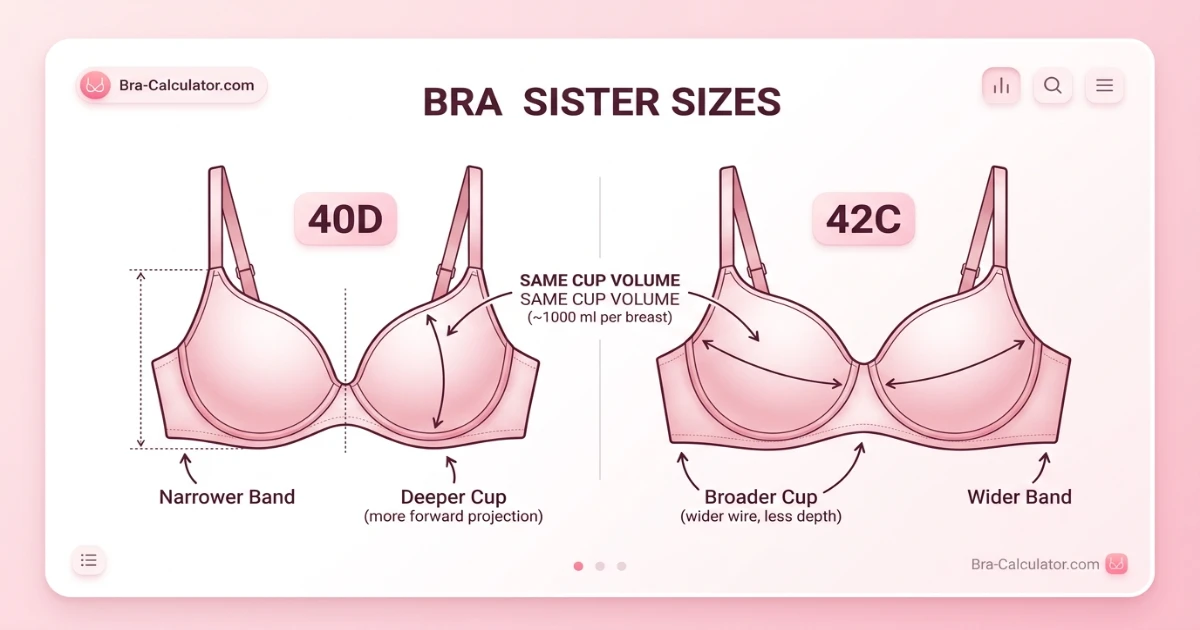
Quick Answer: Yes — 40D and 42C are confirmed sister sizes. They hold approximately the same cup volume (~1000 ml per breast) on different band sizes. Going up one band from 40 to 42 and dropping one cup letter from D to C follows the sister size rule exactly, preserving cup volume across both sizes.
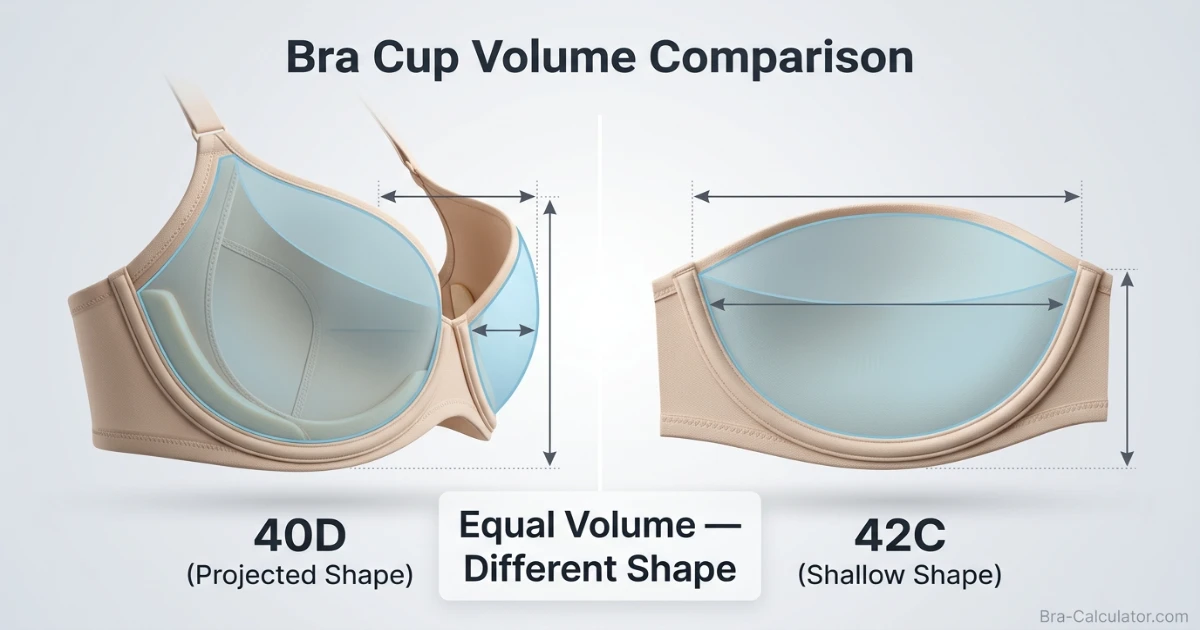
The difference between them is entirely in the band: the 40D grips a narrower ribcage more firmly and produces a slightly deeper, more projected cup — critical for supporting D cup volume. The 42C sits on a wider ribcage with a broader, slightly shallower cup. Neither is larger in cup volume — your underbust measurement is the only deciding factor.
Choose the fit signs you notice in the band, cups, center and straps. We’ll turn them into a practical next step for 40D.
Private fit check — your answers stay in your browser and are used only for this on-page guidance. Nothing is stored or submitted.
⚡ Key Takeaways
- Sister sizes: 40D and 42C hold approximately equal cup volume (~1000 ml per breast) — same volume family.
- Band is the only real difference: 40D fits ~33–34″ (84–87 cm) underbust; 42C fits ~35–36″ (89–91 cm) underbust.
- D-cup band priority: At D cup volume, a correctly fitting firm band is more critical than at smaller cup sizes — resist upsizing the band unless genuinely necessary.
- UK/EU alignment: US 40D = UK 40D = EU 90D; US 42C = UK 42C = EU 95C. No naming divergence at C and D cup.
- Full sister size family: 36E/DD — 38DD — 40D — 42C — 44B.
- Correct substitution: If 40D is unavailable, 42C is the right swap — not 42D.
- 40D is more widely stocked than 42C in mainstream retail; 42C is common in full-figure specialist lines.
- Seamed cups recommended at D volume on both band sizes — moulded cups can lose shape by midday at this volume on wider bands.
- If 40D band digs in: try 42C — same cup volume, wider band, no cup adjustment.
- If 42C band rides up: try 40D — same cup volume, firmer band, better D-cup lift and stability.
Why 40D and 42C Hold the Same Cup Volume
Cup letters in bra sizing are ratios, not fixed measurements. Each letter represents the number of inches by which your fullest bust exceeds your underbust. When the band increases by one size — adding approximately 2 inches to the frame — dropping one cup letter offsets that increase precisely, keeping the total enclosed volume constant throughout the adjustment.
- 1″ difference = A | 2″ = B | 3″ = C | 4″ = D | 5″ = DD
A 40D means the bust is 4 inches larger than the underbust on a 40-inch frame. A 42C means the bust is 3 inches larger on a 42-inch frame. The wider base of the 42 frame compensates for the smaller cup differential — producing a cup space that contains approximately the same breast tissue volume (~1000 ml per breast) as the 40D. A C cup on a 42 band holds the same tissue as a D cup on a 40 band.
The Volume Equivalence Visualised
≈ Equal cup volume (~1000 ml per breast) — confirmed sister sizes
The critical distinction: this is not the same as comparing 40D to 42D. Moving to 42D while keeping the D letter adds one full cup size of volume on top of the wider band — a significantly larger bra. 42C is the correct sister of 40D — not 42D. See our cup size visuals page for a detailed breakdown of how volume changes across band and cup combinations.
Measurement Breakdown: 40D vs 42C
| Measurement | 40D | 42C |
|---|---|---|
| Underbust (Band) | ~33–34″ (84–87 cm) | ~35–36″ (89–91 cm) |
| Fullest Bust | ~44″ (112 cm) | ~45″ (114 cm) |
| Cup Differential | 4″ (10 cm) — D cup | 3″ (8 cm) — C cup |
| Cup Volume (per breast) | ≈ 1000 ml ↔ | ≈ 1000 ml ↔ |
| UK Equivalent | 40D | 42C |
| EU Equivalent | 90D | 95C |
| AU / NZ Equivalent | 22D | 24C |
The fullest bust measurements differ slightly — normal for sister sizes. The 42C cup compensates for its smaller letter differential with a wider cup circumference across the chest, spanning more surface area laterally. The result is approximately equal enclosed volume despite different numbers and letters on the label.
The Sister Size Family: Where 40D and 42C Both Belong
40D and 42C sit on the same rung of the same sister size ladder. Every size in the chain below holds approximately equal breast tissue volume (~1000 ml per breast) — the band changes and the cup letter adjusts, but the total enclosed space remains constant throughout the full family.
40D / 42C Sister Size Family
Every size in this chain is a valid substitute for 40D or 42C in terms of cup volume. The most practically important sister size is 38DD — one band tighter than 40D, same cup volume, delivering a firmer anchor that may be appropriate if the 40D band itself feels too loose. At D cup volume, moving to a firmer band always improves support and lift, provided the band is not uncomfortable on the ribcage. Explore the full chain on our sister sizes guide or use the sister size bra calculator for your complete personal ladder.
Who Should Choose 40D, and Who Should Choose 42C?
Choose 40D if:
- Underbust measures ~33–34″ (84–87 cm) snugly on exhale
- 42C band consistently rides up the back by midday
- You want maximum band support — critical at D cup volume
- Breast tissue sits more centrally or projects forward on a narrower frame
- You want the widest style selection — 40D is more broadly stocked
- Your 42C band feels loose on the tightest hook even from day one
Choose 42C if:
- Underbust measures ~35–36″ (89–91 cm) snugly on exhale
- 40D band leaves deep red marks or restricts breathing from first wear
- 40D band digs under the arms or across the torso throughout the day
- Breast tissue has a wider root spreading more toward the underarms
- 40D is out of stock in a style — 42C is the correct volume-preserving swap
- You need the wider coverage and softer grip on a broader torso
The D-Cup Band Consideration: Why This Matters More Than at Smaller Cups
At D cup volume (~1000 ml per breast), the breast tissue weight is meaningfully greater than at A or B cup. Roughly 80% of a bra’s support comes from the band — and at D cup, that 80% represents a significant load that the band must anchor against gravity continuously. A 40D band on a correctly measured 33–34 inch ribcage stays level all day, holds the cups steady, and requires minimal strap tension.
A 42C on the same ribcage will begin drifting upward at the back within hours, progressively shifting D-cup weight to the shoulder straps — causing the strap digging, shoulder groove formation, and neck tension that worsens through a full day’s wear.
This is the reason the D-cup band rule exists: at D cup and above, the impulse to size up for comfort must be resisted unless the band is genuinely too tight. A slightly loose band feels comfortable in the morning but fails by afternoon. Measure first, then decide. See our underbust measurement guide for correct snug-tape technique on exhale.
The Sister Size Rule Applied to 40D and 42C
| Comparison Type | Example | Same Volume? | Relationship |
|---|---|---|---|
| Band up + Cup letter down | 40D → 42C | ✅ Yes | Sister sizes — equal volume (~1000 ml) |
| Band up, same cup letter | 40D → 42D | ❌ No | 42D is larger — one full cup above 40D |
| Band down + Cup letter up | 40D → 38DD | ✅ Yes | Sister sizes — equal volume, firmer band |
| Band up + Cup letter up | 40D → 42D | ❌ No | 42D is larger — not a sister size swap |
| Same band, cup up | 40D → 40DD | ❌ No | 40DD is one full cup larger on the same band |
| Same band, cup down | 40D → 40C | ❌ No | 40C is one full cup smaller on the same band |
| Band up + Cup down (further) | 42C → 44B | ✅ Yes | Sister sizes — equal volume, wider band still |
| Band down + Cup up (further) | 40D → 36E/DD | ✅ Yes | Sister sizes — equal volume, much firmer band |
The governing rule: the only correct band-change substitute for 40D is 42C — up one band, down one cup letter. Moving to 42D adds both a wider band and more cup volume simultaneously — that is never a sister size swap. When 40D is unavailable, 42C gives the closest possible fit. When 42C is unavailable, 40D is the correct alternative.
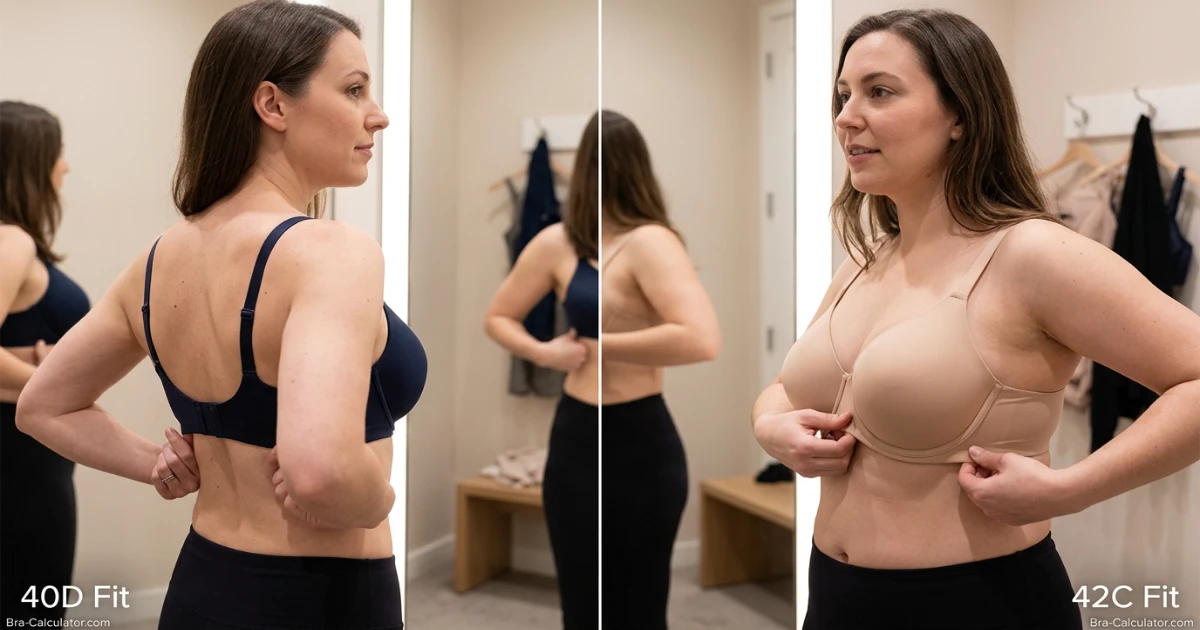
D-Cup Construction: What to Look for in 40D and 42C Styles
At D cup volume on a 40 or 42 band, bra construction becomes meaningfully more important than at smaller cup sizes. The breast tissue weight (~1000 ml per breast) places genuine demands on the bra’s structural engineering — and certain construction choices perform significantly better than others at this size range.
Seamed vs Moulded Cups
Seamed or structured cups are strongly recommended at D volume on both 40D and 42C. Moulded foam cups are manufactured in a fixed shape — at D volume on a wider band, they frequently lose shape by midday, flatten the breast tissue unevenly, or cause the top cup edge to stand away from the breast rather than following its natural contour. Seamed cups — built from multiple fabric panels sewn together — create the shape from the bra’s engineering rather than pre-formed foam, producing more consistent support and a more accurate natural breast shape throughout the day.
Hook-and-Eye Rows
Three-hook back closure is standard and appropriate at both 40D and 42C. Multiple hook rows allow fine adjustment of band tension as the elastic relaxes with wear — at D cup volume, even half a hook of adjustment can change all-day support quality noticeably. Purchase both sizes on their loosest hook; the ability to tighten by two rows as elastic relaxes over 6–12 months extends the garment’s useful life significantly.
Side Panel and Wing Height
At D cup on 40 and 42 bands, the side panel (the fabric between the underwire and the back strap) should be tall enough to contain all lateral breast tissue — the tissue that migrates toward the armpit is more significant at D volume than at smaller cup sizes.
A tall, firmly knit side panel prevents the lateral overflow that creates the “four-breast” silhouette visible through fitted clothing. Compare side panel heights across brands when shopping — this dimension is not captured in the nominal size and varies considerably between manufacturers. See our bra fit problems guide for a full diagnosis of side-tissue overflow issues.
🛍️ Best Bras for 40D and 42C — Our Top Picks
At D cup on 40 and 42 bands, bra selection matters significantly. The breast tissue weight demands genuine structural support — a correctly anchored band, seamed or reinforced cup panels, and wide enough side wings to contain lateral tissue. These two consistently top-rated options cover the two most important use cases — wire-free all-day support and structured underwire — and are available across both 40D and 42C.

Glamorise Women’s MagicLift Active Support Wirefree Bra #1005
The standout wire-free bra for D cup wearers on 40 and 42 bands who need genuine all-day lift and structural support without an underwire. At D cup volume (~1000 ml per breast), the majority of wire-free designs on wider bands fail to maintain cup shape and tissue containment through a full working day — the MagicLift internal sling system is the construction feature that sets this apart.
It lifts, separates, and supports without any wire, delivering meaningful D-cup shape and containment that generic elastic-cup wire-free designs simply cannot achieve on 40 and 42 inch frames. The band construction is reinforced specifically for wider-band D-cup wear — it stays level throughout the day on both 40 and 42 inch ribcages, provided the correct band is chosen for your underbust measurement.
Multi-hook back provides three full levels of band tension adjustment: critical at D cup volume on wider bands where elastic relaxation over time progressively affects support quality. Wide, cushioned straps distribute the D-cup load without digging. Moisture-wicking cotton-blend fabric manages heat during extended wear. Because 40D and 42C are sister sizes, cup performance is identical in both — order the band that matches your underbust measurement.
Available in: 40D, 42C, and full range 30B–46H · Multiple colors
View on Amazon →
Glamorise Women’s WonderWire Front-Close Underwire Bra #1245
An underwire bra engineered specifically for D cup volume on wider 40 and 42 bands. The WonderWire cushioned channel is the defining feature at D cup: it distributes underwire pressure evenly across a padded, wider wire surface rather than concentrating force at two points — eliminating the side-poking and ribcage irritation that standard-gauge underwires cause at D volume on broader bands where the wire spans a wider chest wall.
At D cup volume, side panel height is critical — this construction features reinforced side wings tall enough to contain lateral D-cup tissue and prevent the overflow that creates visible lines under fitted clothing. Front closure removes the behind-the-back fastening challenge — practically significant on wider-band bras where the back-hook reach can be awkward.
Multi-hook back delivers three tension levels: essential for maintaining correct band support as elastic relaxes over 6–12 months of regular wear at D cup load. Because 40D and 42C are sister sizes, cup containment and shape are identical at both sizes — the band determines which is appropriate for your ribcage. 9,100+ Amazon reviews at 4.3 stars across the extended range through 48H confirms its consistency at D cup volume on wider bands.
Available in: 40D, 42C, and extended range through 48H · Multiple colors
View on Amazon →ℹ️ As an Amazon Associate, Bra Calculator earns from qualifying purchases. Product availability and pricing are subject to change. Because 40D and 42C are sister sizes with equal cup volume, cup performance is identical at both sizes — order whichever matches your underbust measurement. At D cup volume, prioritise seamed or structured cup construction over moulded foam for better all-day support and shape retention on wider bands.
5-Step Bra Fit Test: Confirm 40D or 42C Right Now
Because 40D and 42C hold the same cup volume, these checks focus on whether the band is correctly matched to your ribcage — since that is the entire practical distinction between these two sister sizes. Cup-related fit failures resolve by changing cup letter on the same band; band-related failures resolve by switching to the sister size.
Lean well forward and scoop all breast tissue — including the significant side fullness that accumulates at D cup sizes — fully forward and upward into the cup. At D cup volume, side fullness is consistently more than wearers expect.
Any overflow at the top or sides after thorough scooping means the cup is too small: go up one cup letter on the same band (40D → 40DD, or 42C → 42D). Wrinkling or gaping fabric means the cup is too large: go down one letter on the same band. Do not switch between 40D and 42C to resolve a cup volume issue — they hold the same volume and the problem will persist in both.
The centre gore must lie completely flat against the sternum throughout the day. At D cup volume, a floating gore is an almost certain sign the cup is too small — the outward pressure of ~1000 ml of breast tissue per side pushes the cups away from the chest wall. Go up one cup letter on the same band before any other adjustment. If the gore lies flat but the band consistently rides up, that is when switching between 40D and 42C makes sense: try 40D if the 42C band rides up, or 42C if the 40D band digs in.
The underwire must encircle all breast tissue and rest entirely on firm ribcage at every point around its arc. On 40 and 42 bands, the underwire spans a wider chest wall than on narrower bands — check that the wire ends sit precisely at the outer edge of your breast tissue, not on bare ribcage beyond it.
Wire extending past the breast root = underwire too wide for your breast root width — try a different brand’s 40D or 42C with a narrower wire channel. Wire sitting on breast tissue at the sides = cup arc too low — go up one cup letter on the same band.
On the loosest hook, slide two fingers under the back band — firm, consistent resistance is required. The band must run horizontally level all the way around. At D cup volume, this test is more consequential than at smaller cups: roughly 80% of your bra’s support comes from this band, and ~1000 ml of breast tissue per side is depending on it.
If the 40D band leaves deep marks or restricts breathing → try 42C (same cup, wider band). If the 42C band rides up even slightly during normal activity → try 40D (same cup, firmer band). The band decision at D cup is not about comfort preference — it is about genuine support performance throughout the day.
Raise arms overhead, twist side to side, and walk briskly for 60 seconds. The band must stay completely level, cups must hold all D-cup breast tissue in position, and straps must stay on the shoulders without slipping or digging.
Any band rising at the back confirms the band is too wide for your ribcage — switch to 40D if you are in 42C. Any digging or marking confirms the band is too narrow — switch to 42C if you are in 40D. Any cup escape or tissue overflow during movement is a cup size issue — go up one cup letter on the same band.
Still unsure whether 40D, 42C, or a completely different size is right for your measurements? Get a precise answer — including your full sister size ladder — in under 60 seconds.
Try the AI-Powered Bra Size Calculator →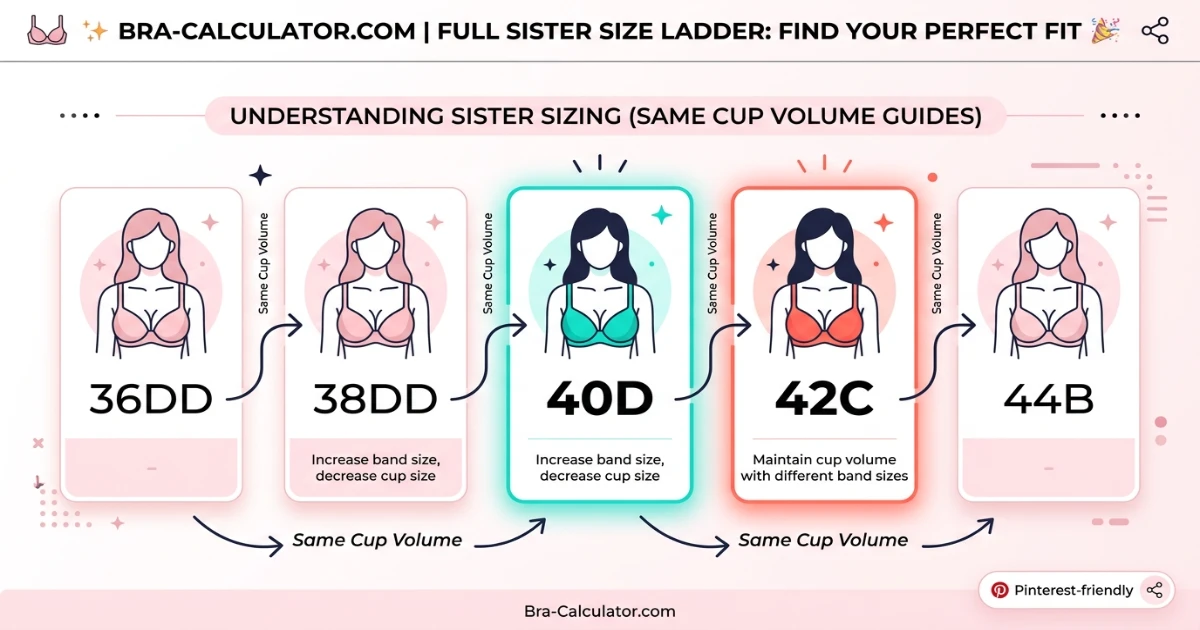
40D vs 42C: Full Side-by-Side Comparison
| Feature | 40D | 42C |
|---|---|---|
| Band Size | 40 — ~33–34″ / 84–87 cm underbust | 42 — ~35–36″ / 89–91 cm underbust |
| Cup Letter (US/UK) | D — 4″ (10 cm) over underbust | C — 3″ (8 cm) over underbust |
| EU Equivalent | 90D | 95C |
| AU / NZ Equivalent | 22D | 24C |
| Cup Volume (per breast) | ≈ 1000 ml ↔ | ≈ 1000 ml ↔ |
| Sister Sizes? | ✅ Yes — confirmed sister sizes, same volume family | |
| Fullest Bust | ~44″ (112 cm) | ~45″ (114 cm) |
| Cup Shape | Deeper, more projected on narrower frame | Broader, slightly shallower on wider frame |
| Underwire Width | Narrower — suits closer-set breast root | Wider — suits broader breast root |
| Band Tightness | Firmer — carries more of D-cup weight | Wider — more relaxed, slightly more strap load |
| Full Sister Family | 36E/DD — 38DD — 40D — 42C — 44B | |
| If cups too small | Try 40DD (same band, next cup up) | Try 42D (same band, next cup up) |
| If cups too large | Try 40C (same band, prior cup) | Try 42B (same band, prior cup) |
| If band too tight | Try 42C (sister — same volume, wider band) | Try 44B (sister — same volume, wider band) |
| If band too loose | Try 38DD (sister — same volume, firmer band) | Try 40D (sister — same volume, firmer band) |
| Cup construction | Seamed or structured cups recommended at D volume on both band sizes | |
| Hook rows | 3-hook back standard for both — purchase on loosest hook | |
| Availability | More widely stocked — mainstream and full-figure retailers | Common in full-figure specialist lines — slightly less mainstream |
| Best For | Underbust ~33–34″, projected or centrally-set breast shape | Underbust ~35–36″, wider-root or laterally-spread breast shape |
People Also Ask: 40D vs 42C — Answered
Are 40D and 42C sister sizes?
Yes — 40D and 42C are confirmed sister sizes. They hold approximately the same cup volume (~1000 ml per breast) on different band sizes. Going up one band from 40 to 42 and dropping one cup letter from D to C follows the sister size rule exactly. They share the same sister size family: 36E/DD, 38DD, 40D, 42C, 44B — all holding approximately equal cup volume.
Which is bigger — 40D or 42C?
Neither holds more cup volume — they are confirmed sister sizes with approximately equal breast tissue capacity (~1000 ml per breast). The 40D cup is slightly deeper and more projected on a narrower frame; the 42C cup is slightly broader and shallower on a wider frame. Volume is equal; the correct size depends entirely on your underbust measurement.
When should I switch from 40D to 42C?
Switch to 42C only when your 40D band is genuinely too tight for your ribcage — leaving deep red marks, restricting breathing, or causing persistent discomfort under the arms from the first wear, while the cups fit correctly with no overflow or floating gore. At D cup volume, the firm band delivers critical support. Do not upsize the band for general comfort if the 40 band actually fits your ribcage measurement.
My 40D band is too tight — should I try 42C or 42D?
If your 40D band is too tight but the cups fit correctly, try 42C — not 42D. The 42C is the sister size: it gives you a wider band while preserving exactly the same cup volume as your 40D. Moving to 42D gives you a wider band AND more cup volume — correct only if both your band and cups are too small. Change one variable at a time.
My 42C cups overflow — should I try 42D or 40D?
If your 42C cups overflow but the band fits correctly, try 42D on the same band — not 40D. The 40D is the sister size of 42C, meaning it holds the same cup volume, not more. Moving to 40D gives you a tighter band with no additional cup space — solving neither problem. Go up one cup letter on the same 42 band.
Can I substitute 42C for 40D?
Yes — 42C is the correct sister size substitute when 40D is unavailable. Cup volume will be approximately equal. The 42C band is 2 inches wider, which means it will feel noticeably looser on a 33–34 inch ribcage. If the looser band causes the bra to ride up at the back, return to 40D — the band fit is not correct on your frame, regardless of cup volume match.
Which gives better support — 40D or 42C?
On the correct ribcage, both sizes give equal support — the band anchors identically on its matching frame. For a 33–34 inch ribcage, the 40D delivers better support because the firmer band carries more of the D-cup weight. A 42C on the same ribcage rides up and shifts load to the straps. For a 35–36 inch ribcage, the 42C delivers equally good support and the 40D would be uncomfortably tight. Underbust measurement is the deciding factor, not the band number.
Do I need seamed cups in 40D or 42C?
Seamed or structured cups are strongly recommended at D cup volume regardless of band size. Moulded foam cups at D volume on wider bands often lose shape by midday, compress tissue unevenly, or create a flattened rather than natural breast profile. Seamed full-cup or balcony constructions provide more consistent support, better lateral tissue containment, and a more accurate natural shape throughout the day at this cup volume.
Is 42C harder to find than 40D?
Somewhat — 40D is more commonly stocked across mainstream and full-figure retail, while 42C tends to appear most reliably in specialist full-figure lines (Bali full-figure, Playtex, Elomi, Glamorise). Online retailers provide the widest 42C selection. When 42C is unavailable in a style you need, 40D is the correct sister size substitute providing the same cup volume in a firmer band.
How do I know my correct bra size at 40D or 42C?
Measure your underbust snugly on a gentle exhale: 33–34 inches = 40 band; 35–36 inches = 42 band. Measure fullest bust and subtract underbust: 4 inches = D cup; 3 inches = C cup. Verify fit with five checks: level band, flat gore, underwire beneath all breast tissue, two fingers under back band on loosest hook, no cup movement or tissue escape during activity. Use our bra size chart calculator for a precise personalised result including your full sister size ladder.