30D vs 30DD: What’s the Real Cup Size Difference? (2026 Guide)
Updated for 2026 · Reviewed by bra-fit experts · 8-minute read
Choose the fit signs you notice in the band, cups, center and straps. We’ll turn them into a practical next step for 30D.
Private fit check — your answers stay in your browser and are used only for this on-page guidance. Nothing is stored or submitted.
Quick Answer
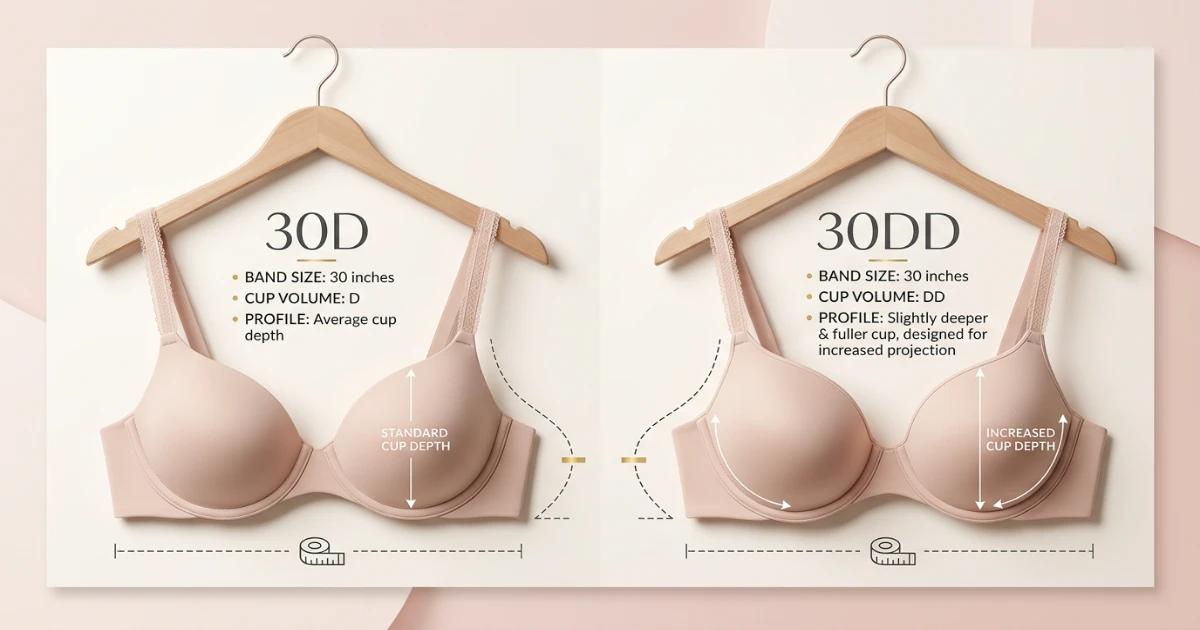
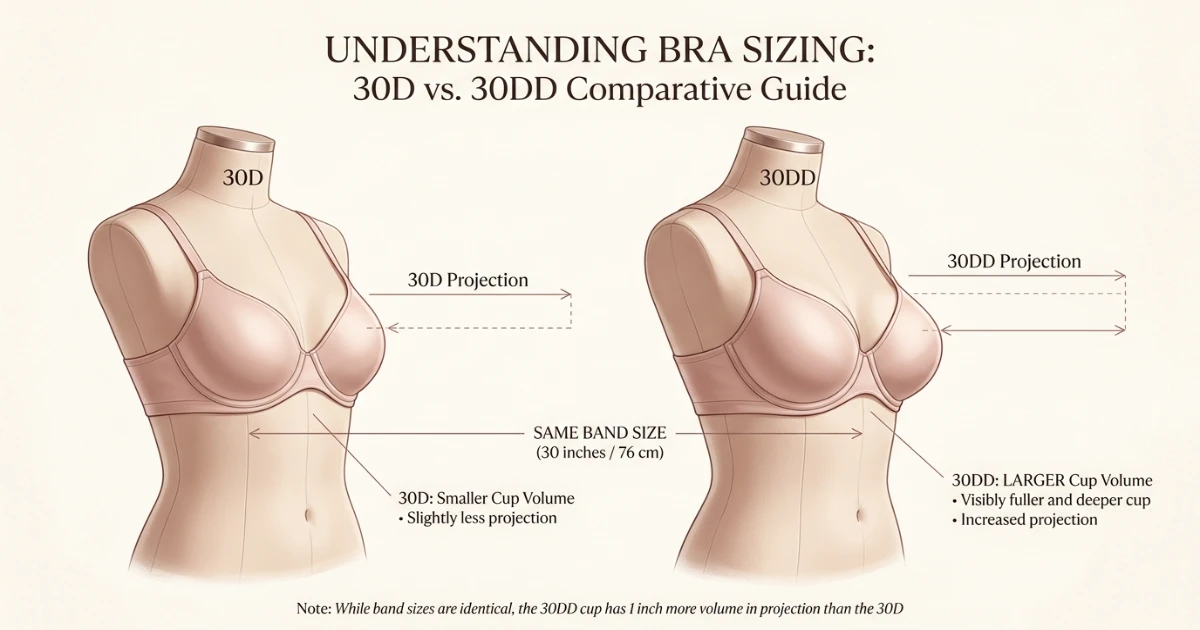
A 30DD cup holds approximately 1 inch more bust projection than a 30D. Both sizes share the same 30-inch band, so the only difference is in the cup’s depth and volume. In practical terms, the 30DD provides roughly ½ to ¾ cup more room — enough to meaningfully affect comfort and shape. If your 30D cups are consistently overflowing at the top or sides, a 30DD is likely the right next step.
Key Takeaways
- The band size (30 inches) is identical in both 30D and 30DD — only the cup volume differs.
- A DD cup is one full cup size larger than a D cup (approximately 1 extra inch of bust–band difference).
- Moving from 30D to 30DD adds cup volume without changing how snugly the band fits around your torso.
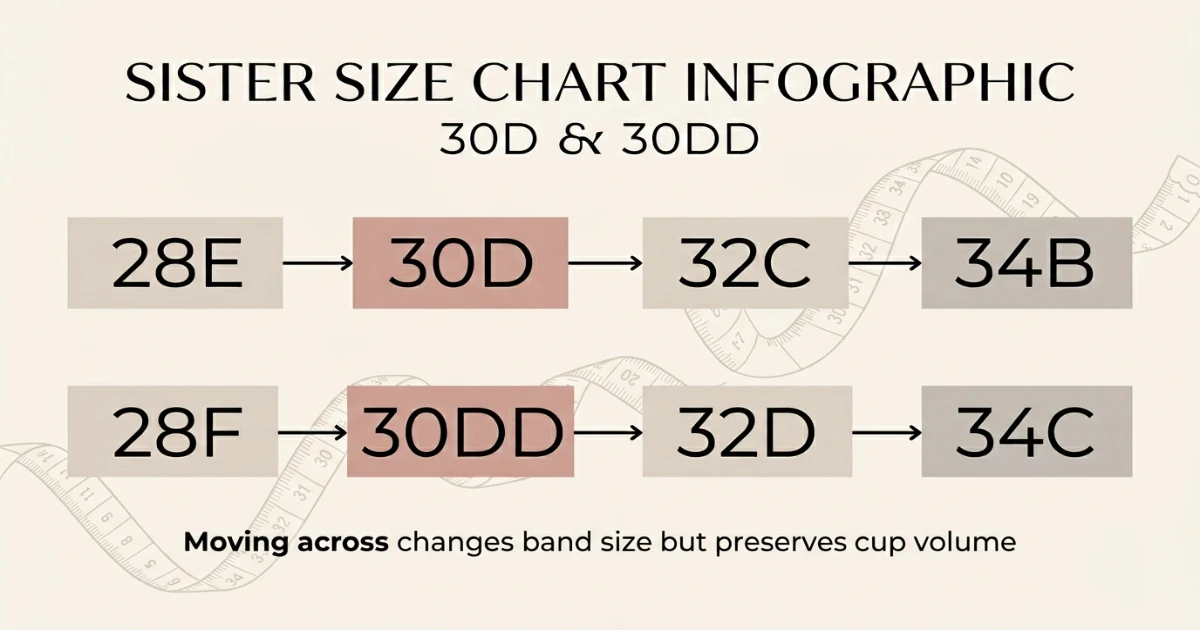
- 30DD is the sister size of 32D, 28E, and 34C — all enclose roughly the same breast volume.
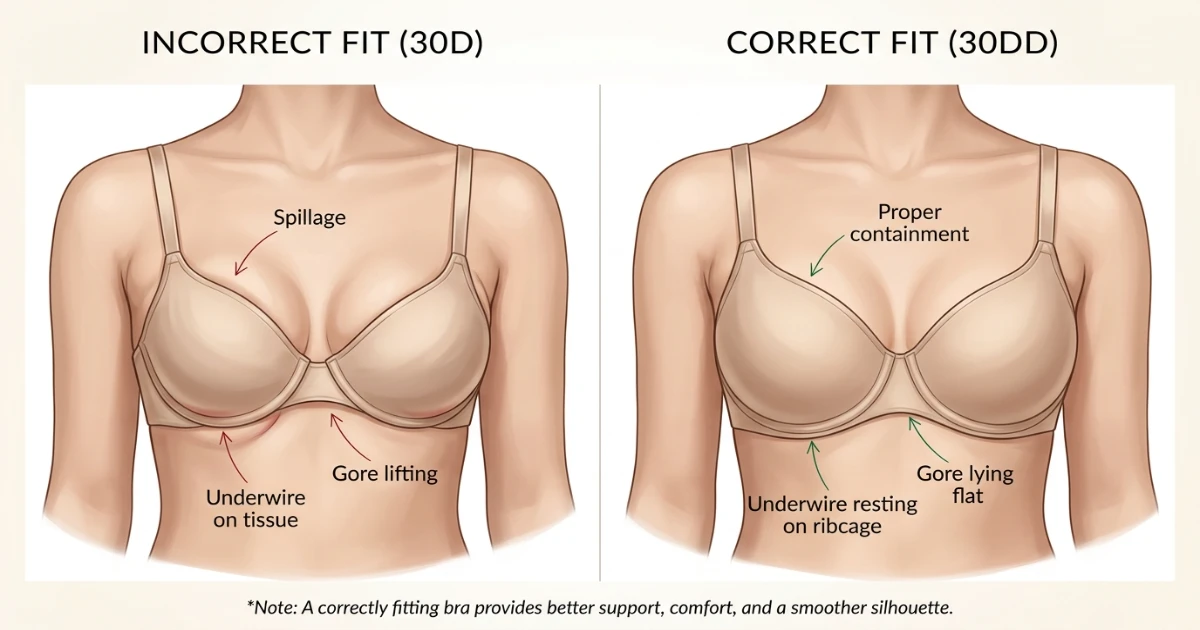
- Signs you need to size up from 30D to 30DD include spillage over the cup top, underwire sitting on breast tissue, and a center gore that won’t lie flat.
- You can use the AI Smart Fit Bra Calculator to confirm your size in under 60 seconds.
Understanding Bra Cup Letters
Bra cup letters represent the difference in inches between your full bust measurement and your band measurement. Each letter step equals approximately one inch of additional difference:
band difference
band difference
Many women are surprised that DD is only one cup size above D, not a dramatically larger jump. The “double D” label can feel intimidating or unfamiliar, but on a 30-inch band it describes a modest, natural cup increase. Cup letters follow a sequential scale: A → B → C → D → DD (E) → DDD (F) → and so on. For a full breakdown of how the scale works, see the bra size charts.
It’s also worth knowing that DD is sometimes written as E depending on the brand’s country of origin. UK and Australian brands commonly use E instead of DD — they refer to the same cup volume. When shopping internationally, always check the brand’s specific sizing chart or use a conversion chart to avoid confusion.
Measurement Breakdown: 30D vs 30DD
To understand the numbers behind both sizes, here is how the standard measurement system maps each size:
| Measurement | 30D | 30DD |
|---|---|---|
| Band size | 30 inches | 30 inches |
| Bust–band difference | 4 inches | 5 inches |
| Cup letter (US/CA) | D | DD |
| Cup letter (UK/AU) | D | E |
| Cup steps from A | 4th cup | 5th cup |
| Projected bust measurement | ~34 inches | ~35 inches |
As the table shows, the only numerical difference is 1 inch of bust projection. Everything about the fit of the band — how it sits on your rib cage, how snug it feels, where the straps attach — remains the same. To learn how to take accurate measurements yourself, visit the how-to-measure guide.
Cup Volume Difference: How Much Larger Is 30DD?
Volume is the most meaningful way to think about cup size differences. Even though the numerical difference is 1 inch, that translates into a noticeable change in the three-dimensional space inside the cup.
Studies and fit data consistently show that stepping up one cup letter on a 30-inch band adds roughly 10–15% more internal cup volume. This is enough to:
- Eliminate top-of-cup spillage in most cases.
- Allow the underwire to sit fully on your rib cage rather than digging into breast tissue.
- Give the breast tissue room to sit fully inside the cup for a smoother, more supported silhouette.
- Reduce the “quad-boob” effect caused by an overfull D cup pressing against the fabric.
Breast volume varies by shape — full-on-top breasts may feel this difference more acutely than full-on-bottom shapes. If you want to see how your shape affects cup choice, the cup size visuals guide offers a detailed look at how different breast shapes fill cups differently.
Fit Differences You’ll Notice: 30D vs 30DD
The 1-inch cup difference produces tangible, everyday fit differences. Here is what distinguishes the two sizes in real wear:
In a 30D that is too small:
- Breast tissue overflows above the cup’s top edge or escapes at the sides.
- The underwire lifts away from the chest wall or digs into the outer breast.
- The center gore (the piece between the cups) pokes forward instead of lying flat against the sternum.
- Straps may dig in trying to compensate for inadequate cup lift.
- The bra looks smooth and “full” even before putting it on — a sign the cup is pre-stretched.
In a correctly fitted 30DD:
- All breast tissue sits neatly inside the cup with no spillage.
- The underwire traces the base of the breast and lies flat against the rib cage.
- The center gore lies flat against the sternum throughout the day.
- Shoulder straps carry minimal load — the band and cups do the work.
- The cup fabric lies smooth with no puckering or wrinkling (which would indicate too much room).
Not sure which fit issues you’re experiencing? The bra fit problems guide walks through the most common fit complaints and their size solutions step by step.
Who Should Choose 30D vs 30DD?
✓ Choose 30D if you…
- Have a 4-inch difference between bust and band measurement.
- Find current cups have slight excess fabric at the top.
- Experience no spillage or underwire displacement in your current bra.
- Are between sizes and prefer a snugger cup feel.
- Have been professionally measured as a 30D.
✓ Choose 30DD if you…
- Have a 5-inch difference between bust and band measurement.
- Notice tissue escaping over your current D cup’s top or sides.
- Feel the underwire sitting on — rather than under — your breast tissue.
- See the center gore lifting away from your sternum.
- Feel restricted or uncomfortable in your current 30D by midday.
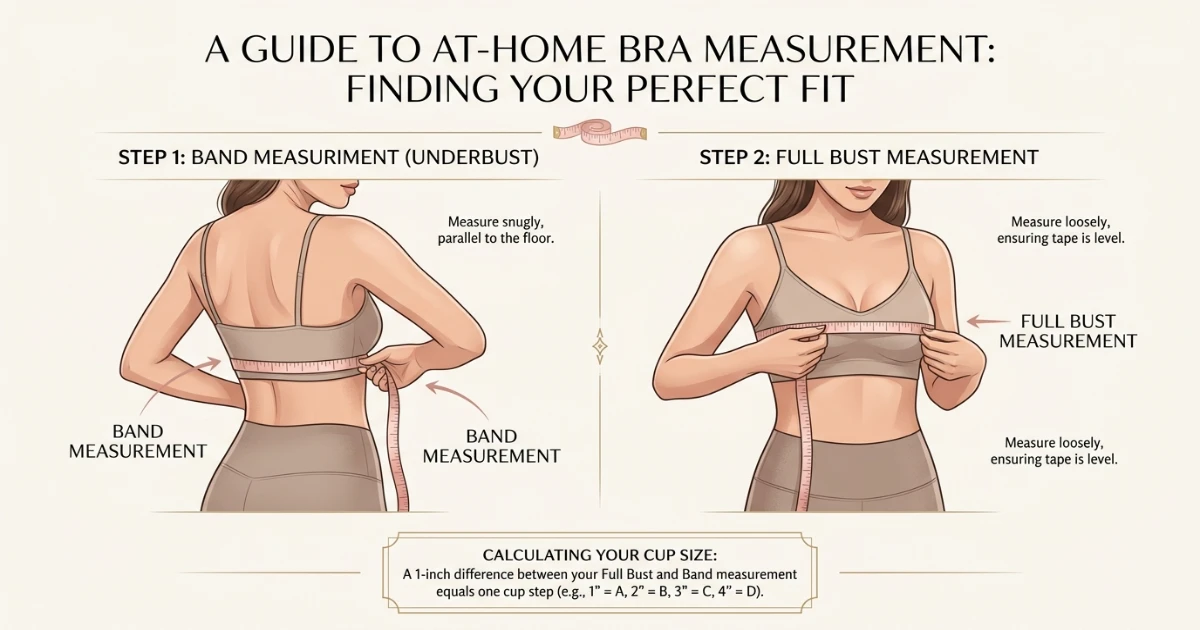
If you’re genuinely uncertain which description fits you, take two fresh measurements — one around the rib cage (band) and one at the fullest part of the bust — and compare them. A 4-inch gap points to 30D; a 5-inch gap points to 30DD. You can also use the AI Smart Fit Bra Calculator to interpret your measurements automatically.
Sister Sizes Explained
Sister sizes are bra sizes that share the same cup volume despite having different band and cup letter combinations. Understanding sister sizes helps you find a better fit when your exact size is out of stock, or when you want a looser or tighter band feel.
Here are the sister size families for both 30D and 30DD:
30D Sister Sizes (same cup volume as 30D)
30DD Sister Sizes (same cup volume as 30DD)
Notice that 30DD shares cup volume with 32D — so if you’ve been comfortably wearing a 32D but want a firmer band, a 30DD is the sister-size equivalent. Conversely, if your 30DD band feels too tight, 32D offers the same cup room with a relaxed band. Use the interactive sister sizes guide or the sister size bra calculator to explore all equivalents for your current size.
Quick Bra Fit Test: Am I Wearing the Right Size?
Put on your current 30D bra and run through this five-point check:
- Band check: Slide two fingers under the back band. It should feel snug but not painful. If it rides up toward your shoulder blades, the band may be too large — but if it digs in painfully, it may be too small.
- Cup top check: Look straight at a mirror. Is any breast tissue sitting above or outside the cup edge? If yes, you likely need the next cup size up (30DD).
- Underwire check: Press lightly on the underwire at the side of your breast. It should rest on your rib cage, not on soft breast tissue. If it’s on tissue, size up the cup.
- Gore check: Press the center gore flat against your sternum. It should stay flat on its own. If it springs forward, the cups are too small.
- Strap check: Loosen both straps slightly. If the bra immediately feels unsupportive, your band/cup combination isn’t doing its job — and a fit adjustment is needed.
If you failed two or more checks, a 30DD (or a professional re-measurement) is likely your next step. For a deeper diagnosis, see the bra fit problems guide.
30D vs 30DD: Full Comparison Table
| Feature | 30D | 30DD |
|---|---|---|
| Band measurement | 30 inches | 30 inches |
| Cup letter (US) | D | DD |
| Cup letter (UK/AU) | D | E |
| Bust–band difference | 4 inches | 5 inches |
| Approximate full bust | 34 inches | 35 inches |
| Cup depth vs D | Baseline | ~1 inch deeper |
| Internal cup volume | Baseline | ~10–15% more |
| Sister sizes | 28E · 32C · 34B | 28F · 32D · 34C |
| Best for bust–band diff | 4 inches | 5 inches |
| Common fit complaint at wrong size | Gaps in cup if too large | Spillage if still in 30D |
For a broader visual reference across many sizes, the breast size comparison tool lets you compare multiple cup sizes side by side.
People Also Ask
Is 30DD bigger than 30D?
Yes. A 30DD is one full cup size larger than a 30D. Both bras share the same 30-inch band, but the DD cup holds approximately 1 inch more bust projection and 10–15% more internal volume. The band tightness and overall fit around the rib cage feels identical between the two.
How much bigger is a DD cup compared to a D cup?
A DD cup is approximately 1 inch larger in bust projection than a D cup, assuming the band size stays the same. This equals one cup step in the standard sizing scale. In volume terms, this is a meaningful but not dramatic increase — roughly equivalent to moving from a 32C to a 32D, or from a 34B to a 34C.
What is the sister size of 30DD?
The sister sizes of 30DD are 28F (smaller band, larger cup letter), 32D (larger band, smaller cup letter), and 34C (even larger band). All of these sizes enclose approximately the same breast volume as a 30DD, though the band tightness and overall silhouette will differ. Use the sister size bra calculator to find all equivalents.
Can I size up to 30DD if my 30D cups overflow?
Yes, cup overflow (tissue spilling over the top or sides of the cup) is one of the clearest signs that you need to go up one cup size. If your 30D band fits well but your cups overflow, trying a 30DD is the correct first step. The band will feel the same while the cups provide the extra room your bust needs.
Is 30DD a rare bra size?
30DD is considered a narrow-band, full-cup size that is not stocked widely in mainstream retail stores. However, specialist lingerie retailers and online brands (particularly UK-based brands such as Bravissimo, Freya, and Panache) carry 30DD as a standard size. Shopping from full-range specialty retailers is recommended for the best selection.
Does DD mean “double D” and is it twice the size of D?
The “DD” label originated from the US sizing convention and is often misunderstood as “twice D.” In reality, DD means exactly one cup size larger than D — it represents a 5-inch bust–band difference versus 4 inches for D. It is not double the volume of a D cup. Many UK and European brands simply call this size “E” to avoid the confusion.
How do I measure myself to know if I’m a 30D or 30DD?
Measure your rib cage snugly just under your bust — this gives your band number (should be close to 30 inches for both sizes). Then measure around the fullest part of your bust while standing relaxed. Subtract the band from the bust: a 4-inch difference = 30D; a 5-inch difference = 30DD. For a step-by-step walkthrough with photos, see the how-to-measure guide.
Is 30DD the same as 32D?
Yes — 30DD and 32D are sister sizes, meaning they contain the same cup volume. The difference is in the band: 30DD has a firmer, tighter band around a 30-inch rib cage, while 32D fits a slightly larger rib cage with a more relaxed band. If you’re between sizes, this sister-size swap is often used to find the most comfortable fit. Learn more at the sister sizes guide.
Related Bra Size Comparisons
Explore adjacent size comparisons to fine-tune your understanding of how cup volume scales across band sizes:
Find Your Exact Size in 60 Seconds
Still weighing whether you’re a 30D or 30DD? Take the guesswork out entirely. The AI Smart Fit Bra Calculator asks about your measurements, current fit issues, breast shape, and preferred bra style — then provides a personalized size recommendation backed by fit data. It’s free, takes under a minute, and considers factors that a simple measurement formula can’t capture.
You can also use the standard measurement guide if you prefer to calculate manually, or browse the bra size charts for a full reference across all sizes.