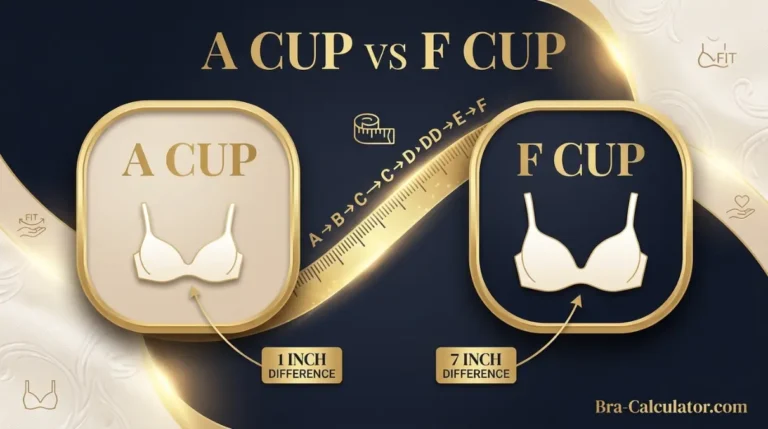
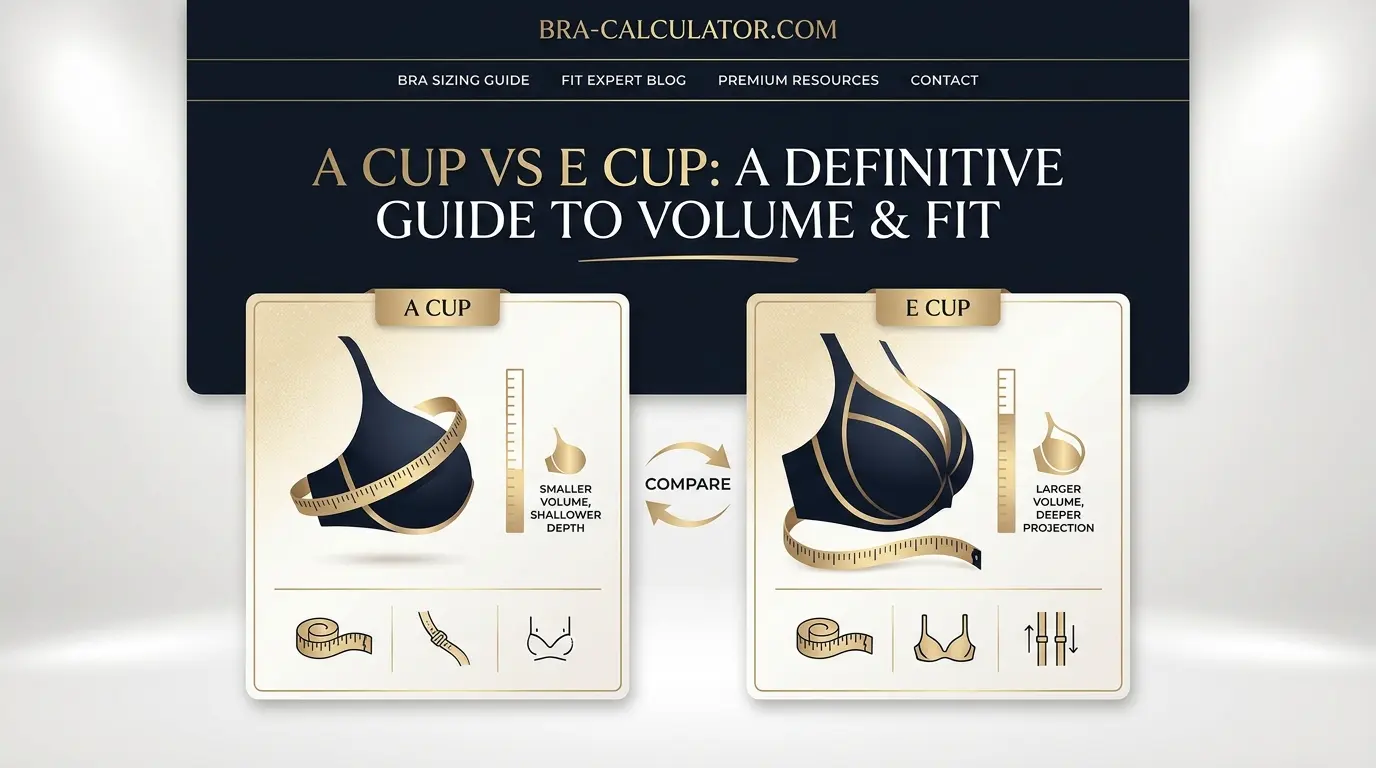
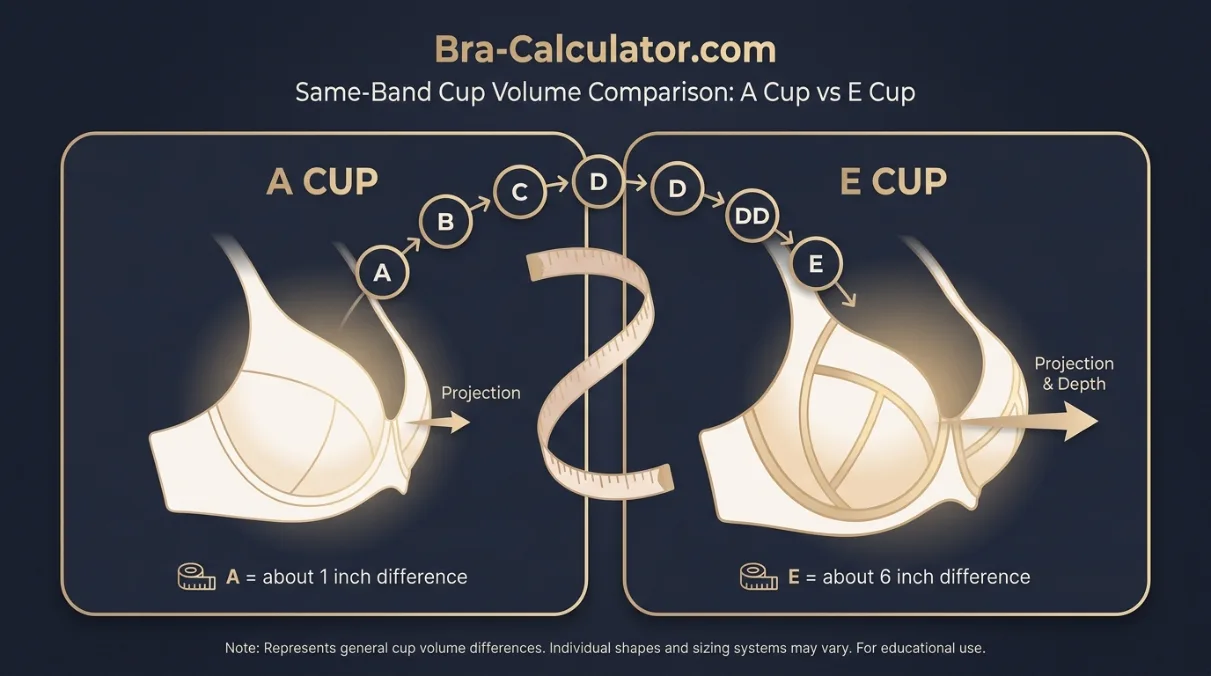
On the same band size, E cup is about 5 cup steps larger than A cup. In many standard systems, A commonly represents about a 1-inch bust-to-underbust difference while E represents about a 6-inch difference. Because this comparison has a meaningful gap, use it as a fitting pathway: check middle sizes, sister sizes, and real symptoms before choosing.
Jump to a Section
A Cup vs E Cup at a Glance
| Attribute | A Cup | E Cup |
|---|---|---|
| Typical same-band difference | About 1 inch | About 6 inches |
| Gap size | 5 cup steps on the same band — middle sizes are important. | |
| Key fitting theme | This is a very wide comparison that works best as an educational pathway from light volume to full-cup depth. | |
| Core reminder | Cup volume is not fixed. Band size, sister sizing, shape, and bra construction can change how the comparison looks. | |
What Does A Cup vs E Cup Really Mean?
A Cup vs E Cup compares a light-volume cup with a deep full cup on the same band. This is not a normal direct switch. It is useful for readers who are trying to understand why cup letters depend on band size and why E is not automatically extreme. If someone wearing A has severe spillage or compression, the right answer should still be found gradually through B, C, D, and DD before E is assumed.
This is a very wide comparison that works best as an educational pathway from light volume to full-cup depth. The most important thing is not to treat the two labels as the only options. A reader may need the smaller cup, the larger cup, a middle size, a different band, or a different cup shape. The correct answer is the one that fixes the main symptom without creating new gaping, pressure, or instability.
The myth is that E always equals huge and A always equals one fixed body type. Both ideas are inaccurate without band context. Bra fitting is not a label contest. A size that sounds bigger can look smoother and feel lighter when it allows the band, wires, and cups to do their jobs properly.
Middle-size warning: Check B, C, D, and DD before E unless A is clearly a severe misfit.
Exact Measurement Difference Between A and E
Because this gap is large, measurement accuracy and middle-size checks are essential. In many standard sizing systems, each cup step adds roughly one inch to the bust-to-underbust difference on the same band. This gap can affect lower-cup lift, center-gore behavior, side-wire reach, and how much tissue is pushed upward or outward.
| Fit sign | Usually points lower / middle | Usually points deeper |
|---|---|---|
| Cup edge | Larger cup wrinkles, gaps, or feels too tall | Smaller cup cuts in or creates visible overflow |
| Center gore | Nearly tacks but cup shape feels wrong | Floats strongly after scoop-and-swoop |
| Side wire | Wire surrounds tissue cleanly | Wire sits on breast tissue or misses outer fullness |
| Movement test | Only mild shifting in one bra | Repeated bounce, compression, or side escape |
A loose band can make both cup sizes feel wrong.
Do not compress tissue, especially when checking wider cup gaps.
Check B, C, D, and DD before E unless A is clearly a severe misfit.
The best size gives clean containment, stable support, and less pressure.
What Does A Cup vs E Cup Look Like?
Visually, A vs E moves from minimal projection into deep cup containment and a much stronger support profile. On smaller bands, E may look balanced rather than dramatic.
On a petite frame, this difference may look more noticeable. On a broader frame, the same volume may distribute more evenly. Projected tissue usually makes the deeper cup look more necessary, while shallow or wide tissue can make the larger cup wrinkle unless the shape is right.
Real fit beats online myths. The right size is the one that looks calmer, sits smoother, and feels more secure on your own body.
If A gaps, E is not the answer. If A is based on a wrong band and severe compression, remeasurement is the first step.
Best Products to Test A Cup vs E Cup
For A vs E, products should be framed as diagnostic tools for a size-range check, not direct replacement advice. Use products as diagnostic tools: they should reveal depth, support, wire position, and cup-edge behavior, not just create a prettier shape.

Structured Everyday Bra
- Useful for checking whether the smaller size is truly wrong or simply the wrong style.
- For A vs E, products should be framed as diagnostic tools for a size-range check, not direct replacement advice.
- Use the same bra model in a logical size range whenever possible.
- Prioritize a level band, smooth cup edge, and stable center gore.

Seamed or Side-Support Bra
- Shows whether extra depth improves containment or whether a middle size is enough.
- For A vs E, products should be framed as diagnostic tools for a size-range check, not direct replacement advice.
- Use the same bra model in a logical size range whenever possible.
- Prioritize a level band, smooth cup edge, and stable center gore.

Supportive Wireless or Soft-Cup Bra
- Helpful after measurement confirmation when comfort and cup edge behavior matter.
- For A vs E, products should be framed as diagnostic tools for a size-range check, not direct replacement advice.
- Use the same bra model in a logical size range whenever possible.
- Prioritize a level band, smooth cup edge, and stable center gore.
How Body Shape Changes A Cup vs E Cup
Body shape can completely change how a cup comparison looks. The same difference can look compact on one person and dramatic on another because height, ribcage width, breast root, projection, and tissue softness all change the visible result.
Difference May Look Bigger
With less torso space, deeper cups can appear more visually noticeable.
Difference May Look Balanced
Volume can distribute across a wider chest, making wire width very important.
Check wire widthDepth Shows Fast
Projected shapes usually reveal too-small cups quickly at the center and lower cup.
Depth mattersShape Can Override Size
A larger cup can still gap if it is too tall or too projected for your shape.
Shape match firstA Cup vs E Cup Sister Sizes
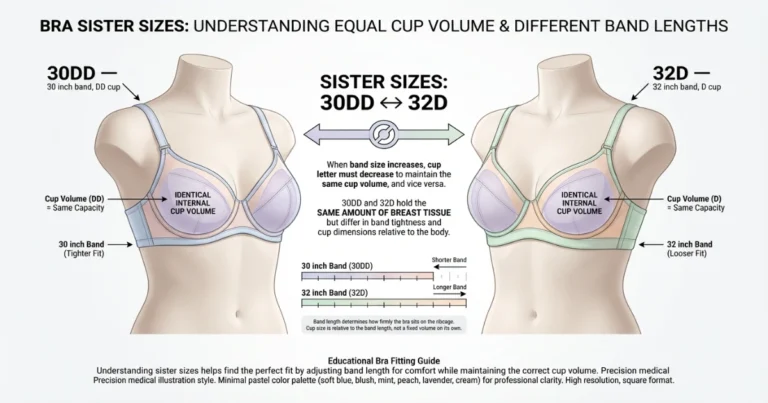
Sister sizing lets you keep similar cup volume while changing the band. This is especially important in wide comparisons because a smaller-band larger cup can look less dramatic than expected, while a larger-band smaller cup can hold more physical volume than the letter suggests.
Check B, C, D, and DD before E unless A is clearly a severe misfit.
| Situation | Try | Why |
|---|---|---|
| Smaller cup spills badly | Work up through the middle range | The correct size may be deeper, but the middle sizes often reveal the best answer. |
| Larger cup gaps | Step down or change cup shape | The larger cup may be too deep, too tall, or too open. |
| Band rides up | Down one band, up one cup | Keep similar volume with firmer support. |
| Band feels tight | Up one band, down one cup | Keep similar volume with more ribcage room. |
A vs E: Real Fit Differences
- A is a light-volume reference on the same band.
- May be correct if the deeper size gaps or feels too tall.
- Should contain tissue cleanly after scoop-and-swoop.
- Can be too shallow if the gore floats or side wire presses.
- E adds deep full-cup support and much more capacity.
- Usually needs stronger construction and deeper architecture.
- May be right when the smaller size fails repeatedly.
- Should improve containment, not just change the label.
- The middle sizes explain the real pathway.
- Middle sizes matter when the smaller size is only mildly wrong.
- Shape mismatch can mimic a cup-size error.
- Sister sizing can make visual assumptions misleading.
- Seamed and side-support bras test depth better than shallow molded bras.
- Return-friendly shopping matters for wide comparisons.
- May feel okay at rest but fail during movement.
- Can push support into the straps when overfilled.
- Needs a stable band to test fairly.
- Should improve weight distribution and cup stability.
- May still fail if the shape is wrong.
- Specialist construction gives the fairest test.
- Check B, C, D, and DD before E unless A is clearly a severe misfit.
- Use the same bra model across sizes when possible.
- Check after movement, not only while standing.
- Use brand charts for deeper cup letters.
- Avoid judging from one shallow molded bra.
- Prioritize fit symptoms over the label.
Which Bra Styles Work Best for A Cup vs E Cup?
The styles below are tailored to this comparison’s support demands. Wider gaps need bras that reveal depth, support, cup height, and side containment honestly.
Useful everyday comparison style when the cup shape is not too shallow.
Shows depth and edge fit better than many molded cups.
Helpful for center fullness and lower gore comfort.
Great for side tissue and forward shape.
Can smooth the profile while still showing fit problems.
Too soft for a fair wide-gap test.
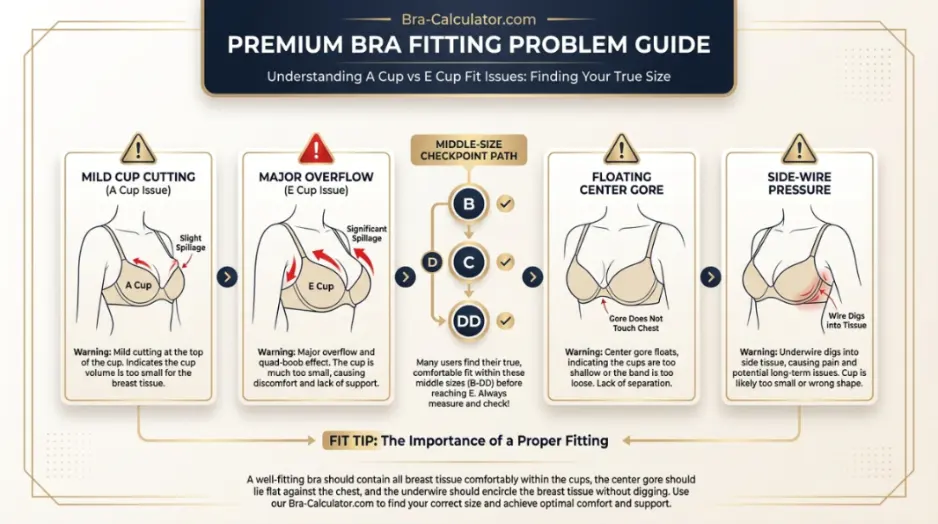
Common Fit Problems in A Cup vs E Cup
If A gaps, E is not the answer. If A is based on a wrong band and severe compression, remeasurement is the first step.
Mild cutting may point to a middle size, while major overflow suggests a deeper range may be needed.
The smaller cup may not have enough depth near the center.
This often means the cup is too shallow, too narrow, or both.
The larger cup may be too tall, too open, or simply the wrong shape.
This is often a band problem hiding inside a cup problem.
When the cups and band do not support correctly, the straps start compensating.
International Conversion Notes for A Cup vs E Cup
International sizing can change the meaning of cup labels. DD, DDD, E, F, G, H, I, J, and K can vary across US, UK, EU, AU, and brand-specific charts. This matters more in wider pages because the same label can behave differently by brand.
Use the Global Bra Size Converter and the Brand Size Decoder before buying across regions.
Related Tools & Guides for A Cup vs E Cup
| Guide / Tool | Why It Helps |
|---|---|
| Bra Size Calculator | Calculate your band and cup using real measurements. |
| Cup Size Visuals | Understand visual volume without treating cup letters as fixed body categories. |
| Sister Size Calculator | Adjust the band while keeping similar cup capacity. |
| Global Bra Size Converter | Check label differences across sizing systems. |
| AI Smart Fit Bra Calculator | Diagnose gaping, spillage, strap digging, floating gore, and side tissue issues. |
Frequently Asked Questions
On the same band, E has more cup depth than A. The visible difference depends on band size, breast shape, and bra construction.
Check B, C, D, and DD before E unless A is clearly a severe misfit.
Because wide cup gaps can cause overcorrection. Middle sizes help find the real fit range.
Yes. Sister sizing, body frame, and band size can make visual differences less obvious.
Try a logical size range in the same bra model and check the cup edge, side wire, gore, band, and movement comfort.
It may be too tall, too open, too projected, or simply too large. Try a middle size or different shape.
Yes, especially in deeper cups. Always verify the brand’s own chart before buying.
Use measurements, middle-size checks, sister sizing, and real fit symptoms. The best size should feel more stable, not just sound bigger.
Find Your Best Cup Size
Use your measurements, fit symptoms, and sister-size options to decide whether A, E, a middle size, or a nearby band-and-cup combination gives the cleanest fit.