DDD Cup vs I Cup: Measurements, Fit & Sister Sizes
Premium cup comparison guide with exact fit logic, sister sizes, visual volume notes, tailored product suggestions, and calculator links.
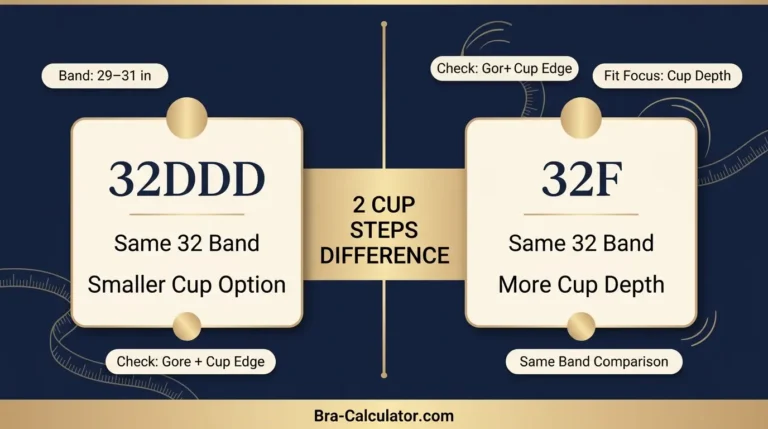
On the same band size, I cup is about 3 cup steps larger than DDD cup. In many standard systems, DDD commonly represents about a 6-inch bust-to-underbust difference while I represents about a 9-inch difference. Because this comparison has a meaningful gap, use it as a fitting pathway: check F, G, and H as middle sizes before committing to I, and use real fit symptoms — not just measurements — as the final guide.
Jump to a Section
Choose the fit signs you notice in the band, cups, center and straps. We’ll use them to suggest the most useful next step.
Private fit check — your answers stay in your browser and are used only for this on-page guidance. Nothing is stored or submitted.
DDD Cup vs I Cup at a Glance
| Attribute | DDD Cup | I Cup |
|---|---|---|
| Typical same-band difference | About 6 inches | About 9 inches |
| Also labelled | F cup (UK / EU / AU) | I cup (UK) · varies by brand |
| Gap size | 3 cup steps on the same band — F, G, and H are essential middle checkpoints | |
| Key fitting theme | Advanced specialist range. Do not jump from DDD to I without testing the middle sizes first. | |
| Main reminder | Cup volume is not fixed. Band size, sister sizing, and cup shape all change how this comparison behaves. | |
What Does DDD Cup vs I Cup Really Mean?
DDD Cup vs I Cup compares two sizes that both sit firmly in specialist lingerie territory. DDD (also called F in UK, EU, and AU sizing) is where mainstream retail ends for most brands. I cup extends well beyond that into the specialist-only range where brands like Elomi, Fantasie, Freya, Panache, and Goddess produce their most engineered, deeply constructed bras.
The most important lesson in a 3-step comparison is that the endpoints are not always the real decision. F, G, and H sit between DDD and I — and one of those middle sizes is often the correct answer. This guide treats the range as a diagnostic ladder, not a binary choice between two extreme labels.
The myth is that jumping three cup steps always produces a dramatic or necessary change. Sometimes it simply removes compression and improves weight distribution. Sometimes the correct answer is G — just two steps up — and I would overcorrect by producing top wrinkling or empty fabric in the upper cup. Bra fitting is not about chasing the largest letter. It is about getting a stable band, a smooth cup edge, a centered silhouette, and all-day comfort.
Middle-size warning: Use F, G, and H as the main checkpoints before I unless DDD is dramatically overwhelmed by overflow, floating gore, and persistent wire pressure across multiple styles and brands.
Labelling note: US DDD = UK/EU/AU F. When shopping UK specialist brands at this range, search for F (for DDD), G, H, and I — the US DDD label does not appear in their catalogues.
Exact Measurement Difference Between DDD and I
In most standard sizing systems, each cup step adds roughly one inch to the bust-to-underbust difference on the same band. This 3-step gap at an already deep starting point affects lower-cup lift, center-gore behavior, side-wire reach, and overall support stability more dramatically than the same 3 steps would at smaller cups.
Middle sizes: F/DDD (~6 in) · G (~7 in) · H (~8 in) — check these before I
| Fit Sign | Usually points to DDD (or middle) | Usually points toward I |
|---|---|---|
| Cup edge | Larger size gaps, wrinkles, or feels too tall | Smaller size cuts in or creates visible overflow |
| Center gore | Sits nearly flat; deeper cup looks overbuilt | Floats strongly — smaller cup lacks center depth |
| Side wire | Wire already surrounds tissue cleanly at DDD | Wire sits on breast tissue or misses outer fullness |
| Support feel | Deeper size feels too roomy or too tall | DDD feels compressed, strap-heavy, or unstable |
A loose or tight band distorts the entire cup comparison. The band must be correctly anchored before cup depth can be assessed fairly.
Do not compress tissue. Let the tape rest at the fullest point. Compression at this cup range underestimates the difference significantly.
Use F (UK), G, and H as the main checkpoints before I. A single step up from DDD often resolves most symptoms cleanly.
Choose the size that best controls overflow, wire pressure, gore stability, and band level across movement — not just while standing still.
What Does DDD Cup vs I Cup Look Like?
Visually, DDD vs I shifts from deep specialist-cup support into advanced high-volume projection with maximal lower-cup lift and side containment. A correctly fitted I cup can look more compact and centered than expected because tissue is properly encapsulated rather than compressed, spread, or overflowing sideways.
On a petite or narrow frame, this 3-step gap can appear very dramatic — the bust occupies more visual space relative to the torso, and cup height becomes a critical variable. On a broader or taller frame, the same volume shift may look considerably calmer and more proportionate. Projected tissue reveals too-small cups most quickly at this depth; shallow or wide tissue may tolerate DDD longer before symptoms become obvious.
Real fit beats online myths. The right size is the one that looks calmer, sits smoother, and provides more stable support — not the one that carries a more impressive label. If DDD shows only mild issues, G may be the cleanest solution. I is warranted when DDD fails repeatedly and clearly across multiple specialist bra styles.
Best Products to Test DDD Cup vs I Cup
For DDD vs I, the best products reinforce careful progression through a deep specialist range. Both sizes require proper construction — seamed cups, long side wings, firm underwire, and strong band engineering. Avoid judging the comparison from a shallow mainstream bra or an underpowered everyday style.

Engineered Full-Cup Bra
- Designed for deep-cup support and firm anchoring at specialist volumes
- Use the same bra model in both sizes so cup depth is the main variable
- Prioritize a firm band, calm cup edge, and stable center gore over the label
- Best diagnostic tool for testing whether I genuinely improves on DDD

Specialist Side-Support Bra
- Creates centered projection and controls side spread in advanced cup ranges
- Reveals whether extra depth genuinely improves containment or a middle size suffices
- Side-support construction tests I cup depth more honestly than standard wired styles
- Most effective tested in the same specialist brand across the DDD-to-I range

High-Impact Sports Bra
- Movement testing is essential at I cup volume — static fit alone is insufficient
- Reveals whether band, straps, and cup depth are genuinely cooperating
- I cup volume requires encapsulation construction for any moderate-to-high impact
- Prioritize firm band, smooth cup edge, and stable overall containment
How Body Shape Changes DDD Cup vs I Cup
Body shape can completely change how this comparison looks and functions. The same DDD-to-I difference appears subtle on one body and dramatic on another, because height, ribcage width, breast root, projection depth, and tissue softness all alter the visible and functional result significantly at this cup depth.
Difference May Look Bigger
With less torso height and surface area, deeper cups appear more visually noticeable and may change neckline fit dramatically. Cup height at I can feel too tall on a shorter torso — a balconette construction may suit better than a full-height specialist cup.
Watch cup heightDifference May Look More Balanced
Volume distributes across a wider chest, so the DDD-to-I jump can look considerably calmer than expected. Support quality, side-wire width, and underwire span all matter more than visual drama on a broader frame at this depth.
Check wire widthDepth Shows Fast
Deeply projected tissue reveals too-small cups very quickly — the center gore floats, the lower cup strains, and side wire presses inward. For projected shapes, moving from DDD toward I often produces an immediate and obvious improvement in containment and gore behavior.
Depth matters mostShape Can Override Size
A larger cup can still gap at the top if it is too tall or too projected for shallow, wide-set tissue. Shape match is often more critical than cup depth in this range. A balconette or half-cup may suit shallow tissue better than a full-depth specialist bra at I cup.
Shape match firstDDD Cup vs I Cup Sister Sizes
Sister sizing lets you keep similar cup volume while changing the band. In this deeper range, a smaller-band larger cup can look less dramatic than expected, while a larger-band smaller cup can hold more physical volume than the letter suggests. Use the Sister Size Calculator to find your exact equivalent.
Use F (UK), G, and H as the main middle checkpoints before committing to I unless DDD is dramatically overwhelmed by overflow and persistent wire pressure across multiple bra styles.
| Situation | Try | Why |
|---|---|---|
| DDD spills badly | Work up through F, G, H | Middle sizes often reveal the cleanest solution before committing to a 3-step jump. |
| I cup gaps at top | Step down or change shape | I may be too deep, too tall, or the wrong cup construction for your tissue. |
| Band rides up | Down one band, up one cup | Keep similar volume with a firmer, more effective band anchor. |
| Band feels too tight | Up one band, down one cup | Keep similar cup volume with more ribcage room. |
DDD vs I: Real Fit Differences
- DDD (UK: F) is a deep specialist cup where mainstream retail ends.
- May be correct if the deeper size gaps, wrinkles, or feels too tall for your shape.
- Should contain tissue cleanly after scoop-and-swoop in a correctly sized band.
- Can be too shallow if the gore floats strongly or side wire presses tissue.
- I cup belongs to the advanced specialist range — requires seamed, deeply engineered construction.
- Needs longer side wings, deeper lower cup, and proper underwire width for this volume.
- May be right when DDD fails repeatedly across multiple specialist styles and brands.
- Should improve containment and center stability — not just change the label.
- F, G, and H are key checkpoints in the fitting pathway from DDD toward I.
- DDD can work better if I is too tall or too projected for your tissue distribution.
- Shape mismatch can mimic a size problem — always test in structured specialist construction.
- Seamed and side-support bras test DDD depth more honestly than mainstream bras.
- I cup is best tested in a seamed, structured specialist-brand bra — not a mainstream style.
- Often looks smoother and more centered when it truly matches tissue projection and shape.
- Deeply projected tissue shows I cup improvement most clearly and immediately.
- Shallow or wide-set tissue may still gap in I if the cup height is wrong for the shape.
- DDD may feel adequate at rest but fail during movement with substantial tissue volume.
- Watch for strap overload, side pressure, and persistent gore lift during activity.
- A firm, correctly sized band is essential before concluding the cup depth is wrong.
- G or H often gives the cleanest resolution without the overcorrection risk of I.
- I should improve weight distribution, lower-cup support, and movement stability.
- May still fail if the bra is too shallow, poorly engineered, or wrong cup shape.
- Specialist brands — Elomi, Freya, Fantasie, Panache — test I cup most reliably.
- Movement testing is non-negotiable at I cup volume.
- Try DDD if the deeper size wrinkles, gaps at top, or feels overbuilt for your tissue.
- Confirm in a seamed or side-support specialist style, not a mainstream bra.
- Do not use strap tightening as the main support fix at this cup volume.
- UK label for DDD is F — always check the brand’s own chart.
- Try I if DDD spills, flattens tissue, or causes the gore to float repeatedly.
- Work up through F, G, H first — don’t skip to I from DDD without middle-size checks.
- Specialist brands only — mainstream chains rarely carry I with proper cup depth.
- Verify international labelling carefully — I cup varies across UK, US, and EU charts.
Which Bra Styles Work Best for DDD Cup vs I Cup?
The styles below are tailored to the support demands of this deep specialist range. Both sizes require properly engineered construction. Accurate cup depth, side wing length, and underwire span all matter far more here than at mainstream sizes.
Best starting point for deep-cup range testing. Seamed construction provides stable all-day support and honest cup depth assessment across both sizes.
Excellent for centering tissue, controlling side spread, and managing wire position at advanced cup depths. Tests the DDD-to-I gap most honestly.
Movement testing is critical at this range. Reveals whether the band, straps, and cup depth are genuinely cooperating under load.
Creates forward-supported shape without flattening deep tissue. Good for projected shapes moving through the DDD-to-I range.
Good when taller center gores cause sternum discomfort. Must be from a specialist brand with genuine I cup depth — not a mainstream plunge.
Completely inadequate for honest diagnostic fitting at DDD or I cup volume. Cannot reveal true cup depth, wire position, or support capacity at this range.
Common Fit Problems in DDD Cup vs I Cup
If DDD shows only mild issues — slight cutting or occasional center pressure — F or G may be enough. I is warranted when DDD fails repeatedly and clearly across multiple specialist bra styles and brands.
International Conversion Notes for DDD Cup vs I Cup
International sizing creates significant label differences at this depth. US DDD = UK/EU/AU F. I cup labels also vary between systems. Buying across regions without checking charts is one of the most common errors at specialist cup sizes.
Use the Global Bra Size Converter and the Brand Size Decoder before buying across regions. At DDD and I cup depths, labelling differences are largest and errors are most costly.
Related Tools & Guides for DDD Cup vs I Cup
| Guide / Tool | Why It Helps |
|---|---|
| Bra Size Calculator | Calculate your band and cup using real measurements rather than guesswork. |
| Cup Size Visuals | Understand visual volume without assuming cup letters are fixed body categories. |
| Sister Size Calculator | Adjust the band while keeping similar cup capacity across the full range. |
| Global Bra Size Converter | Check label differences across US, UK, EU, AU, and brand systems. |
| AI Smart Fit Bra Calculator | Diagnose gaping, spillage, strap digging, floating gore, and side tissue issues. |
Frequently Asked Questions
On the same band, I cup has about 3 inches more cup depth than DDD cup. DDD represents approximately a 6-inch bust-to-underbust difference while I represents approximately a 9-inch difference. The visible and functional impact depends on band size, breast shape, tissue projection, and bra construction quality.
No — check F, G, and H before I unless DDD is dramatically overwhelmed by repeated overflow, floating gore, and persistent wire pressure across multiple specialist bra styles. Middle sizes frequently resolve symptoms cleanly without the overcorrection risk of a 3-step jump.
Yes — in UK, EU, and AU sizing systems, what US brands call DDD is labelled F. So US 36DDD equals UK 36F equals EU 90F. When shopping UK specialist brands like Freya, Panache, or Elomi, always search for F rather than DDD — the DDD label does not appear in their catalogues.
Because the gap is 3 cup steps starting from an already deep specialist size. Jumping from DDD to I can overcorrect — producing top wrinkling, excess upper-cup fabric, or a cup that feels too tall. F, G, and H are genuine diagnostic checkpoints that often reveal the correct answer without a dramatic 3-step jump.
Try both sizes — and the middle sizes F, G, and H — in the same structured specialist-brand bra. Scoop all tissue into the cup, then check cup edge smoothness, center gore position, side wire placement, band level, and stability during movement. Static fit alone is not sufficient at this cup depth.
Top wrinkling in I cup usually means it is too tall, too projected, or simply too large for your tissue distribution. This is especially common with shallow or wide-set tissue. Step back to G or H, or try a balconette or half-cup style with a more forgiving upper-cup construction rather than a full-height specialist bra.
Absolutely — and critically so at this depth. US DDD translates to F in UK/EU/AU systems, and I cup labels vary between brands and regions. Always verify the specific brand’s size chart before purchasing, and use the Global Bra Size Converter for any cross-region shopping at specialist cup sizes.
Use this comparison as a fitting pathway, not a two-option decision. The best size — whether DDD, F, G, H, or I — is the one that delivers a clean cup edge, level band, stable center gore, and proper side-wire containment without relying on straps to compensate. Middle sizes matter. Symptoms matter. Labels are secondary.
Find Your Best Cup Size
Use your measurements, fit symptoms, and sister-size options to decide whether DDD, I, a middle size, or a nearby band-and-cup combination gives the cleanest fit.