
Breast Weight & Volume Calculator
Estimate your breast weight and volume using your bra size or direct measurements. Switch tabs to explore all three modes.
Estimate by Bra Size
Weight Reference by Cup Size
All estimates assume a mid-range band size (34–36) and average tissue density. Actual weight varies.
| Cup | Per breast (g) | Per breast (lbs) | Both (lbs) |
|---|---|---|---|
| A | 140–180 g | 0.31–0.40 lb | 0.6–0.8 lb |
| B | 200–280 g | 0.44–0.62 lb | 0.9–1.2 lb |
| C | 300–400 g | 0.66–0.88 lb | 1.3–1.8 lb |
| D | 400–550 g | 0.88–1.21 lb | 1.8–2.4 lb |
| DD / E | 550–680 g | 1.21–1.50 lb | 2.4–3.0 lb |
| DDD / F | 680–820 g | 1.50–1.81 lb | 3.0–3.6 lb |
| G | 820–1,000 g | 1.81–2.20 lb | 3.6–4.4 lb |
| H | 1,000–1,200 g | 2.20–2.65 lb | 4.4–5.3 lb |
| I | 1,200–1,450 g | 2.65–3.20 lb | 5.3–6.4 lb |
| J | 1,450–1,700 g | 3.20–3.75 lb | 6.4–7.5 lb |
| K | 1,700–2,000 g | 3.75–4.41 lb | 7.5–8.8 lb |
| L | 2,000–2,350 g | 4.41–5.18 lb | 8.8–10.4 lb |
| M | 2,350–2,700 g | 5.18–5.95 lb | 10.4–11.9 lb |
| N | 2,700–3,100 g | 5.95–6.83 lb | 11.9–13.7 lb |
| O | 3,100–3,500 g | 6.83–7.72 lb | 13.7–15.4 lb |
| P | 3,500–4,000 g | 7.72–8.82 lb | 15.4–17.6 lb |
Estimate by Measurements
R = base radius: measure from the nipple horizontally to where the breast meets the chest wall.
h = projection: measure straight out from the chest wall to the nipple tip.
Breast Reduction Weight Estimate
Select your current size and your desired size after reduction to see the estimated tissue removed.
Estimated Tissue Removal
Most of us know our bra size, but few people ever stop to ask how much their breasts actually weigh. This question isn’t just trivia—it ties into posture, comfort and even surgical planning. Women with heavy breasts often experience back, neck and shoulder pain, while others are simply curious about the numbers. That’s why we built a two‑part breast weight & volume calculator: it gives you realistic estimates based on either your bra size or your actual measurements.

SHEFIT Ultimate Sports Bra (High Support, Fully Adjustable)
A high-support, crop-style sports bra that stands out for large busts because you can fine-tune both the band and strap tension—ideal when sizing fluctuates.
- Best for: high bounce control, training days, and heavy busts that need a locked-in band.
- Support features: adjustable straps + underband, high neckline coverage, stable wide base.
- Trade-off: more structured feel than lounge crops.
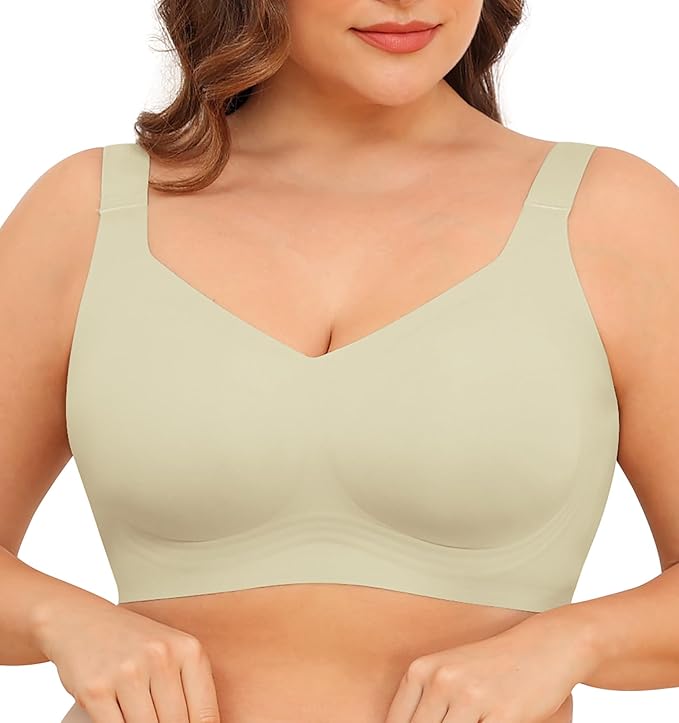
Evelyn & Bobbie Beyond Bra (Wireless, Smooth, All-Day Wear)
A wireless pull-on bra with dense knit support and wide straps—built for a smooth silhouette and long-wear comfort without underwires or bulky hardware.
- Best for: desk days, travel, errands, sensitive skin, wire fatigue.
- Support features: seamless knit, wide straps, full coverage cups, breathable structure.
- Trade-off: not meant for high-impact workouts.
Affiliate disclosure: As an Amazon Associate, we earn from qualifying purchases.
Why knowing breast weight matters
Breasts are more than numbers on a label. According to breast‑health experts, breast weight can affect everyday life. Heavier breasts contribute to poor posture and back or neck pain, make bras feel tighter or unsupportive, and can interfere with activities like exercise or baby wearing. Knowing your weight helps you find better support and discuss health concerns with your doctor.
Breast composition also varies: each breast contains glandular tissue, connective tissue and fat. Hormonal changes during the menstrual cycle, pregnancy, breastfeeding and menopause can alter their size and weight. Denser breasts feel firmer and weigh more because glandular tissue is denser than fat.

How does our calculator work?
Our tool offers two methods:
- Simple mode (bra size) – You select your band and cup size. The calculator converts cup letter to a numerical value and uses an approximate formula to estimate weight per breast. It applies an average tissue density of 0.9 g/cm³—a figure commonly used for fatty tissue—to convert volume into weight.
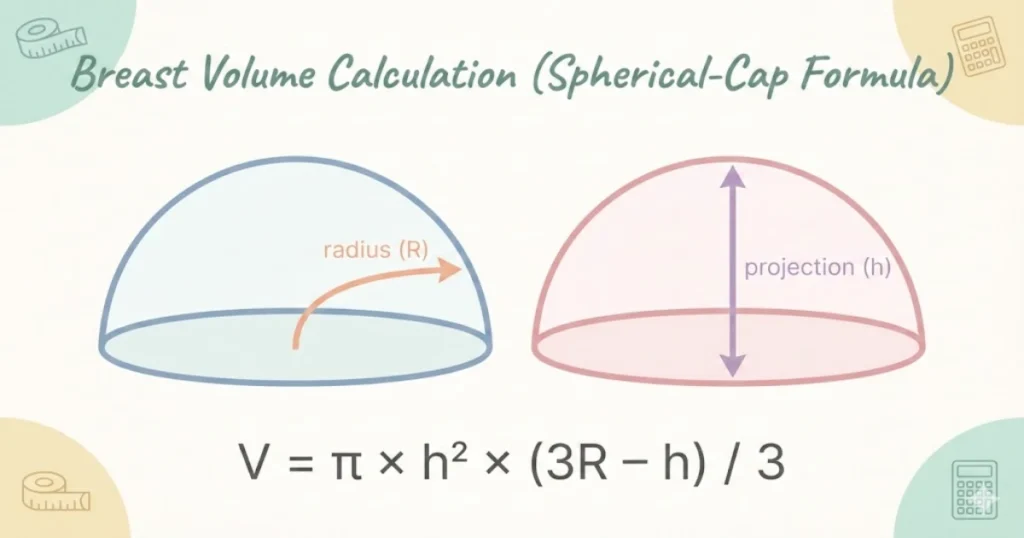
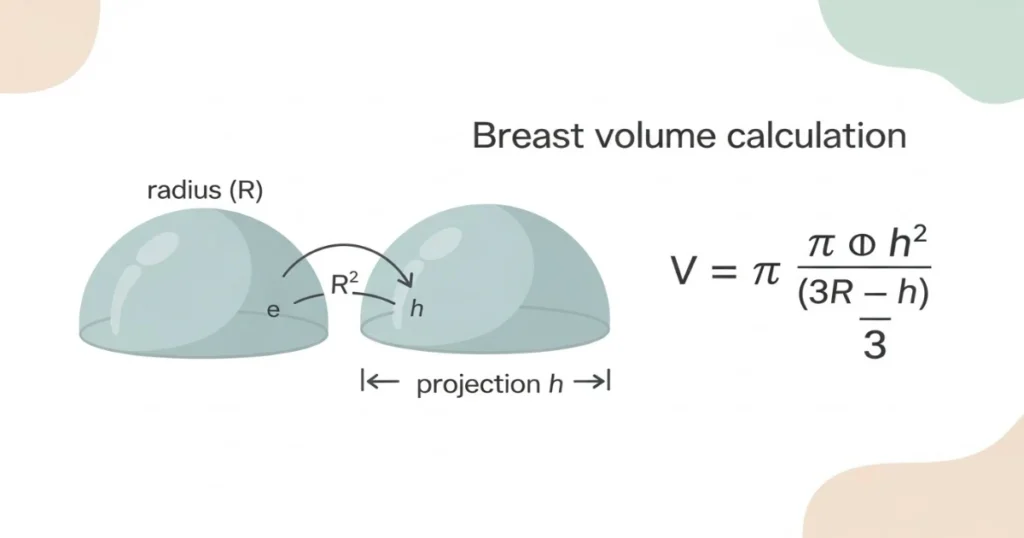
- Advanced mode (measurements) – You measure the radius of your breast base and its projection from the chest wall. Using the spherical‑cap formula (V=3πh2(3R−h)), the tool calculates each breast’s volume and multiplies by the same tissue density to estimate weight. This method gives a personalised result and accounts for asymmetry.
Note on density: Surgical studies have found that breast specimens removed during reduction surgery have a mean density around 1.06–1.07 g/mL—slightly higher than fatty tissue. Because most breasts contain a mix of fat and glandular tissue, we use 0.9 g/cm³ as a conservative average. If you have mammogram data or know your tissue density, you can adjust the weight accordingly.
Step‑by‑step: using the simple calculator
- Pick your band size. Choose the size that wraps around your ribcage (e.g. 32, 34, 36).
- Select your cup size. Cup letters (A–P) represent the difference between band and bust measurement; larger letters mean more volume.
- View your estimate. The calculator displays the estimated weight of one breast and both breasts in kilograms and pounds.
This method is quick but approximate. Actual weight can differ due to density, body composition and hormonal fluctuations.
Approximate weights by cup size
These ranges come from aggregated estimates and give you a ballpark idea. They assume an average tissue density and a mid‑range band size:
| Cup size (band 34–36) | Approx. weight per pair* |
|---|---|
| C | 1.1–1.3 lb (500–600 g) |
| D | 1.5–2.0 lb (680–900 g) |
| DD/E | 2.0–2.5 lb (900–1,100 g) |
| G | 3.0–4.0 lb (1,400–1,800 g) |
*Actual weight varies with band size, tissue density and individual anatomy.
Step‑by‑step: using the advanced calculator
If you want a more precise estimate, the advanced tool calculates volume from direct measurements:
- Measure the base radius of your breast (distance from the nipple to where the breast meets the chest) in centimetres. Repeat for both breasts if they differ.
- Measure the projection, the distance from your chest wall to the nipple.
- Enter these numbers into the calculator. It computes each breast’s volume using the spherical cap formula and multiplies by 0.9 g/cm³ to convert to weight.
This approach accounts for asymmetry—many women have one breast slightly larger than the other. Remember to keep measurements consistent (use a flexible tape and measure in centimetres).
Voice search friendly FAQs
How much does the average breast weigh?
Each breast can weigh between 200 and 500 grams (about 7–17 oz) depending on cup size and body composition. For example, a C‑cup pair averages 1.1–1.3 pounds, while a D‑cup pair can reach 2–3 pounds. Heavier breasts are more common with larger band and cup sizes.
Why do my breasts feel heavy and cause back pain?
Breast weight can affect posture and strain the muscles of your neck, shoulders and back. Wearing a properly fitted, supportive bra helps distribute weight. If discomfort persists, consult a healthcare provider—heavier breasts sometimes warrant physical therapy or surgery.
How do I measure breast volume at home?
For a rough estimate, use our advanced calculator. Measure the base radius and projection of your breast in centimetres, then enter them into the tool. The calculator uses the spherical cap formula to convert these measurements into volume and weight.
Does breast size affect cancer risk or milk production?
No. Breast size alone doesn’t affect your risk of cancer. Milk production depends on gland function and hormones, not breast size.
Can losing weight change my breast size?
Yes. Breasts contain fatty tissue, so weight loss often reduces their size, though results vary by person.
Tips for accurate measurements and better support
- Use a soft measuring tape and ensure it’s level against your skin.
- Don’t compress the breast when measuring projection; stand naturally and measure from the chest wall to the nipple.
- Measure each breast separately for the most accurate results—many women have slight asymmetry.
- Choose a supportive bra. A well‑fitted bra can relieve strain and make heavy breasts feel lighter.
- Consult a professional. For personalized advice, consider a professional bra fitting or speak with your healthcare provider if you experience persistent pain.
Conclusion: empower yourself with knowledge
Breasts come in all shapes, sizes and densities, and there’s no “ideal” weight. Still, knowing approximate weight can help you make informed choices about bra fit, posture, exercise and even surgery. Our breast weight & volume calculator offers two easy ways to estimate: a quick bra‑size method for curiosity and an advanced measurement mode for accuracy. Whichever you choose, remember that numbers are just a starting point. Your comfort and confidence matter most